
Spotted a bird? Identify it instantly with the Birdby app
Open the appAbout
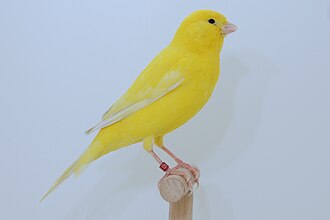
The Domestic Canary is a domesticated form of the wild Canary (Serinus canaria), a small passerine bird belonging to the finch family. Bred for centuries, primarily for its song and diverse color mutations, it is one of the most popular cage birds worldwide. Its origins trace back to the Macaronesian islands, specifically the Canary Islands, Azores, and Madeira.
Size & lifespan
- Length
- 12.5-14 cm
- Wingspan
- 20-23 cm
- Weight
- 15-20 g
- Lifespan
- 10-15 years (in captivity, with proper care)
- Diet
- Granivore (primarily seeds, supplemented with fruits, vegetables, and insects)
Physical characteristics
- Plumage
- Highly variable due to selective breeding. Original wild type is greenish-yellow with streaking. Domesticated varieties exhibit a vast array of colors including yellow, orange, red, white, brown, black, and various combinations (e.g., variegated, mosaic). Feather types can also vary (e.g., plain-headed, crested, frilled).
- Beak shape
- Small, conical, and pointed, adapted for cracking seeds. Color typically horn-colored, but can vary with plumage.
- Eye color
- Dark brown to black, small and beady.
- Leg color
- Pinkish-grey to dark grey, slender with small, grasping feet.
- Distinguishing features
- Small size, conical beak, and often vibrant, artificially selected plumage colors. The most distinctive feature is often its melodious song.
- Juvenile appearance
- Juveniles often have duller, more streaked plumage compared to adults, especially in varieties that are solid-colored as adults. Their song development begins with subsong, gradually maturing into adult song.
- Seasonal changes
- No significant seasonal plumage changes as seen in wild birds. Plumage is maintained through molting, typically once a year after the breeding season.
- Sexual dimorphism
- Minimal in appearance. Males are generally more robust and have a more developed and consistent song. Females may sing, but typically less frequently and with less complexity. In some color varieties, subtle differences in color intensity or pattern may exist, but these are not universal.
How to identify
- 1
Plumage Color
Observe the bird's color. If it exhibits bright yellow, orange, red, white, or variegated patterns not typically found in wild finches, it is likely a Domestic Canary. Wild canaries are greenish-yellow.
- 2
Song
Listen for its song. Domestic Canaries, especially males, are known for their complex, varied, and melodious songs, often sustained for long periods. This is a key identifier for song breeds.
- 3
Behavior in Captivity
If observed in a cage or aviary, it is almost certainly a Domestic Canary. Escaped individuals may be seen briefly in gardens but are unlikely to thrive long-term in non-native environments.
- 4
Size and Shape
Note its small size (around 12.5-14 cm) and typical finch-like body shape with a conical beak.
Habitat & range
- Biomes
- Not applicable in the wild sense. Primarily found in human-modified environments as a domesticated pet.
- Geographic range
- Globally distributed in captivity. The wild ancestor (Serinus canaria) is endemic to the Macaronesian islands (Canary Islands, Azores, Madeira).
- Elevation range
- Not applicable for the domesticated form. Wild canaries inhabit elevations from sea level up to 2,000 meters.
- Preferred environments
- Cages and aviaries in human dwellings. Requires a stable, temperate environment, protected from extreme temperatures and predators.
Behavior
- Activity time
- Diurnal. Active during daylight hours, foraging, singing, and interacting with their environment.
- Feeding habits
- In captivity, fed commercial canary seed mixes, supplemented with fresh greens (e.g., kale, broccoli), fruits (e.g., apple, pear), and occasional protein sources (e.g., egg food, mealworms). They use their conical beaks to de-husk seeds efficiently.
- Social behavior
- Canaries can be kept individually, especially males known for their song, or in pairs or small colonies in larger aviaries. Males can be territorial towards other males during breeding season. Generally peaceful with other finch species.
- Flight pattern
- In captivity, flight is limited to the confines of their cage or aviary, typically short, rapid bursts. In the wild, the ancestral species exhibits an undulating flight pattern typical of finches.
- Migration pattern
- Non-migratory. Domesticated canaries are resident in their captive environments. The wild Canary is also resident.
- Territoriality
- Males can be territorial, especially during the breeding season, defending their nesting site and mate. This is primarily expressed through song and occasional aggressive posturing towards other males.
Song & calls
- Song
- Males are renowned for their complex, varied, and melodious songs, consisting of trills, whistles, chirps, and rolls. The song is used to attract mates and defend territory. Different 'song canary' breeds have been developed for specific song qualities (e.g., Roller, Waterslager, Timbrado).
- Call
- Common calls include a soft 'chip' or 'cheep' for contact, and a sharper 'tseet' or 'twee' as an alarm call.
- When they vocalize
- Males sing most frequently and intensely during the breeding season (spring and summer) and often throughout the day. Calls are used year-round for communication.
Breeding & reproduction
- Breeding season
- Typically spring to early summer, but can be induced year-round in captivity with appropriate lighting and diet.
- Nesting habits
- In captivity, they readily use open-cup nests or nest baskets provided by breeders. The female builds the nest using fine grasses, fibers, and soft materials. In the wild, the ancestral species builds a neat, cup-shaped nest in shrubs or trees.
- Clutch size
- 3-5 eggs, typically.
- Egg description
- Small, oval, pale blue or bluish-white, often with reddish-brown speckles, particularly at the larger end.
- Incubation period
- 13-14 days, primarily by the female.
- Fledging period
- 14-21 days after hatching. Young leave the nest but are still fed by parents for a period.
- Parental care
- Both parents feed the young, though the female does most of the incubation and initial brooding. The male often feeds the female on the nest and continues to feed the fledglings as the female prepares for a second clutch.
Where to find
Pet Stores and Breeders
The primary place to find Domestic Canaries, where various breeds and color mutations are available.
Homes and Aviaries
Commonly kept as pets in private residences and public aviaries worldwide.
Wild (Ancestral Species)
To observe the wild Canary (Serinus canaria), one must travel to its native Macaronesian islands: the Canary Islands, Azores, and Madeira, where they inhabit gardens, orchards, and laurel forests.
Field tips
- Listen for Song. If you are in an area where an escaped canary might be present, listening for its distinctive song can help locate it.
- Observe in Captivity. For detailed study of Domestic Canaries, visiting a bird show, a reputable breeder, or a pet store will allow close observation of their diverse forms and behaviors.
- Wild Canary Observation. For the wild ancestor, focus on areas with dense vegetation, gardens, and agricultural lands on the Macaronesian islands. They are often found in small flocks outside the breeding season.
Similar species
Wild Canary
Serinus canaria
The wild Canary is the ancestral species. It is typically smaller, more slender, and exclusively greenish-yellow with streaking, lacking the wide array of color mutations and specialized forms found in the Domestic Canary. Its habitat is restricted to the Macaronesian islands.
European Serin
Serinus serinus
The European Serin is a close relative, found across Europe and North Africa. It is smaller than the wild Canary, with a more compact body and a shorter tail. Males have brighter yellow on the face and breast, and more prominent streaking on the flanks. Its song is a rapid, jingling trill, distinct from the more varied song of the Domestic Canary.
Yellow-fronted Canary
Crithagra mozambica
An African species, sometimes confused due to its yellow plumage. It has a more robust bill, a distinct yellow supercilium, and a different song. Its geographic range does not overlap with the wild Canary.
Quick facts
- Origin:
- Macaronesian Islands (Canary Islands, Azores, Madeira)
- Primary Use:
- Pet bird, bred for song and color
- Diet in Captivity:
- Seed mixes, fresh fruits, vegetables
- Song Quality:
- Highly prized, complex, and melodious
- Color Varieties:
- Extremely diverse (yellow, red, white, variegated, etc.)
Fun facts
- Canaries were first brought to Europe by Spanish sailors in the 17th century, quickly becoming popular pets among royalty and the wealthy.
- The term 'canary in a coal mine' originates from their historical use by miners to detect dangerous gases like carbon monoxide, as their small size made them more susceptible to the gas, providing an early warning system.
- There are over 40 recognized breeds of Domestic Canaries, categorized by color, song, or type (shape and feathering).
- The red color in some canaries is not natural; it was introduced through hybridization with the Red Siskin (Spinus cucullata) and is maintained by feeding color-enhancing foods.
Scientific classification
- Kingdom
- Animalia
- Phylum
- Chordata
- Class
- Aves
- Order
- Passeriformes
- Family
- Fringillidae
- Genus
- Serinus
- Species
- Serinus canaria
Explore the Domestic Canary
Identify birds anywhere
Free on iOS, Android, and Web. Photo & sound identification, full species database, and your personal life list.