
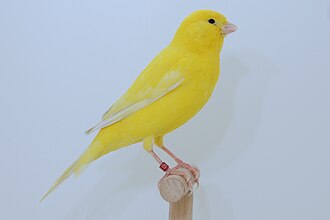
How to identify the Domestic Canary
Serinus canaria domestica
Spotted a bird? Identify it instantly with the Birdby app
Open the appTo correctly identify the Domestic Canary (Serinus canaria domestica), check each of these features. Birds can be tricky: habit, habitat, and call often confirm a sighting that a single photo cannot.
Size at a glance
- Length
- 12.5-14 cm
- Wingspan
- 20-23 cm
- Weight
- 15-20 g
Physical features to check
- 1
Plumage
Overall feather coloration and pattern.
Highly variable due to selective breeding. Original wild type is greenish-yellow with streaking. Domesticated varieties exhibit a vast array of colors including yellow, orange, red, white, brown, black, and various combinations (e.g., variegated, mosaic). Feather types can also vary (e.g., plain-headed, crested, frilled).
- 2
Beak shape
Shape and color of the bill: a key field mark.
Small, conical, and pointed, adapted for cracking seeds. Color typically horn-colored, but can vary with plumage.
- 3
Eye color
Iris color and any distinctive eye markings.
Dark brown to black, small and beady.
- 4
Leg color
Leg and foot color.
Pinkish-grey to dark grey, slender with small, grasping feet.
- 5
Distinguishing features
Standout features that separate this species.
Small size, conical beak, and often vibrant, artificially selected plumage colors. The most distinctive feature is often its melodious song.
- 6
Juvenile appearance
How young birds differ from adults.
Juveniles often have duller, more streaked plumage compared to adults, especially in varieties that are solid-colored as adults. Their song development begins with subsong, gradually maturing into adult song.
- 7
Seasonal changes
Plumage variation between breeding and non-breeding seasons.
No significant seasonal plumage changes as seen in wild birds. Plumage is maintained through molting, typically once a year after the breeding season.
- 8
Sexual dimorphism
How males and females differ.
Minimal in appearance. Males are generally more robust and have a more developed and consistent song. Females may sing, but typically less frequently and with less complexity. In some color varieties, subtle differences in color intensity or pattern may exist, but these are not universal.
Key field marks
- Plumage Color. Observe the bird's color. If it exhibits bright yellow, orange, red, white, or variegated patterns not typically found in wild finches, it is likely a Domestic Canary. Wild canaries are greenish-yellow.
- Song. Listen for its song. Domestic Canaries, especially males, are known for their complex, varied, and melodious songs, often sustained for long periods. This is a key identifier for song breeds.
- Behavior in Captivity. If observed in a cage or aviary, it is almost certainly a Domestic Canary. Escaped individuals may be seen briefly in gardens but are unlikely to thrive long-term in non-native environments.
- Size and Shape. Note its small size (around 12.5-14 cm) and typical finch-like body shape with a conical beak.
Explore the Domestic Canary
Identify birds anywhere
Free on iOS, Android, and Web. Photo & sound identification, full species database, and your personal life list.