
Spotted a bird? Identify it instantly with the Birdby app
Open the appAbout
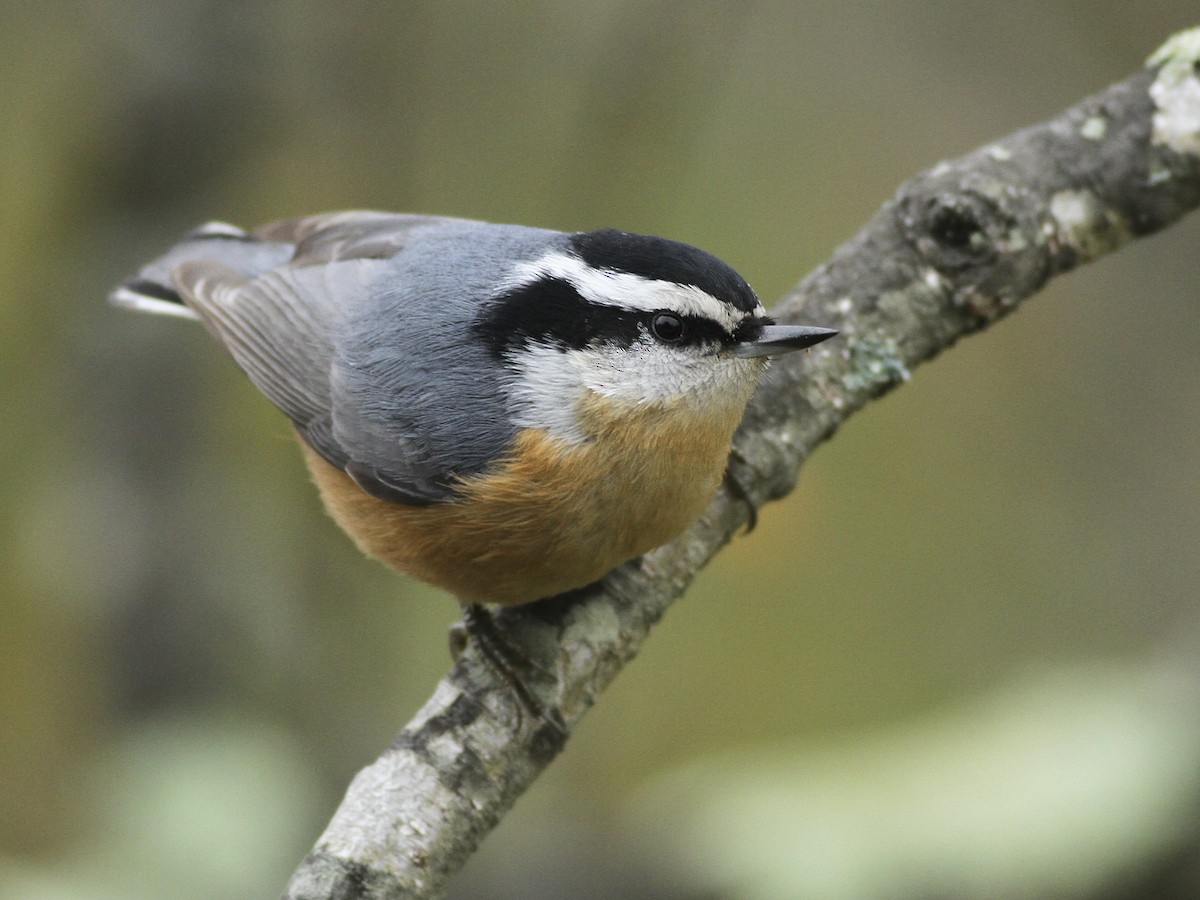
The Red-breasted Nuthatch is a small, active songbird known for its distinctive foraging behavior of climbing headfirst down tree trunks. It is characterized by its blue-gray upperparts, rusty underparts, and a prominent black eye-stripe. Primarily an inhabitant of coniferous and mixed forests, it is a year-round resident in much of its range but can undertake irruptive migrations in response to cone crop failures.
Size & lifespan
- Length
- 10.5-11.5 cm (4.1-4.5 in)
- Wingspan
- 20-22 cm (7.9-8.7 in)
- Weight
- 8.9-13.8 g (0.31-0.49 oz)
- Lifespan
- Typically 2-3 years in the wild, with a maximum recorded lifespan of over 7 years.
- Diet
- Omnivore, primarily insectivorous during breeding season and granivorous (conifer seeds) during winter.
Physical characteristics
- Plumage
- Adults have blue-gray upperparts, a prominent black eye-stripe, and a white supercilium (eyebrow). The underparts are rusty or rufous, varying in intensity. The throat and cheeks are white. The wings are dark with lighter edgings, and the tail is short and dark with white outer tail feathers visible in flight.
- Beak shape
- Slender, straight, and pointed, dark gray to black.
- Eye color
- Dark brown.
- Leg color
- Dark gray to black.
- Distinguishing features
- The combination of blue-gray back, rusty belly, and a strong black eye-stripe with a white supercilium is diagnostic. Its habit of climbing headfirst down trees is also a key behavioral identifier.
- Juvenile appearance
- Juveniles resemble adult females but have a slightly duller overall plumage, with less distinct markings and often a more brownish wash to the underparts. Their plumage is generally looser and less compact.
- Seasonal changes
- No significant seasonal plumage changes. The plumage remains consistent throughout the year, though wear and fading can make colors appear slightly duller by late summer.
- Sexual dimorphism
- Males typically have a more intense, darker black eye-stripe and richer rufous underparts than females. Females have a duller, grayer eye-stripe and paler, more washed-out rufous underparts. This difference is subtle but discernible with good views.
How to identify
- 1
Size and Shape
Small, compact bird with a short tail and a relatively large head. Appears active and agile.
- 2
Plumage - Upperparts
Look for the distinctive blue-gray back and wings.
- 3
Plumage - Underparts
Note the rusty or rufous coloration on the breast and belly. This is a key field mark.
- 4
Head Markings
Identify the prominent black eye-stripe contrasting with a white supercilium (eyebrow) and white throat/cheeks.
- 5
Behavior
Observe its unique foraging style: climbing headfirst down tree trunks, probing bark crevices. This behavior is characteristic of nuthatches.
- 6
Vocalization
Listen for its distinctive nasal 'yank-yank-yank' call, which is higher pitched than other nuthatches.
Habitat & range
- Biomes
- Coniferous forests, mixed coniferous-deciduous forests.
- Geographic range
- Widespread across North America. Breeds from Alaska and Canada south through the western mountains to northern Baja California, and in the eastern United States south to the Great Lakes region and Appalachian Mountains. Irruptive movements can extend its winter range further south.
- Elevation range
- From sea level to high elevations in mountainous regions, typically favoring higher elevations in the southern parts of its range.
- Preferred environments
- Mature coniferous forests dominated by spruce, fir, pine, and hemlock. Also found in mixed forests with a significant conifer component. Requires trees with suitable bark for foraging and nesting cavities.
Behavior
- Activity time
- Diurnal.
- Feeding habits
- Forages primarily on tree trunks and large branches, often moving headfirst down the bark. It probes crevices for insects and spiders, and extracts seeds from conifer cones. It frequently caches seeds and insects under bark flakes or in crevices, often covering them with lichen or bark fragments. Will visit bird feeders for sunflower seeds and suet.
- Social behavior
- Typically solitary or found in pairs during the breeding season. Outside of breeding, they may join mixed-species foraging flocks, especially with chickadees and kinglets. They are generally not highly social.
- Flight pattern
- Undulating flight pattern over short distances, often direct and swift between trees.
- Migration pattern
- Primarily a resident species throughout much of its range. However, it is known for irruptive migrations, particularly in the eastern part of its range, during winters when conifer seed crops fail in northern forests. These irruptions can lead to large numbers of birds moving south into areas where they are not typically found.
- Territoriality
- Pairs defend a breeding territory during the nesting season. They are less territorial outside of breeding.
Song & calls
- Song
- A nasal, reedy, and somewhat monotonous series of notes, often described as 'yank-yank-yank' or 'wee-wee-wee'. The pitch is higher and more rapid than the White-breasted Nuthatch's call.
- Call
- The most common call is a distinctive, nasal 'yank-yank' or 'anh-anh', often given while foraging. It also has a softer 'tit-tit-tit' contact call and various alarm calls.
- When they vocalize
- Vocalizes year-round, but most frequently and conspicuously during the breeding season (spring and early summer) to establish and defend territories and communicate with mates.
Breeding & reproduction
- Breeding season
- Typically May to July, with peak activity in late May and June.
- Nesting habits
- Nests in natural cavities or old woodpecker holes in dead or decaying trees, usually conifers. They will excavate or enlarge existing cavities. Uniquely, they often smear pitch or resin around the entrance of their nest cavity, possibly to deter predators or competitors.
- Clutch size
- 3-7 eggs, most commonly 5-6.
- Egg description
- 3-7 eggs (typically 5-6), white to creamy white, speckled with reddish-brown or purplish dots, especially at the larger end. Eggs measure approximately 15-17 mm (0.6-0.7 in) in length.
- Incubation period
- 12-13 days, primarily by the female.
- Fledging period
- 21-22 days after hatching. Both parents feed the young.
- Parental care
- Both parents participate in feeding the nestlings and fledglings. The male often feeds the female during incubation.
Where to find
Coniferous Forests
Primary habitat, especially those with mature spruce, fir, pine, and hemlock trees. Look in both dense stands and forest edges.
Mixed Forests
Areas where conifers are mixed with deciduous trees, particularly if there's a good conifer component.
Parks and Backyards
During irruptive years or in areas with suitable habitat, they may visit feeders in suburban or urban areas with mature trees.
Field tips
- Look Up. Scan tree trunks and large branches, especially the upper parts of conifers. They often forage high in the canopy.
- Listen for Calls. Their nasal 'yank-yank' call is often the first indication of their presence. Learn to distinguish it from other nuthatch calls.
- Observe Foraging Behavior. Watch for birds moving headfirst down tree trunks. This unique behavior is a strong identifier.
- Check Feeders. In winter, especially during irruptions, they are attracted to suet and black oil sunflower seeds at feeders.
- Patience. They are small and can be well-camouflaged against tree bark. Patience and careful observation are key.
Similar species
White-breasted Nuthatch
Sitta carolinensis
The White-breasted Nuthatch is larger, has a white breast and belly, a black cap (not an eye-stripe), and lacks the rusty underparts. Its call is a lower-pitched, more nasal 'wah-wah-wah'.
Pygmy Nuthatch
Sitta pygmaea
The Pygmy Nuthatch is smaller, has a brown cap, and lacks the prominent black eye-stripe and rusty underparts. It is found primarily in western pine forests and often forages in flocks.
Brown-headed Nuthatch
Sitta pusilla
The Brown-headed Nuthatch is similar in size but has a brown cap, a small white spot on the nape, and lacks the black eye-stripe and rusty underparts. It is found in southeastern pine forests.
Quick facts
- Diet:
- Insects, spiders, conifer seeds
- Habitat:
- Coniferous and mixed forests
- Nesting:
- Cavity nester, often smears pitch around entrance
- Foraging Style:
- Climbs headfirst down trees
- Migration:
- Resident, but undertakes irruptive movements
Fun facts
- Red-breasted Nuthatches are one of the few bird species that can climb headfirst down tree trunks, a unique adaptation for finding insects and seeds that other birds might miss.
- They are known to cache thousands of seeds, particularly conifer seeds, during the fall and winter, hiding them in bark crevices and covering them with lichen or bark fragments for later consumption.
- The practice of smearing conifer resin around their nest cavity entrance is thought to deter predators like squirrels or larger birds, as the sticky substance can make entry difficult.
- During irruptive years, these nuthatches can travel hundreds or even thousands of miles south of their typical winter range in search of food, making them an exciting find for birdwatchers in unexpected locations.
Scientific classification
- Kingdom
- Animalia
- Phylum
- Chordata
- Class
- Aves
- Order
- Passeriformes
- Family
- Sittidae
- Genus
- Sitta
- Species
- Sitta canadensis
Explore the Red-breasted Nuthatch
Identify birds anywhere
Free on iOS, Android, and Web. Photo & sound identification, full species database, and your personal life list.