
Spotted a bird? Identify it instantly with the Birdby app
Open the appAbout
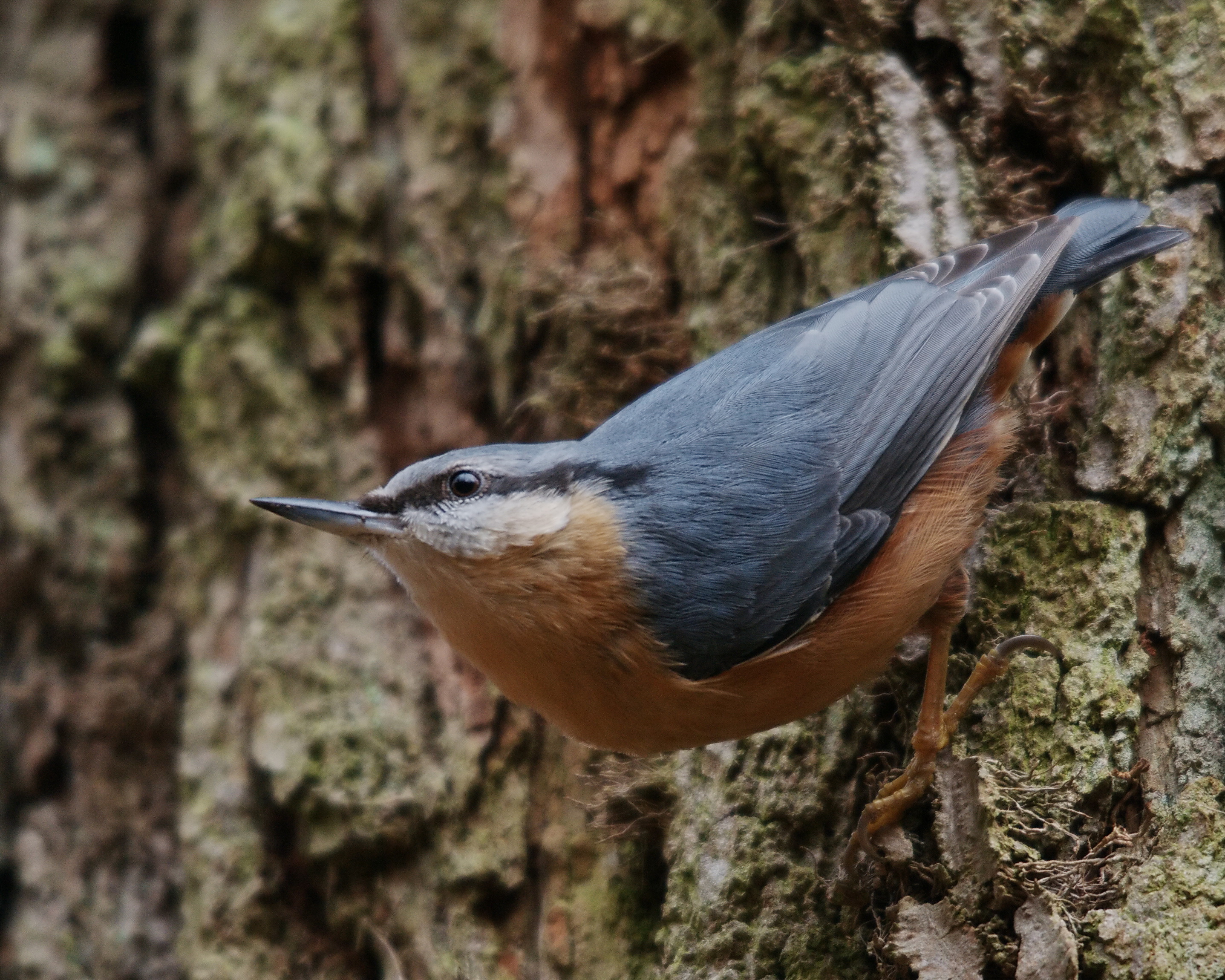
The Eurasian Nuthatch (Sitta europaea) is a small, arboreal passerine bird characterized by its distinctive ability to climb headfirst down tree trunks, a feat few other birds can accomplish. It is a stocky bird with a large head, short tail, and a powerful, chisel-like bill. Its plumage is typically blue-grey above and whitish to rufous below, with a prominent black eye-stripe. It is a resident species across much of its range, known for its loud, far-carrying calls and its habit of 'plastering' the entrance to its nest hole with mud to reduce its size.
Size & lifespan
- Length
- 12-14.5 cm
- Wingspan
- 22.5-27 cm
- Weight
- 17-28 g
- Lifespan
- 2-3 years (up to 10 years recorded)
- Diet
- Omnivore (primarily insects in summer, seeds and nuts in winter)
Physical characteristics
- Plumage
- Adults have a blue-grey back, crown, and nape, with a prominent black eye-stripe extending from the bill to the shoulder. The underparts vary geographically; in western populations, they are typically whitish on the throat and breast, becoming rufous-orange on the flanks and vent. Eastern populations tend to have paler, more uniform underparts. The undertail coverts are rufous with white tips. The wings are dark grey with paler edges to the flight feathers. The tail is short, dark grey, with white spots on the outer tail feathers.
- Beak shape
- Strong, straight, pointed, and chisel-like bill, dark grey to blackish.
- Eye color
- Dark brown.
- Leg color
- Dark grey to blackish.
- Distinguishing features
- Its unique ability to climb headfirst down tree trunks, its blue-grey upperparts, prominent black eye-stripe, and stocky build with a short tail are key identifiers. The rufous flanks (in western populations) are also distinctive.
- Juvenile appearance
- Juveniles resemble adults but have duller plumage overall, with a less distinct black eye-stripe and paler, less vibrant rufous on the flanks. Their plumage is generally looser and softer.
- Seasonal changes
- No significant seasonal plumage changes. Plumage may appear slightly duller when worn before the annual molt.
- Sexual dimorphism
- Subtle. Males typically have a slightly darker and broader black eye-stripe and more intense rufous coloration on the flanks and undertail coverts compared to females. However, this can be difficult to discern in the field.
How to identify
- 1
Climbing Style
Look for a bird climbing down tree trunks headfirst. This is a unique and highly characteristic behavior among European passerines.
- 2
Plumage
Observe the blue-grey upperparts, the prominent black eye-stripe, and the whitish throat/breast contrasting with rufous flanks (especially in western populations). The short tail is also noticeable.
- 3
Bill Shape
Note the strong, straight, chisel-like bill, adapted for probing bark and hammering nuts.
- 4
Vocalizations
Listen for its loud, clear, whistling song ('twee-twee-twee') and its sharp 'sit!' or 'twit!' calls. These are often the first indication of its presence.
- 5
Habitat
Search in mature deciduous or mixed woodlands, parks, and large gardens with old trees.
Habitat & range
- Biomes
- Temperate and boreal forests, woodlands, parks, and large gardens.
- Geographic range
- Widespread across temperate Eurasia, from Western Europe (excluding Ireland and parts of Scotland) eastward through Russia, Siberia, and into East Asia (including Japan, Korea, and parts of China).
- Elevation range
- Typically found from sea level up to 2,000 meters, occasionally higher in some mountainous regions.
- Preferred environments
- Mature deciduous or mixed woodlands with a good supply of old trees for nesting and foraging. Prefers areas with oak, beech, and hornbeam, but also found in coniferous forests. Requires trees with crevices for foraging and suitable holes for nesting.
Behavior
- Activity time
- Diurnal.
- Feeding habits
- Forages on tree trunks and branches, often moving headfirst downwards, probing bark crevices for insects, spiders, and larvae. In autumn and winter, its diet shifts to nuts and seeds, particularly acorns, hazelnuts, and beech mast. It often wedges large nuts into bark crevices and hammers them open with its strong bill. Known for caching food in bark crevices for later consumption.
- Social behavior
- Primarily solitary or found in pairs during the breeding season. Outside of breeding, they may occasionally join mixed-species foraging flocks, especially with tits and treecreepers, but generally maintain their independent foraging style.
- Flight pattern
- Flight is typically short, direct, and undulating, often between trees. Not a strong or sustained flyer.
- Migration pattern
- Mostly resident throughout its range. Some northern and eastern populations may undertake short-distance dispersal movements in harsh winters or during irruptions, but true long-distance migration is rare.
- Territoriality
- Highly territorial, especially during the breeding season. Pairs defend their nesting and foraging territory vigorously against other nuthatches.
Song & calls
- Song
- The song is a series of loud, clear, whistling notes, often accelerating and descending in pitch, such as 'twee-twee-twee-twee' or 'pee-pee-pee-pee'. It can also include a rapid, trilling 'trr-trr-trr'.
- Call
- A variety of calls, including a sharp, explosive 'sit!' or 'twit!', a rapid 'chit-chit-chit', and a more drawn-out 'tuih'. Alarm calls are typically harsh and scolding.
- When they vocalize
- Most vocal during the breeding season (late winter to early summer) when establishing territories and attracting mates. Calls can be heard year-round, especially when foraging or interacting with other birds.
Breeding & reproduction
- Breeding season
- Typically April to July, with peak activity in May.
- Nesting habits
- Nests in natural tree cavities or old woodpecker holes. If the entrance hole is too large, the nuthatch will 'plaster' it with mud, clay, or dung to reduce its size, leaving just enough space for itself to enter. The nest cup itself is lined with bark flakes, wood chips, and sometimes moss or leaves.
- Clutch size
- 5-9 eggs, typically 6-8.
- Egg description
- 5-9 eggs, white with fine reddish-brown speckles, particularly concentrated at the broader end. Approximately 19.5 x 14.5 mm.
- Incubation period
- 13-18 days, primarily by the female.
- Fledging period
- 23-25 days after hatching. Both parents feed the young.
- Parental care
- Both parents participate in feeding the nestlings and fledglings. The female incubates, while the male brings food to her and later to the young.
Where to find
Mature Deciduous Woodlands
Especially those with oak, beech, and hornbeam trees, which provide abundant food and nesting sites.
Mixed Forests
Areas where deciduous and coniferous trees intermingle, offering diverse foraging opportunities.
Parks and Large Gardens
Urban and suburban green spaces with mature trees can host nuthatches, particularly if supplementary food (like peanuts) is provided.
Orchards and Avenues
Older orchards and tree-lined avenues can also be suitable habitats.
Field tips
- Listen for Calls. Their loud and distinctive calls often reveal their presence before they are seen. Learn their 'sit!' call and whistling song.
- Watch Tree Trunks. Focus your observation on the bark of tree trunks and large branches, especially where they meet. Nuthatches are constantly searching for food in crevices.
- Look for Movement. Their characteristic headfirst descent is a strong clue. They move quickly and jerkily, often pausing to probe.
- Check Bird Feeders. In winter, they are frequent visitors to bird feeders offering peanuts or sunflower seeds, which they often carry off to cache.
- Be Patient. While often vocal, they can be elusive. Patience and quiet observation in suitable habitat will increase your chances.
Similar species
Corsican Nuthatch
Sitta whiteheadi
Smaller, endemic to Corsica. Has a shorter black eye-stripe that does not extend as far back, and lacks the rufous flanks of the Eurasian Nuthatch. Its song is also distinct.
Krüper's Nuthatch
Sitta krueperi
Found in Turkey and the Caucasus. Distinguished by a prominent rufous breast patch and a shorter black eye-stripe. Its habitat is typically coniferous forests.
Red-breasted Nuthatch
Sitta canadensis
North American species. Has a more pronounced black eye-stripe, a white supercilium, and distinctly rufous underparts, including the breast. Smaller in size.
Quick facts
- Unique Climbing:
- Only European bird that can climb down trees headfirst.
- Nest Hole Plastering:
- Reduces nest hole entrance with mud to deter predators and competitors.
- Food Caching:
- Stores nuts and seeds in bark crevices for winter.
- Diet Shift:
- Primarily insects in summer, nuts/seeds in winter.
- Vocal:
- Known for loud, far-carrying whistling songs and sharp calls.
Fun facts
- The name 'nuthatch' is derived from 'nut-hack', referring to its habit of hacking open nuts.
Scientific classification
- Kingdom
- Animalia
- Phylum
- Chordata
- Class
- Aves
- Order
- Passeriformes
- Family
- Sittidae
- Genus
- Sitta
- Species
- Sitta europaea
Explore the Eurasian Nuthatch
Identify birds anywhere
Free on iOS, Android, and Web. Photo & sound identification, full species database, and your personal life list.