
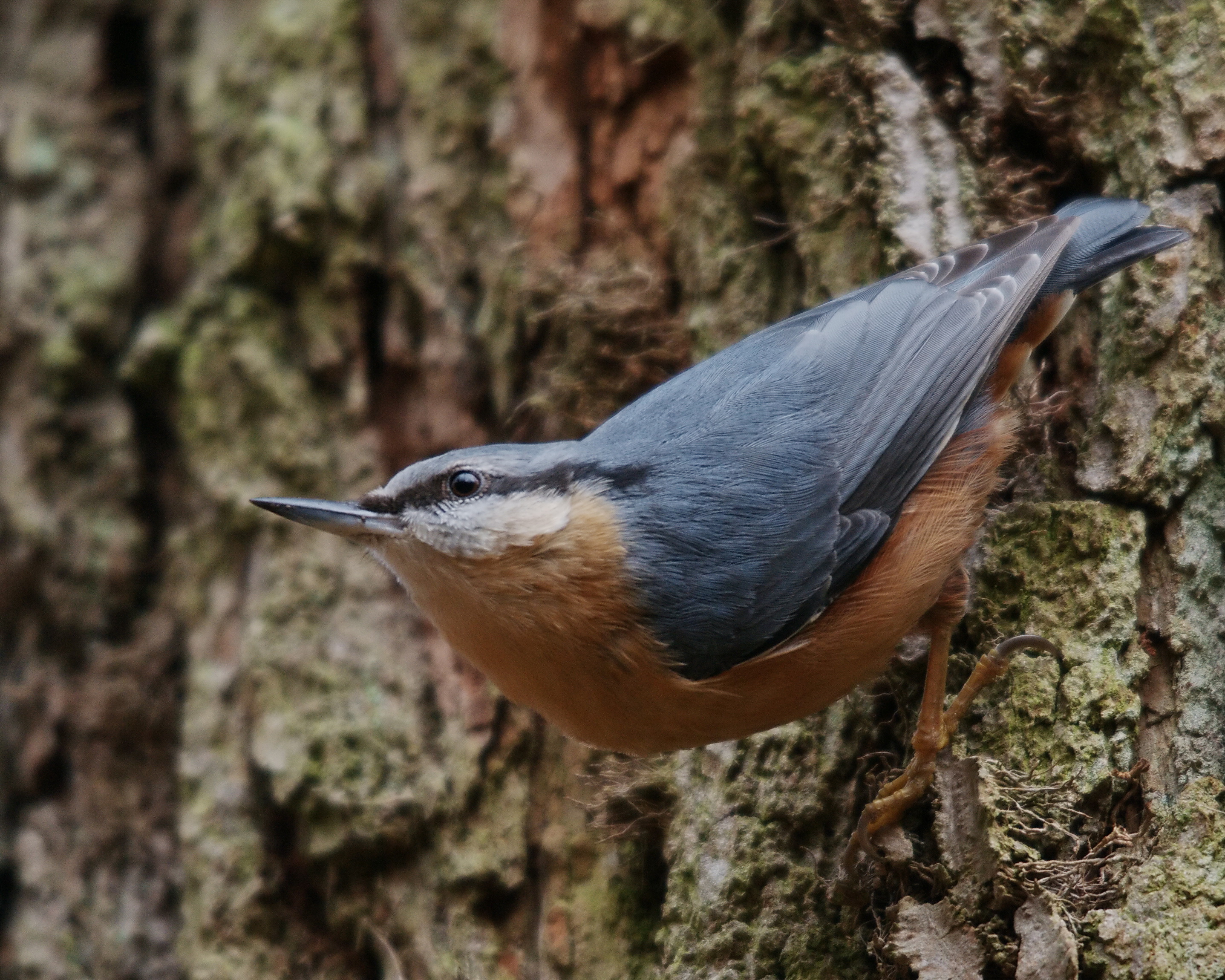
How to identify the Eurasian Nuthatch
Sitta europaea
Spotted a bird? Identify it instantly with the Birdby app
Open the appTo correctly identify the Eurasian Nuthatch (Sitta europaea), check each of these features. Birds can be tricky: habit, habitat, and call often confirm a sighting that a single photo cannot.
Size at a glance
- Length
- 12-14.5 cm
- Wingspan
- 22.5-27 cm
- Weight
- 17-28 g
Physical features to check
- 1
Plumage
Overall feather coloration and pattern.
Adults have a blue-grey back, crown, and nape, with a prominent black eye-stripe extending from the bill to the shoulder. The underparts vary geographically; in western populations, they are typically whitish on the throat and breast, becoming rufous-orange on the flanks and vent. Eastern populations tend to have paler, more uniform underparts. The undertail coverts are rufous with white tips. The wings are dark grey with paler edges to the flight feathers. The tail is short, dark grey, with white spots on the outer tail feathers.
- 2
Beak shape
Shape and color of the bill: a key field mark.
Strong, straight, pointed, and chisel-like bill, dark grey to blackish.
- 3
Eye color
Iris color and any distinctive eye markings.
Dark brown.
- 4
Leg color
Leg and foot color.
Dark grey to blackish.
- 5
Distinguishing features
Standout features that separate this species.
Its unique ability to climb headfirst down tree trunks, its blue-grey upperparts, prominent black eye-stripe, and stocky build with a short tail are key identifiers. The rufous flanks (in western populations) are also distinctive.
- 6
Juvenile appearance
How young birds differ from adults.
Juveniles resemble adults but have duller plumage overall, with a less distinct black eye-stripe and paler, less vibrant rufous on the flanks. Their plumage is generally looser and softer.
- 7
Seasonal changes
Plumage variation between breeding and non-breeding seasons.
No significant seasonal plumage changes. Plumage may appear slightly duller when worn before the annual molt.
- 8
Sexual dimorphism
How males and females differ.
Subtle. Males typically have a slightly darker and broader black eye-stripe and more intense rufous coloration on the flanks and undertail coverts compared to females. However, this can be difficult to discern in the field.
Key field marks
- Climbing Style. Look for a bird climbing down tree trunks headfirst. This is a unique and highly characteristic behavior among European passerines.
- Plumage. Observe the blue-grey upperparts, the prominent black eye-stripe, and the whitish throat/breast contrasting with rufous flanks (especially in western populations). The short tail is also noticeable.
- Bill Shape. Note the strong, straight, chisel-like bill, adapted for probing bark and hammering nuts.
- Vocalizations. Listen for its loud, clear, whistling song ('twee-twee-twee') and its sharp 'sit!' or 'twit!' calls. These are often the first indication of its presence.
- Habitat. Search in mature deciduous or mixed woodlands, parks, and large gardens with old trees.
Explore the Eurasian Nuthatch
Identify birds anywhere
Free on iOS, Android, and Web. Photo & sound identification, full species database, and your personal life list.