
Spotted a bird? Identify it instantly with the Birdby app
Open the appAbout
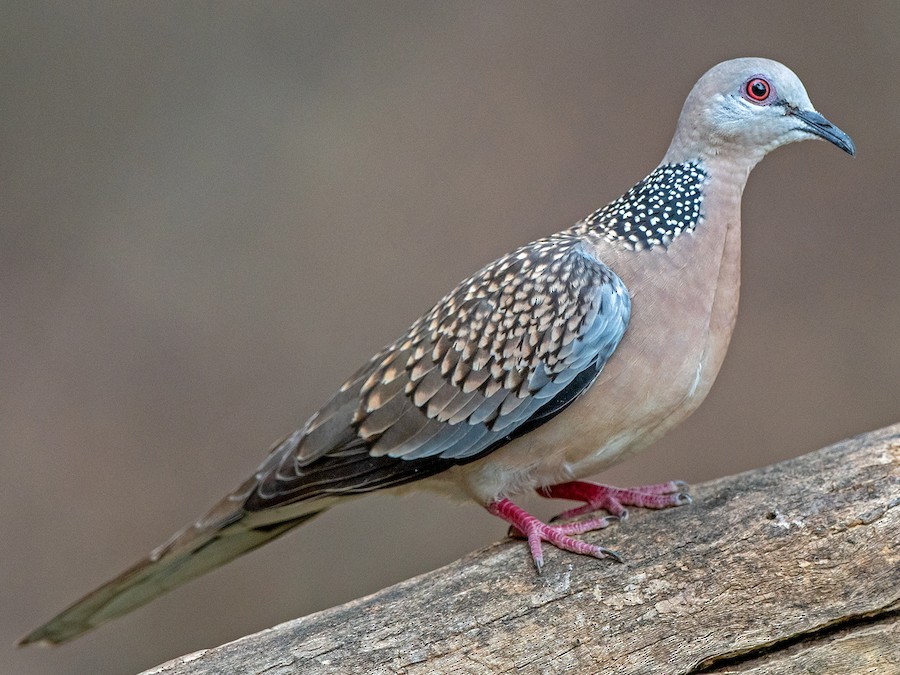
The Spotted Dove is a small to medium-sized, long-tailed pigeon, characterized by a distinctive black-and-white checkered patch on the hindneck. It is a common and widespread species across its native range in Asia and has been introduced to various parts of the world, where it has often established thriving populations. Known for its gentle cooing calls and adaptable nature, it thrives in both urban and rural environments.
Size & lifespan
- Length
- 28-32 cm
- Wingspan
- 43-48 cm
- Weight
- 100-180 g
- Lifespan
- Up to 10 years in the wild, potentially longer in captivity.
- Diet
- Granivore (primarily seeds, grains, fallen fruits, and occasionally small insects or snails)
Physical characteristics
- Plumage
- Adults have a pinkish-brown head and underparts, fading to white on the belly. The back and wings are brownish with darker centers to the feathers, giving a scaled appearance. The most distinctive feature is a broad black patch on the hindneck and sides of the neck, finely spotted with white. The tail is long, graduated, and dark brown with white tips on the outer tail feathers, visible in flight and when fanned. The primary flight feathers are dark.
- Beak shape
- Slender, dark grey to blackish beak, relatively short.
- Eye color
- Dark brown, surrounded by a narrow, greyish orbital ring.
- Leg color
- Dull reddish-pink to purplish-red.
- Distinguishing features
- The black-and-white checkered neck patch is the most reliable field mark. Its relatively long tail and scaled back also aid in identification.
- Juvenile appearance
- Juveniles are duller overall, with less distinct or absent black-and-white spotting on the neck patch, which develops with age. Their plumage is generally browner, and the pinkish wash on the head and underparts is less pronounced.
- Seasonal changes
- No significant seasonal plumage changes. Plumage may appear slightly worn or faded before molting.
- Sexual dimorphism
- Males and females are generally monomorphic in plumage, appearing identical. Males may be slightly larger and have a more robust head, but these differences are subtle and not reliable for field identification.
How to identify
- 1
Neck Patch
Look for the distinctive broad black patch on the hindneck and sides of the neck, finely spotted with white. This is the most reliable field mark.
- 2
Plumage Coloration
Note the pinkish-brown head and underparts, fading to white on the belly, and the brownish, scaled appearance of the back and wings.
- 3
Tail Shape and Markings
Observe the relatively long, graduated tail with dark brown central feathers and white tips on the outer tail feathers, especially visible in flight or when fanned.
- 4
Vocalization
Listen for its characteristic soft, mournful, rhythmic cooing call: 'coo-CROO-croo'.
- 5
Size and Shape
It's a medium-sized, slender dove with a relatively long tail, distinguishing it from chunkier pigeons or smaller doves.
Habitat & range
- Biomes
- Forest edges, open woodlands, scrublands, agricultural areas, parks, gardens, and urban environments.
- Geographic range
- Native to the Indian subcontinent, Southeast Asia, and southern China. Introduced populations are found in Australia, New Zealand, Fiji, Hawaii, and parts of the United States (e.g., California, Florida).
- Elevation range
- Sea level up to approximately 2,000 meters (6,500 feet), occasionally higher.
- Preferred environments
- Highly adaptable, preferring areas with a mix of open ground for foraging and scattered trees or shrubs for roosting and nesting. They are particularly common in human-modified landscapes.
Behavior
- Activity time
- Diurnal, most active during the morning and late afternoon.
- Feeding habits
- Forages primarily on the ground, walking with a characteristic bobbing head motion. It feeds on a variety of seeds, grains, fallen berries, and fruits. Occasionally consumes small invertebrates like ants or termites. Often seen feeding in pairs or small flocks.
- Social behavior
- Typically seen in pairs or small family groups. Can form larger flocks at abundant food sources or communal roosts. Generally not highly gregarious outside of breeding season.
- Flight pattern
- Flight is strong and direct, with rapid wing beats. When flushed, it often flies up with a clatter of wings before settling into a steady flight. Glides on stiff wings for short distances.
- Migration pattern
- Resident throughout its range; it does not undertake long-distance migrations. Local movements may occur in response to food availability.
- Territoriality
- Pairs defend a small nesting territory during the breeding season, but are generally tolerant of other doves outside of this period.
Song & calls
- Song
- The primary song is a soft, mournful, and rhythmic cooing call, often transcribed as "coo-CROO-croo" or "coo-COO-cuk-cuk." The second note is typically emphasized and slightly higher pitched.
- Call
- A short, soft "coo" or "hoo" call is used as a contact call. When alarmed, they may emit a sharper, more abrupt "whup" sound as they take flight.
- When they vocalize
- Vocalizes throughout the day, particularly in the morning and late afternoon, and more frequently during the breeding season.
Breeding & reproduction
- Breeding season
- Varies geographically, but generally year-round in tropical regions, with peaks during warmer months or after rains. In temperate regions, typically spring and summer (e.g., March to October in India, September to January in Australia).
- Nesting habits
- Nests are typically flimsy platforms of twigs, roots, and grass, often placed in trees, shrubs, or sometimes on ledges of buildings. Both parents participate in nest construction.
- Clutch size
- Typically 2 eggs.
- Egg description
- Usually two pure white, elliptical eggs, smooth and non-glossy.
- Incubation period
- Approximately 13-15 days.
- Fledging period
- Young fledge around 10-14 days after hatching, but remain dependent on parents for a short period thereafter.
- Parental care
- Both parents share incubation duties and feed the nestlings 'crop milk' (pigeon milk) initially, transitioning to regurgitated seeds as they grow.
Where to find
Urban Parks and Gardens
Common in well-vegetated urban areas, often seen foraging on lawns or perched on wires and trees.
Agricultural Lands
Frequently found in cultivated fields, especially those growing grains, where they feed on spilled seeds.
Open Woodlands and Forest Edges
Prefers areas with a mix of open ground and scattered trees, providing both foraging opportunities and cover.
Suburban Areas
Very common in residential areas, often visiting bird feeders or foraging in backyards.
Field tips
- Listen for Calls. Their distinctive cooing call is often the first indication of their presence, especially in the morning or late afternoon.
- Look on the Ground. They are primarily ground feeders, so scan lawns, paths, and open areas under trees for foraging individuals.
- Check Wires and Branches. Spotted Doves frequently perch on utility wires, fences, and exposed tree branches, especially when resting or sunning.
- Visit Bird Feeders. In areas where they are introduced or accustomed to human presence, they may visit ground feeders or platforms offering seeds.
Similar species
Eurasian Collared-Dove
Streptopelia decaocto
The Eurasian Collared-Dove is larger, paler, and has a solid black half-collar on the hindneck, lacking the white spots of the Spotted Dove. Its call is a distinctive three-note 'hoo-HOO-hoo' rather than the Spotted Dove's 'coo-CROO-croo'.
Laughing Dove
Spilopelia senegalensis
The Laughing Dove is smaller and has a rufous-pink head and underparts, with a finely spotted rufous patch on the breast and sides of the neck, not a black-and-white checkered patch. Its back is unscaled, and its tail is shorter. Its call is a distinctive 'hoo-hoo-hoo-hoo-hoo' or 'coo-coo-coo-coo-coo' that sounds like laughter.
Peaceful Dove
Geopelia placida
The Peaceful Dove (found in Australia and New Guinea) is smaller and has fine black barring on the neck and breast, rather than the distinct spotted patch. Its underparts are whiter, and its call is a higher-pitched 'doo-doo-doo'.
Quick facts
- Distinguishing Mark:
- Black-and-white checkered neck patch
- Diet:
- Mainly seeds and grains
- Habitat:
- Urban, suburban, agricultural, open woodlands
- Vocalization:
- Soft, mournful 'coo-CROO-croo'
- Status:
- Least Concern (widespread and common)
Fun facts
- The Spotted Dove is one of the most successful introduced bird species globally, establishing populations in diverse environments far from its native range.
- Like all pigeons and doves, Spotted Doves produce 'crop milk' to feed their young, a nutritious secretion from the lining of their crop.
- Their adaptability to human-modified landscapes has allowed them to thrive in urban centers, often becoming a familiar sight in parks and gardens.
- The scientific name 'chinensis' refers to China, indicating a part of its native range.
Scientific classification
- Kingdom
- Animalia
- Phylum
- Chordata
- Class
- Aves
- Order
- Columbiformes
- Family
- Columbidae
- Genus
- Spilopelia
- Species
- Spilopelia chinensis
Explore the Spotted Dove
Identify birds anywhere
Free on iOS, Android, and Web. Photo & sound identification, full species database, and your personal life list.