
How to identify the Spotted Dove
Spilopelia chinensis
Spotted a bird? Identify it instantly with the Birdby app
Open the appTo correctly identify the Spotted Dove (Spilopelia chinensis), check each of these features. Birds can be tricky: habit, habitat, and call often confirm a sighting that a single photo cannot.
Size at a glance
- Length
- 28-32 cm
- Wingspan
- 43-48 cm
- Weight
- 100-180 g
Physical features to check
- 1
Plumage
Overall feather coloration and pattern.
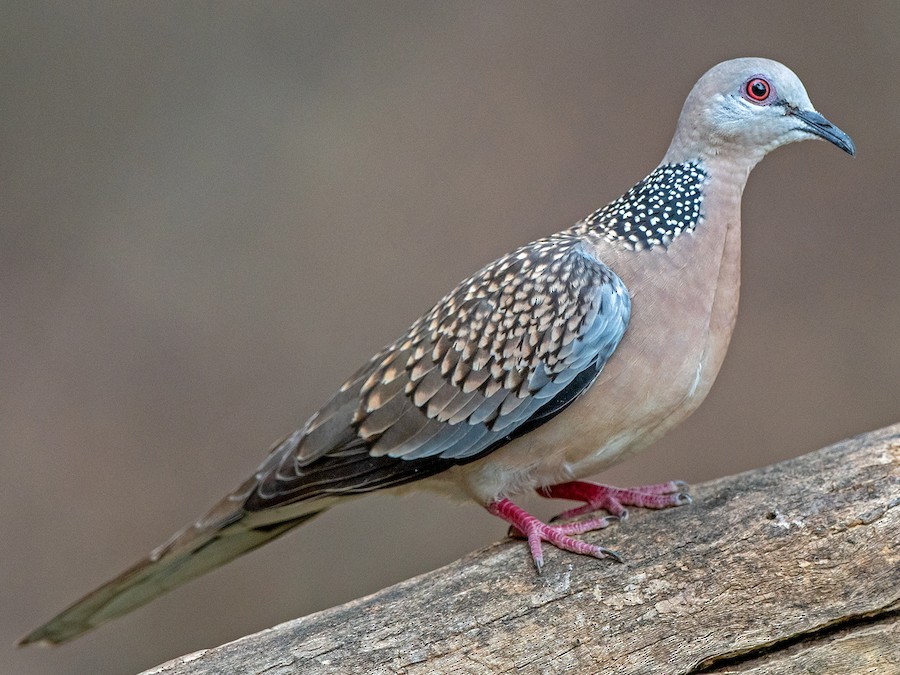
Adults have a pinkish-brown head and underparts, fading to white on the belly. The back and wings are brownish with darker centers to the feathers, giving a scaled appearance. The most distinctive feature is a broad black patch on the hindneck and sides of the neck, finely spotted with white. The tail is long, graduated, and dark brown with white tips on the outer tail feathers, visible in flight and when fanned. The primary flight feathers are dark.
- 2
Beak shape
Shape and color of the bill: a key field mark.
Slender, dark grey to blackish beak, relatively short.
- 3
Eye color
Iris color and any distinctive eye markings.
Dark brown, surrounded by a narrow, greyish orbital ring.
- 4
Leg color
Leg and foot color.
Dull reddish-pink to purplish-red.
- 5
Distinguishing features
Standout features that separate this species.
The black-and-white checkered neck patch is the most reliable field mark. Its relatively long tail and scaled back also aid in identification.
- 6
Juvenile appearance
How young birds differ from adults.
Juveniles are duller overall, with less distinct or absent black-and-white spotting on the neck patch, which develops with age. Their plumage is generally browner, and the pinkish wash on the head and underparts is less pronounced.
- 7
Seasonal changes
Plumage variation between breeding and non-breeding seasons.
No significant seasonal plumage changes. Plumage may appear slightly worn or faded before molting.
- 8
Sexual dimorphism
How males and females differ.
Males and females are generally monomorphic in plumage, appearing identical. Males may be slightly larger and have a more robust head, but these differences are subtle and not reliable for field identification.
Key field marks
- Neck Patch. Look for the distinctive broad black patch on the hindneck and sides of the neck, finely spotted with white. This is the most reliable field mark.
- Plumage Coloration. Note the pinkish-brown head and underparts, fading to white on the belly, and the brownish, scaled appearance of the back and wings.
- Tail Shape and Markings. Observe the relatively long, graduated tail with dark brown central feathers and white tips on the outer tail feathers, especially visible in flight or when fanned.
- Vocalization. Listen for its characteristic soft, mournful, rhythmic cooing call: 'coo-CROO-croo'.
- Size and Shape. It's a medium-sized, slender dove with a relatively long tail, distinguishing it from chunkier pigeons or smaller doves.
Explore the Spotted Dove
Identify birds anywhere
Free on iOS, Android, and Web. Photo & sound identification, full species database, and your personal life list.