
Spotted a bird? Identify it instantly with the Birdby app
Open the appAbout
The Zebra Finch is a small, highly social passerine bird native to Australia and parts of Indonesia. Renowned for its striking plumage, particularly in males, and its adaptability, it is one of the most widely studied bird species in scientific research, especially in neurobiology and behavioral ecology. They are typically found in arid and semi-arid grasslands and savannas, often near water sources.
Size & lifespan
- Length
- 10-12 cm (4-5 in)
- Wingspan
- 15-18 cm (6-7 in)
- Weight
- 10-16 g (0.35-0.56 oz)
- Lifespan
- 3-5 years in the wild, up to 7-10 years in captivity
- Diet
- Granivore (primarily seeds), occasionally insects
Physical characteristics
- Plumage
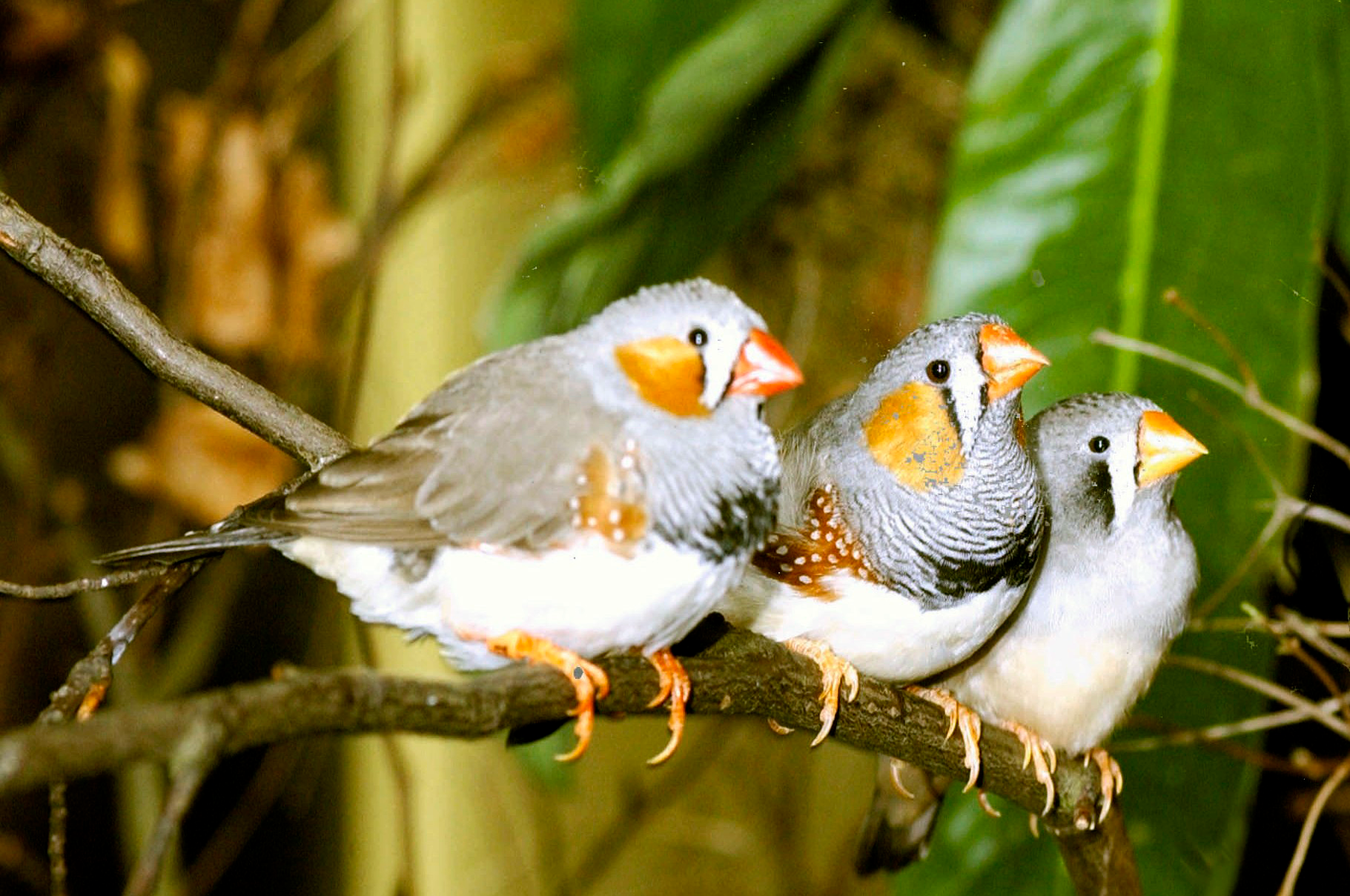
- Males have a distinctive orange-red beak, chestnut cheek patches bordered by a black stripe, and fine black-and-white barring on the throat and upper breast, resembling a zebra pattern. Their flanks are chestnut with white spots. The back and wings are grey-brown, and the belly is white. Females are duller, lacking the cheek patches and flank spots, with a grey head, grey-brown back, and a black tear-drop stripe below the eye. Both sexes have a black tail with white barring.
- Beak shape
- Conical and stout, adapted for cracking seeds. Bright orange-red in males, duller orange in females, and black in juveniles.
- Eye color
- Reddish-brown
- Leg color
- Orange
- Distinguishing features
- The 'zebra' barring on the throat and breast of males, and the prominent orange cheek patches in males are key. The black tear-drop stripe below the eye is present in both sexes but more prominent in females.
- Juvenile appearance
- Juveniles have a dull grey plumage overall, similar to females but lacking the black tear-drop stripe. Their beaks are black, gradually turning orange as they mature, typically within 60-90 days.
- Seasonal changes
- No significant seasonal plumage changes. Plumage remains consistent year-round, with variations primarily due to age and sex.
- Sexual dimorphism
- Pronounced. Males have bright orange cheek patches, chestnut flanks with white spots, and more vibrant orange beaks. Females lack these features, having a plainer grey head and duller orange beak.
How to identify
- 1
Size and Shape
Small, plump finch with a short, conical beak and a relatively short tail.
- 2
Male Plumage
Look for the bright orange-red beak, prominent orange cheek patches, black-and-white 'zebra' barring on the throat/upper breast, and chestnut flanks with white spots. Grey-brown back and white belly.
- 3
Female Plumage
Duller than males. Look for the duller orange beak, grey head, grey-brown back, white belly, and a distinct black tear-drop stripe below the eye. Lacks cheek patches and flank spots.
- 4
Juvenile Plumage
Initially grey overall with a black beak, gradually acquiring adult plumage and beak color.
- 5
Vocalizations
Listen for the loud, nasal 'teet' call and the male's complex, chattering song.
- 6
Behavior
Often seen in small to large flocks, foraging on the ground, and frequently visiting water sources.
Habitat & range
- Biomes
- Arid and semi-arid grasslands, savannas, shrublands, open woodlands
- Geographic range
- Native to Australia (widespread across most of the continent, avoiding coastal areas and Tasmania) and the Lesser Sunda Islands (Timor, Sumba, Flores, etc.) in Indonesia. Introduced populations exist in Puerto Rico, Portugal, and the United States.
- Elevation range
- Typically found from sea level up to approximately 1,000 meters (3,300 feet).
- Preferred environments
- Open, dry country with scattered trees and shrubs, particularly acacia and eucalypt woodlands, spinifex grasslands, and areas near human habitation. Access to water is crucial, and they are often found near waterholes, dams, and rivers.
Behavior
- Activity time
- Diurnal, most active during the cooler parts of the day, morning and late afternoon, avoiding the midday heat.
- Feeding habits
- Primarily ground feeders, foraging for fallen seeds of grasses and herbs. They will also pluck seeds directly from plants. Occasionally consume small insects, especially during breeding season to supplement protein for chicks. They drink frequently, often in large groups, and can survive long periods without surface water by extracting moisture from seeds.
- Social behavior
- Highly gregarious, forming large flocks outside the breeding season, sometimes numbering in the hundreds. They are monogamous, forming strong pair bonds that often last for life. They communicate frequently through calls and songs.
- Flight pattern
- Fast, direct, and undulating flight, often in tight flocks. They are agile flyers, capable of quick maneuvers.
- Migration pattern
- Resident throughout their range, but nomadic movements occur in response to rainfall and food availability, particularly in arid regions. They do not undertake long-distance seasonal migrations.
- Territoriality
- While generally social, breeding pairs will defend a small territory around their nest site from other finches, though colonies often nest in close proximity.
Song & calls
- Song
- Males sing a complex, highly variable song, often described as a series of short, high-pitched 'teet' notes, followed by a rapid, chattering, and buzzing phrase. Each male's song is unique and learned from its father or other adult males. The song is used for courtship and territorial defense.
- Call
- A distinctive, loud, nasal 'teet' or 'tew' call is the most common vocalization, used for contact within the flock, alarm, and general communication. They also emit softer 'tat-tat' calls and various chirps and trills.
- When they vocalize
- Vocalize throughout the day, especially during foraging, social interactions, and courtship. Males sing most frequently during the breeding season.
Breeding & reproduction
- Breeding season
- Highly opportunistic, breeding primarily after rainfall, which can occur at any time of year in arid regions. In more temperate areas, breeding may be concentrated in spring and autumn.
- Nesting habits
- Nests are typically dome-shaped structures with a side entrance, built from grass stems, twigs, and other plant material, lined with soft feathers, wool, or plant down. They are often placed in dense shrubs, small trees, or even artificial structures like eaves of buildings. They may nest colonially.
- Clutch size
- Typically 4-6 eggs, but can range from 2 to 8.
- Egg description
- Small, oval, and white to pale blue, sometimes with faint reddish-brown speckles. Approximately 1.5 cm (0.6 in) long.
- Incubation period
- 11-16 days, primarily by the female, but both parents share duties.
- Fledging period
- 17-21 days after hatching, chicks leave the nest but are still fed by parents for another 1-2 weeks.
- Parental care
- Both parents participate in nest building, incubation, and feeding of the young. They are highly attentive parents.
Where to find
Arid and Semi-arid Grasslands
Look in open, dry areas with scattered grasses and shrubs, especially after rainfall.
Waterholes and Dams
They are highly dependent on water and will congregate at water sources, particularly in the morning and late afternoon.
Open Woodlands and Shrublands
Check areas with acacia and eucalypt trees, where they may nest or seek shelter.
Human-modified Landscapes
Can be found in parks, gardens, and agricultural areas, especially if water and suitable nesting sites are available.
Field tips
- Listen for their calls. Their distinctive 'teet' call is often the first indication of their presence, especially when they are in flocks.
- Visit water sources. In dry environments, waterholes are prime locations to observe Zebra Finches, often in large numbers.
- Look on the ground. They are primarily ground feeders, so scan the ground beneath grasses and shrubs for foraging individuals or flocks.
- Observe social behavior. Their highly social nature means they are rarely seen alone; look for groups interacting.
Similar species
Double-barred Finch
Taeniopygia bichenovii
The Double-barred Finch has two distinct black bars across its white breast, a white face with a black border, and a black tail. It lacks the orange cheek patches and flank spots of the male Zebra Finch and the 'zebra' barring on the throat.
Diamond Firetail
Stagonopleura guttata
Larger than the Zebra Finch, the Diamond Firetail has a bright red rump, white spots on its black flanks, and a black band across its breast. It lacks the orange cheek patches and 'zebra' barring of the Zebra Finch.
Plum-headed Finch
Aidemosyne modesta
The Plum-headed Finch has a distinctive plum-colored cap (male) or duller cap (female), fine white barring on its underparts, and lacks the orange cheek patches and prominent 'zebra' barring of the Zebra Finch.
Quick facts
- Primary Diet:
- Seeds
- Sociality:
- Highly social, forms flocks
- Breeding:
- Opportunistic, after rain
- Male Song:
- Learned and unique
- Conservation Status:
- Least Concern
Fun facts
- Zebra Finches are one of the most widely studied bird species in the world, particularly in research on vocal learning, neurobiology, and social behavior.
- Male Zebra Finches learn their songs from their fathers or other adult males, and each male develops a unique song, similar to human speech acquisition.
- They are incredibly adaptable to arid environments, capable of breeding even during droughts if sufficient food and water are available.
- Zebra Finches can drink water very rapidly, often in a single gulp, which is an adaptation to minimize exposure to predators at waterholes.
- They form strong, lifelong pair bonds, and both parents are actively involved in raising their young.
Scientific classification
- Kingdom
- Animalia
- Phylum
- Chordata
- Class
- Aves
- Order
- Passeriformes
- Family
- Estrildidae
- Genus
- Taeniopygia
- Species
- Taeniopygia guttata
Explore the Zebra Finch
Identify birds anywhere
Free on iOS, Android, and Web. Photo & sound identification, full species database, and your personal life list.