
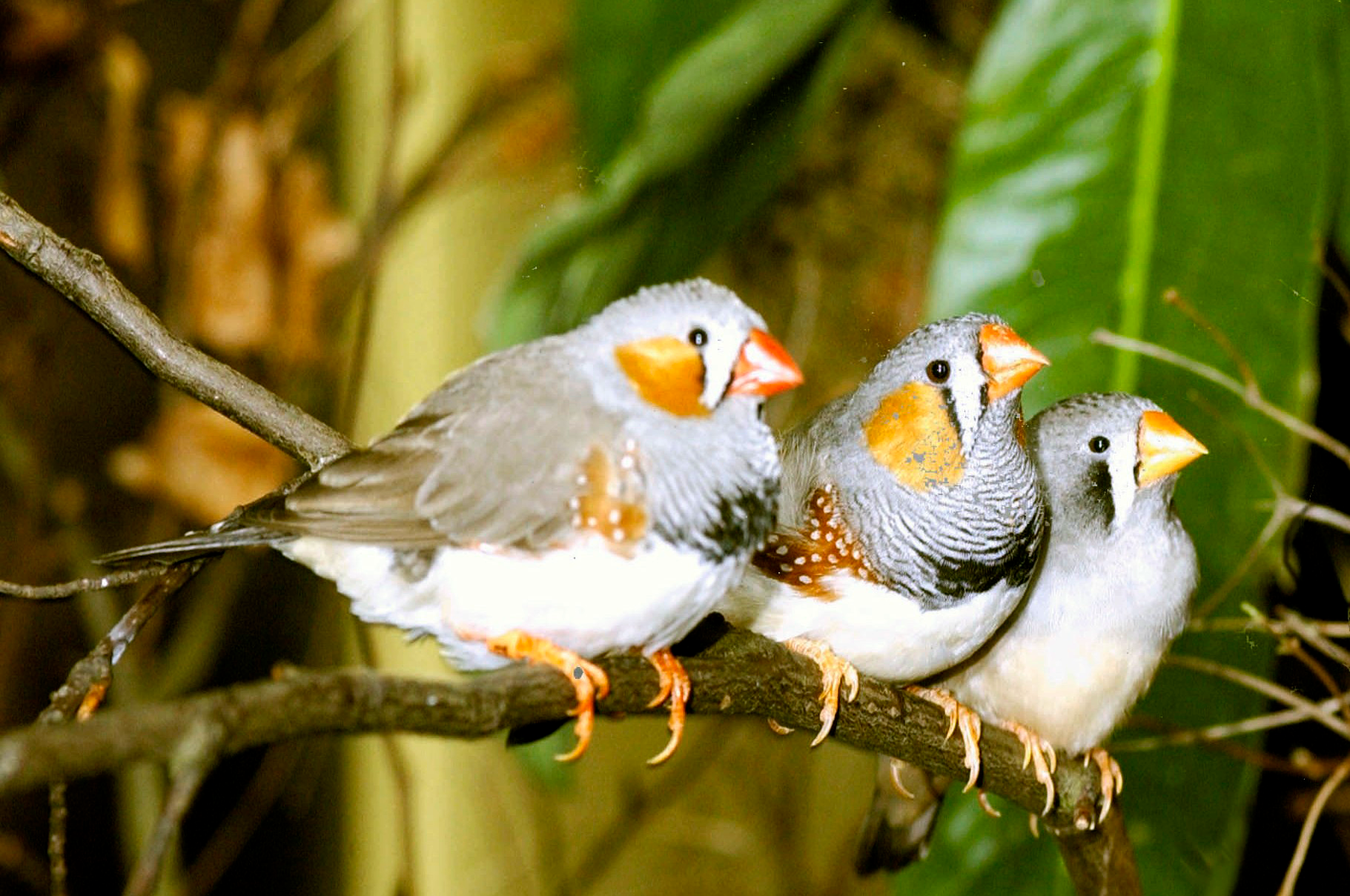
How to identify the Zebra Finch
Taeniopygia guttata
Spotted a bird? Identify it instantly with the Birdby app
Open the appTo correctly identify the Zebra Finch (Taeniopygia guttata), check each of these features. Birds can be tricky: habit, habitat, and call often confirm a sighting that a single photo cannot.
Size at a glance
- Length
- 10-12 cm (4-5 in)
- Wingspan
- 15-18 cm (6-7 in)
- Weight
- 10-16 g (0.35-0.56 oz)
Physical features to check
- 1
Plumage
Overall feather coloration and pattern.
Males have a distinctive orange-red beak, chestnut cheek patches bordered by a black stripe, and fine black-and-white barring on the throat and upper breast, resembling a zebra pattern. Their flanks are chestnut with white spots. The back and wings are grey-brown, and the belly is white. Females are duller, lacking the cheek patches and flank spots, with a grey head, grey-brown back, and a black tear-drop stripe below the eye. Both sexes have a black tail with white barring.
- 2
Beak shape
Shape and color of the bill: a key field mark.
Conical and stout, adapted for cracking seeds. Bright orange-red in males, duller orange in females, and black in juveniles.
- 3
Eye color
Iris color and any distinctive eye markings.
Reddish-brown
- 4
Leg color
Leg and foot color.
Orange
- 5
Distinguishing features
Standout features that separate this species.
The 'zebra' barring on the throat and breast of males, and the prominent orange cheek patches in males are key. The black tear-drop stripe below the eye is present in both sexes but more prominent in females.
- 6
Juvenile appearance
How young birds differ from adults.
Juveniles have a dull grey plumage overall, similar to females but lacking the black tear-drop stripe. Their beaks are black, gradually turning orange as they mature, typically within 60-90 days.
- 7
Seasonal changes
Plumage variation between breeding and non-breeding seasons.
No significant seasonal plumage changes. Plumage remains consistent year-round, with variations primarily due to age and sex.
- 8
Sexual dimorphism
How males and females differ.
Pronounced. Males have bright orange cheek patches, chestnut flanks with white spots, and more vibrant orange beaks. Females lack these features, having a plainer grey head and duller orange beak.
Key field marks
- Size and Shape. Small, plump finch with a short, conical beak and a relatively short tail.
- Male Plumage. Look for the bright orange-red beak, prominent orange cheek patches, black-and-white 'zebra' barring on the throat/upper breast, and chestnut flanks with white spots. Grey-brown back and white belly.
- Female Plumage. Duller than males. Look for the duller orange beak, grey head, grey-brown back, white belly, and a distinct black tear-drop stripe below the eye. Lacks cheek patches and flank spots.
- Juvenile Plumage. Initially grey overall with a black beak, gradually acquiring adult plumage and beak color.
- Vocalizations. Listen for the loud, nasal 'teet' call and the male's complex, chattering song.
- Behavior. Often seen in small to large flocks, foraging on the ground, and frequently visiting water sources.
Explore the Zebra Finch
Identify birds anywhere
Free on iOS, Android, and Web. Photo & sound identification, full species database, and your personal life list.