
Spotted a bird? Identify it instantly with the Birdby app
Open the appAbout
The Carolina Wren is a small, active songbird known for its loud, cheerful song and distinctive white supercilium. It is a common resident across the southeastern United States and parts of Mexico and Central America, often found in dense undergrowth.
Size & lifespan
- Length
- 12.5-14 cm (4.9-5.5 in)
- Wingspan
- 29 cm (11.4 in)
- Weight
- 18-23 g (0.63-0.81 oz)
- Lifespan
- Average 2-6 years in the wild, up to 7 years recorded.
- Diet
- Insectivore, primarily feeding on insects and spiders, occasionally small fruits or seeds.
Physical characteristics
- Plumage
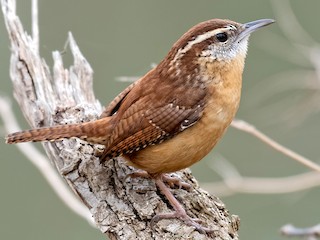
- Upperparts are rich rufous-brown, underparts are warm buffy-orange, fading to whitish on the throat. The most striking feature is a prominent white supercilium (eyebrow stripe) contrasting with a dark eye-line. The tail is barred with dark brown. Sexes are monomorphic in plumage.
- Beak shape
- Slender, slightly decurved, dark horn-colored bill.
- Eye color
- Dark brown.
- Leg color
- Pinkish-brown to grayish-brown.
- Distinguishing features
- Prominent white supercilium, rich rufous-brown upperparts, buffy-orange underparts, and an often cocked tail.
- Juvenile appearance
- Juveniles resemble adults but may have slightly duller plumage and a less distinct supercilium.
- Seasonal changes
- No significant seasonal plumage changes.
- Sexual dimorphism
- None; males and females are identical in plumage.
How to identify
- 1
White Supercilium
Look for the prominent white stripe above the eye, contrasting with the dark eye-line and rufous-brown head. This is the most reliable field mark.
- 2
Plumage Color
Note the rich rufous-brown upperparts and warm buffy-orange underparts. No other wren in its range has this combination of colors and a strong supercilium.
- 3
Tail Position
Observe its habit of often holding its tail cocked upwards, though not as steeply as some other wren species.
- 4
Song
Listen for its loud, clear, and repetitive 'teakettle-teakettle-teakettle' song. This is often the first indication of its presence.
- 5
Behavior
Watch for its active, skulking movements in dense undergrowth, hopping and creeping through tangles.
Habitat & range
- Biomes
- Forests, woodlands, suburban gardens, parks, swamps, thickets.
- Geographic range
- Southeastern Canada (southern Ontario), eastern and central United States, northeastern Mexico, and parts of Central America (Belize, Guatemala, Honduras, Nicaragua).
- Elevation range
- Typically found from sea level up to approximately 1,500 meters (5,000 feet).
- Preferred environments
- Dense undergrowth, tangled vegetation, brush piles, suburban yards with ample shrubbery, riparian zones, and forest edges. They prefer areas with good cover for foraging and nesting.
Behavior
- Activity time
- Diurnal.
- Feeding habits
- Forages actively in dense vegetation, gleaning insects and spiders from leaves, bark, and crevices. Often hops and creeps through tangles, probing with its bill. Occasionally forages on the ground among leaf litter.
- Social behavior
- Typically solitary or found in pairs, especially during the breeding season. Pairs often stay together year-round and defend their territory.
- Flight pattern
- Short, quick, and direct flights, often low to the ground between patches of cover. Not known for long-distance flights.
- Migration pattern
- Non-migratory; a permanent resident throughout its range. Northern populations may show some short-distance dispersal in harsh winters.
- Territoriality
- Highly territorial, with both sexes defending their breeding and winter territories through vocalizations and displays.
Song & calls
- Song
- Loud, clear, and often repeated three-part whistle, typically described as 'teakettle-teakettle-teakettle' or 'cheerily-cheerily-cheerily'. Males have a repertoire of up to 30 different song types. The song is surprisingly loud for such a small bird.
- Call
- A variety of calls including a sharp 'chek' or 'churr', a scolding 'chatter', and a softer 'tew-tew-tew' contact call.
- When they vocalize
- Sings year-round, though most frequently during the breeding season (spring and summer). Can be heard singing on sunny days even in winter.
Breeding & reproduction
- Breeding season
- Typically March to September, with peak activity from April to July. May raise multiple broods per season.
- Nesting habits
- Nests are bulky, domed structures with a side entrance, built from twigs, leaves, bark strips, moss, and often lined with hair or feathers. Nests are placed in a wide variety of sheltered locations, including tree cavities, brush piles, old tin cans, mailboxes, hanging baskets, and even old boots.
- Clutch size
- 3-7 eggs.
- Egg description
- 3-7 eggs (typically 4-6), white to creamy-white, often speckled with reddish-brown or purplish spots, particularly at the larger end.
- Incubation period
- 12-14 days, primarily by the female.
- Fledging period
- 12-14 days after hatching. Both parents feed the young.
- Parental care
- Both male and female participate in feeding the nestlings and fledglings. Males may continue to feed fledglings from the first brood while the female begins a second clutch.
Where to find
Suburban Gardens and Parks
Often found in backyards with dense shrubbery, brush piles, and mature trees. They readily visit feeders.
Forest Edges and Woodlands
Look in the understory of deciduous and mixed forests, especially near clearings or water sources.
Riparian Zones
Areas along streams, rivers, and wetlands with dense vegetation provide ideal habitat.
Thickets and Brush Piles
These provide excellent cover for foraging and nesting.
Field tips
- Listen for their song. Their loud, distinctive song is often heard before the bird is seen. Learn to recognize it, and you'll find them easily.
- Check dense cover. They prefer to stay hidden in thick vegetation. Look closely in shrubbery, brush piles, and tangled vines.
- Be patient. They are active but can be elusive. Sit quietly near suitable habitat and wait for them to emerge or move.
- Look for movement. Their constant foraging movements in dense foliage can give away their presence.
- Attract them to your yard. Provide brush piles, dense native shrubs, and suet feeders to encourage them to visit.
Similar species
House Wren
Troglodytes aedon
House Wrens are smaller, duller brown overall, lack the prominent white supercilium, and have a shorter tail. Their song is a jumbled, bubbly series of trills, distinct from the Carolina Wren's clear whistles.
Winter Wren
Troglodytes hiemalis
Winter Wrens are much smaller, darker brown, have a very short, often cocked tail, and a less distinct supercilium. Their song is a long, complex, high-pitched cascade of notes, very different from the Carolina Wren.
Bewick's Wren
Thryomanes bewickii
Bewick's Wrens also have a white supercilium but are grayer-brown on the back and whiter on the belly. Their tail is longer and often fanned, showing white spots on the outer tail feathers, which Carolina Wrens lack. Their song is a series of buzzy notes and trills, often starting with a clear whistle.
Quick facts
- Status:
- Permanent Resident
- Diet:
- Insects, Spiders
- Nest Type:
- Domed, bulky structure
- Song:
- Loud, clear, repeated whistles ('teakettle')
- Distinguishing Mark:
- Prominent white supercilium
Fun facts
- The Carolina Wren's song is one of the loudest for its size among North American birds, often carrying a considerable distance.
- Males can have a repertoire of up to 30 different song variations, which they use to defend territory and attract mates.
- They are known for their adaptability in nesting sites, often choosing unusual locations like old boots, mailboxes, or even car engines.
- Carolina Wrens are highly sensitive to cold weather. Severe winters can significantly reduce their populations in the northern parts of their range.
- Pairs often stay together year-round, maintaining their territory even outside the breeding season.
Scientific classification
- Kingdom
- Animalia
- Phylum
- Chordata
- Class
- Aves
- Order
- Passeriformes
- Family
- Troglodytidae
- Genus
- Thryothorus
- Species
- Thryothorus ludovicianus
Explore the Carolina Wren
Identify birds anywhere
Free on iOS, Android, and Web. Photo & sound identification, full species database, and your personal life list.