
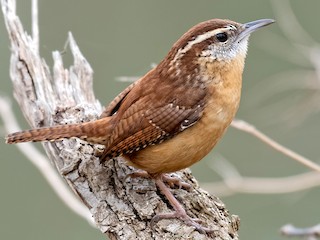
Where does the Carolina Wren live?
Thryothorus ludovicianus
Spotted a bird? Identify it instantly with the Birdby app
Open the appThe Carolina Wren lives in specific habitats and regions. Knowing where, and when, to look improves your chances of a successful sighting.
Biomes
Forests, woodlands, suburban gardens, parks, swamps, thickets.
Geographic range
Southeastern Canada (southern Ontario), eastern and central United States, northeastern Mexico, and parts of Central America (Belize, Guatemala, Honduras, Nicaragua).
Preferred environments
Dense undergrowth, tangled vegetation, brush piles, suburban yards with ample shrubbery, riparian zones, and forest edges. They prefer areas with good cover for foraging and nesting.
Elevation range
Typically found from sea level up to approximately 1,500 meters (5,000 feet).
Where to look
Suburban Gardens and Parks
Often found in backyards with dense shrubbery, brush piles, and mature trees. They readily visit feeders.
Forest Edges and Woodlands
Look in the understory of deciduous and mixed forests, especially near clearings or water sources.
Riparian Zones
Areas along streams, rivers, and wetlands with dense vegetation provide ideal habitat.
Thickets and Brush Piles
These provide excellent cover for foraging and nesting.
Field tips
- Listen for their song. Their loud, distinctive song is often heard before the bird is seen. Learn to recognize it, and you'll find them easily.
- Check dense cover. They prefer to stay hidden in thick vegetation. Look closely in shrubbery, brush piles, and tangled vines.
- Be patient. They are active but can be elusive. Sit quietly near suitable habitat and wait for them to emerge or move.
- Look for movement. Their constant foraging movements in dense foliage can give away their presence.
- Attract them to your yard. Provide brush piles, dense native shrubs, and suet feeders to encourage them to visit.
Migration
Non-migratory; a permanent resident throughout its range. Northern populations may show some short-distance dispersal in harsh winters.
Explore the Carolina Wren
Identify birds anywhere
Free on iOS, Android, and Web. Photo & sound identification, full species database, and your personal life list.