
Spotted a bird? Identify it instantly with the Birdby app
Open the appAbout
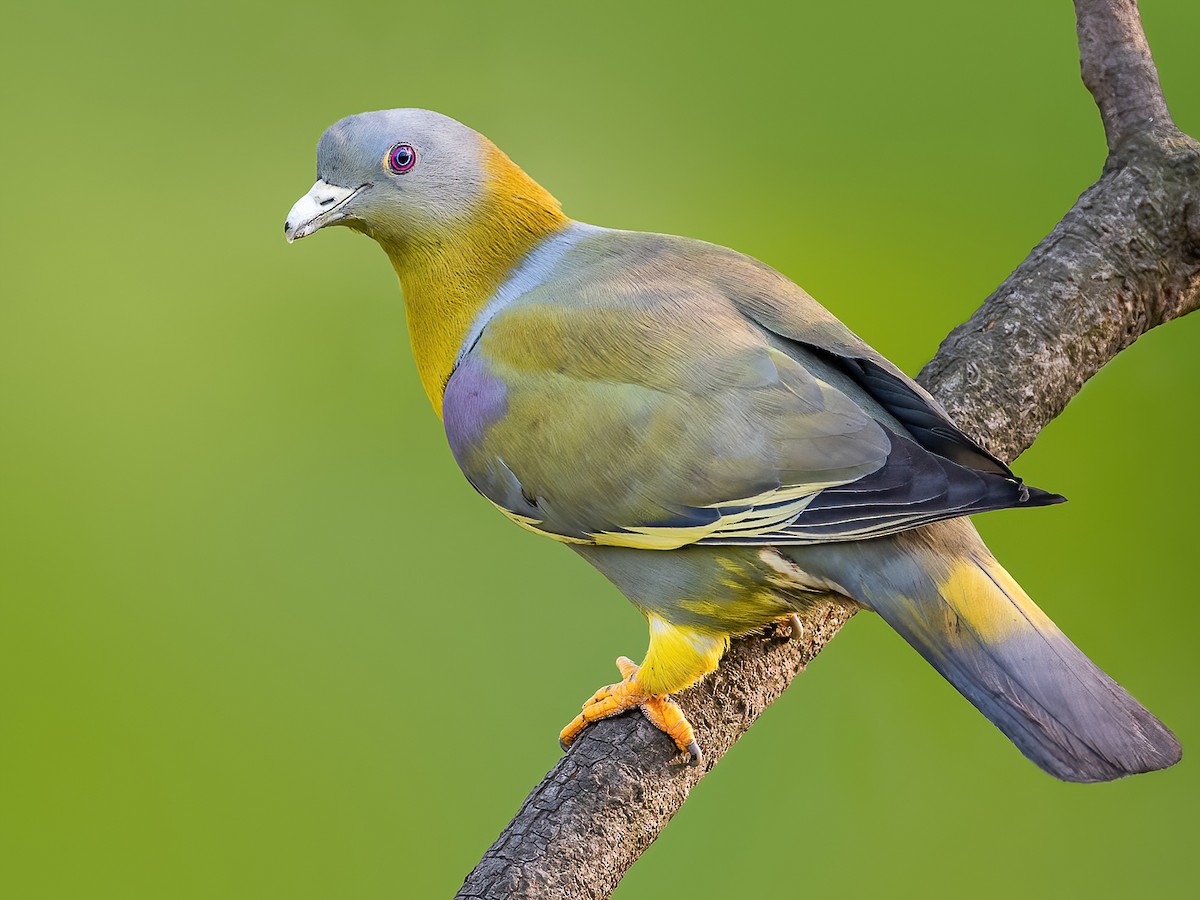
The Yellow-footed Green Pigeon is a medium-sized pigeon characterized by its predominantly green plumage, yellow feet, and a distinctive lilac patch on the crown and nape in males. It is a frugivorous species found across a wide range of habitats in the Indian subcontinent and Southeast Asia, often seen in flocks feeding on figs and other fruits.
Size & lifespan
- Length
- 27-33 cm
- Wingspan
- 48-54 cm
- Weight
- 220-260 g
- Lifespan
- Approximately 8-12 years in the wild
- Diet
- Frugivore
Physical characteristics
- Plumage
- Adults are predominantly green. The back and wings are olive-green, with a prominent maroon patch on the lesser wing coverts (visible in flight and sometimes at rest). The underparts are yellowish-green, fading to yellow on the belly and undertail coverts. The tail is greyish with a broad subterminal black band. Males have a distinctive lilac-grey patch on the crown and nape, which is absent or much reduced in females.
- Beak shape
- Relatively short and stout, pale bluish-grey at the base, transitioning to greenish-yellow or yellowish at the tip.
- Eye color
- Inner orbital ring is blue, outer ring is yellow-orange. The iris is typically blue-grey.
- Leg color
- Bright yellow, hence the common name.
- Distinguishing features
- Bright yellow feet, a maroon patch on the wing, and the lilac-grey crown/nape in males are key identifiers. The overall yellowish-green underparts are also characteristic.
- Juvenile appearance
- Juveniles resemble females but are duller, with a more uniform green plumage and lacking the distinct lilac-grey crown patch. The maroon wing patch may be less developed or absent, and the yellow on the feet might be less intense.
- Seasonal changes
- No significant seasonal plumage changes. Plumage remains consistent throughout the year, though wear and tear can make colors appear slightly duller over time.
- Sexual dimorphism
- Males possess a distinct lilac-grey patch on the crown and nape, which is absent or much duller/greener in females. Females are generally duller overall, with less vibrant green plumage.
How to identify
- 1
Yellow Feet
The most distinctive and reliable field mark. Look for bright yellow legs and feet, especially when perched.
- 2
Maroon Wing Patch
A prominent maroon patch on the lesser wing coverts is visible on the folded wing and especially in flight. This helps distinguish it from other green pigeons.
- 3
Lilac Crown (Males)
Adult males have a soft lilac-grey wash on the crown and nape. This is absent or much duller in females and juveniles.
- 4
Overall Plumage
Predominantly yellowish-green plumage, with a greyish tail that has a broad black subterminal band.
- 5
Vocalization
Listen for its characteristic soft, fluty, ascending and descending whistles and coos, which are quite distinctive among green pigeons.
Habitat & range
- Biomes
- Tropical and subtropical moist broadleaf forests, dry deciduous forests, scrublands, agricultural areas, urban parks, and gardens.
- Geographic range
- Indian subcontinent, including India, Nepal, Bangladesh, Sri Lanka, Pakistan, and parts of Southeast Asia (Myanmar, Thailand, Laos, Vietnam, Cambodia, southern China).
- Elevation range
- Primarily lowlands up to approximately 1,500 meters (5,000 feet) above sea level, occasionally higher.
- Preferred environments
- Prefers areas with abundant fruiting trees, especially fig trees. Found in open woodlands, forest edges, riverine forests, and well-wooded urban environments.
Behavior
- Activity time
- Diurnal, most active during the morning and late afternoon.
- Feeding habits
- Strictly frugivorous, primarily feeding on figs (Ficus species), but also consumes berries and fruits of other trees like banyan, peepal, and various wild fruits. They forage in the canopy, often hanging upside down to reach fruits. They swallow fruits whole.
- Social behavior
- Highly gregarious, typically found in small to large flocks, especially when feeding at fruiting trees. They can form very large congregations at abundant food sources. They are generally shy but can become accustomed to human presence in urban areas.
- Flight pattern
- Strong, direct, and swift flight, often in small to large flocks. They can be quite agile when maneuvering through tree canopies.
- Migration pattern
- Mostly resident throughout its range, but some local movements may occur in response to fruit availability. Not considered a long-distance migratory species.
- Territoriality
- Not strongly territorial, especially outside the breeding season. Flocks share feeding grounds. During breeding, pairs will defend a small nesting territory.
Song & calls
- Song
- The song is a series of soft, low-pitched, fluty whistles and coos, often described as 'whu-whu-whu-whu-whu' or 'koo-koo-koo-koo' that gradually ascends and then descends in pitch. It can be quite melodious and ventriloquial.
- Call
- Common calls include a soft, purring 'coo-coo-coo' and a more abrupt 'whut-whut'. Alarm calls are sharper and more urgent.
- When they vocalize
- Most vocal during the breeding season and when feeding in flocks. Calls can be heard throughout the day, but more frequently in the early morning and late afternoon.
Breeding & reproduction
- Breeding season
- Varies geographically, but generally from March to June in most parts of its range, extending into September in some areas, coinciding with fruit availability.
- Nesting habits
- Nests are typically flimsy platforms of twigs, placed high up in the canopy of trees or large bushes. Both parents participate in nest construction.
- Clutch size
- 1-2 eggs, most commonly 2.
- Egg description
- Usually 1-2 eggs, pure white, elliptical to oval in shape, smooth, and glossy.
- Incubation period
- Approximately 14-16 days.
- Fledging period
- Chicks fledge around 12-14 days after hatching.
- Parental care
- Both parents share incubation duties and care for the young, feeding them 'crop milk' initially, followed by regurgitated fruit pulp.
Where to find
Fruiting Trees
Look for them in large fruiting trees, especially fig trees (Ficus species) like banyan and peepal, where they gather in large numbers to feed.
Forest Edges and Open Woodlands
Common in the canopy of deciduous and semi-evergreen forests, particularly at the edges or in clearings.
Urban Parks and Gardens
In well-wooded urban areas with mature fruiting trees, they can be surprisingly common and approachable.
Riverine Forests
Often found along water bodies where fruiting trees are abundant.
Field tips
- Look Up. These pigeons spend most of their time in the tree canopy, so scan the upper branches of fruiting trees.
- Listen for Calls. Their soft, fluty calls are often the first indication of their presence, especially when they are hidden by foliage.
- Observe Feeding Flocks. They are gregarious feeders. If you find one, there are likely more. Watch for movement in the foliage of fruiting trees.
- Patience is Key. Their green plumage provides excellent camouflage. Remain still and observe for a while, and they will often reveal themselves.
Similar species
Orange-breasted Green Pigeon
Treron bicinctus
The Orange-breasted Green Pigeon has a distinct orange band across its breast and a greyish-blue crown (lacking the lilac patch of the Yellow-footed). Its undertail coverts are chestnut, not yellow. The maroon wing patch is also present but the overall coloration differs.
Wedge-tailed Green Pigeon
Treron sphenurus
The Wedge-tailed Green Pigeon has a distinctly wedge-shaped tail, a grey head (lacking lilac), and a more olive-green plumage. It typically inhabits higher altitudes and denser forests. Its feet are red, not yellow.
Pin-tailed Green Pigeon
Treron apicauda
The Pin-tailed Green Pigeon has elongated central tail feathers forming a 'pin-tail' and lacks the maroon wing patch. Its feet are red, and it has a more uniform green plumage without the distinct lilac crown.
Quick facts
- Diet:
- Frugivorous (primarily figs)
- Sociality:
- Highly gregarious, forms flocks
- Feet Color:
- Bright yellow
- Male Head Patch:
- Lilac-grey
- Conservation Status:
- Least Concern
Fun facts
- The Yellow-footed Green Pigeon is the State Bird of Maharashtra, India.
- They play a crucial ecological role as seed dispersers for many fruiting trees, especially figs, helping in forest regeneration.
- Despite their bright green plumage, they are remarkably well-camouflaged among the leaves of fruiting trees.
- They can often be seen hanging upside down to reach ripe fruits, showcasing their agility.
Scientific classification
- Kingdom
- Animalia
- Phylum
- Chordata
- Class
- Aves
- Order
- Columbiformes
- Family
- Columbidae
- Genus
- Treron
- Species
- Treron phoenicoptera
Explore the Yellow-footed Green Pigeon
Identify birds anywhere
Free on iOS, Android, and Web. Photo & sound identification, full species database, and your personal life list.