
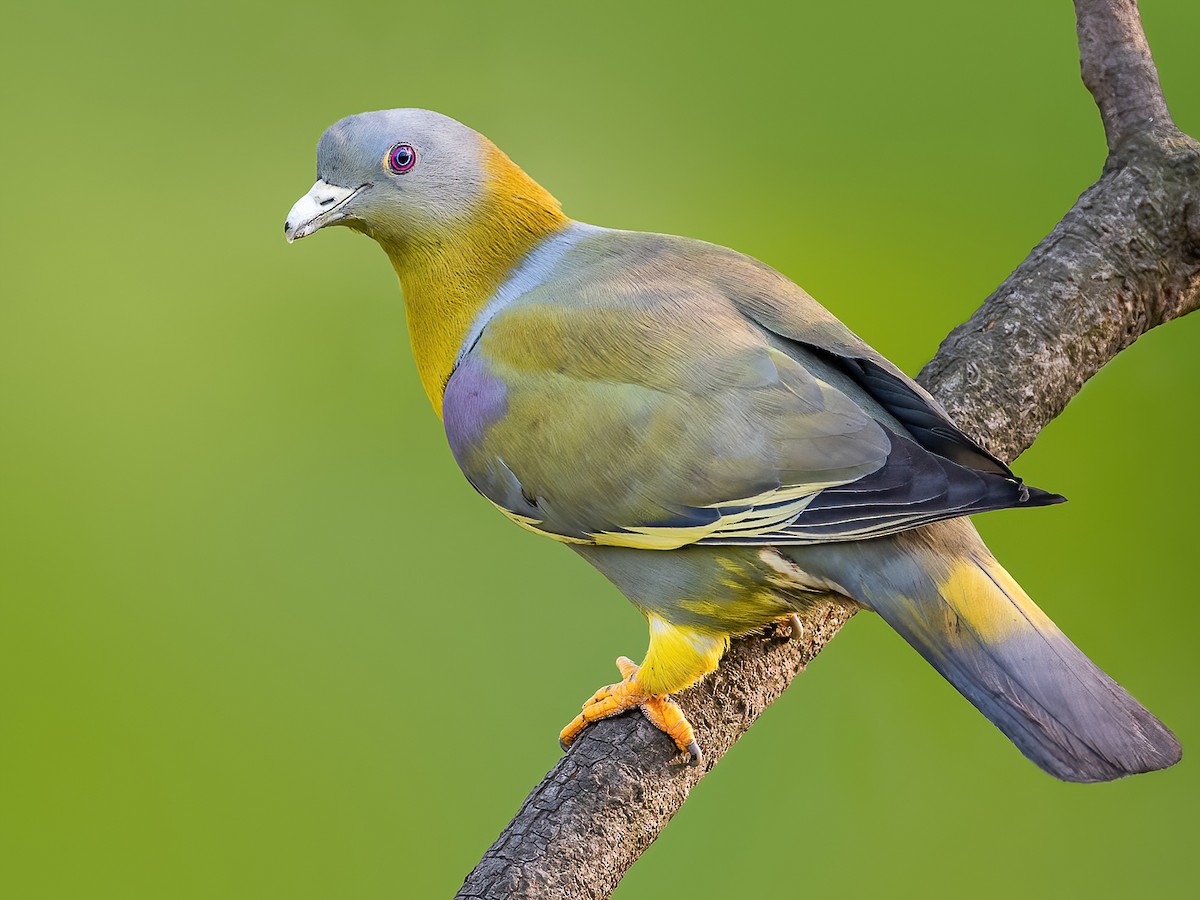
How to identify the Yellow-footed Green Pigeon
Treron phoenicoptera
Spotted a bird? Identify it instantly with the Birdby app
Open the appTo correctly identify the Yellow-footed Green Pigeon (Treron phoenicoptera), check each of these features. Birds can be tricky: habit, habitat, and call often confirm a sighting that a single photo cannot.
Size at a glance
- Length
- 27-33 cm
- Wingspan
- 48-54 cm
- Weight
- 220-260 g
Physical features to check
- 1
Plumage
Overall feather coloration and pattern.
Adults are predominantly green. The back and wings are olive-green, with a prominent maroon patch on the lesser wing coverts (visible in flight and sometimes at rest). The underparts are yellowish-green, fading to yellow on the belly and undertail coverts. The tail is greyish with a broad subterminal black band. Males have a distinctive lilac-grey patch on the crown and nape, which is absent or much reduced in females.
- 2
Beak shape
Shape and color of the bill: a key field mark.
Relatively short and stout, pale bluish-grey at the base, transitioning to greenish-yellow or yellowish at the tip.
- 3
Eye color
Iris color and any distinctive eye markings.
Inner orbital ring is blue, outer ring is yellow-orange. The iris is typically blue-grey.
- 4
Leg color
Leg and foot color.
Bright yellow, hence the common name.
- 5
Distinguishing features
Standout features that separate this species.
Bright yellow feet, a maroon patch on the wing, and the lilac-grey crown/nape in males are key identifiers. The overall yellowish-green underparts are also characteristic.
- 6
Juvenile appearance
How young birds differ from adults.
Juveniles resemble females but are duller, with a more uniform green plumage and lacking the distinct lilac-grey crown patch. The maroon wing patch may be less developed or absent, and the yellow on the feet might be less intense.
- 7
Seasonal changes
Plumage variation between breeding and non-breeding seasons.
No significant seasonal plumage changes. Plumage remains consistent throughout the year, though wear and tear can make colors appear slightly duller over time.
- 8
Sexual dimorphism
How males and females differ.
Males possess a distinct lilac-grey patch on the crown and nape, which is absent or much duller/greener in females. Females are generally duller overall, with less vibrant green plumage.
Key field marks
- Yellow Feet. The most distinctive and reliable field mark. Look for bright yellow legs and feet, especially when perched.
- Maroon Wing Patch. A prominent maroon patch on the lesser wing coverts is visible on the folded wing and especially in flight. This helps distinguish it from other green pigeons.
- Lilac Crown (Males). Adult males have a soft lilac-grey wash on the crown and nape. This is absent or much duller in females and juveniles.
- Overall Plumage. Predominantly yellowish-green plumage, with a greyish tail that has a broad black subterminal band.
- Vocalization. Listen for its characteristic soft, fluty, ascending and descending whistles and coos, which are quite distinctive among green pigeons.
Explore the Yellow-footed Green Pigeon
Identify birds anywhere
Free on iOS, Android, and Web. Photo & sound identification, full species database, and your personal life list.