
Spotted a bird? Identify it instantly with the Birdby app
Open the appAbout
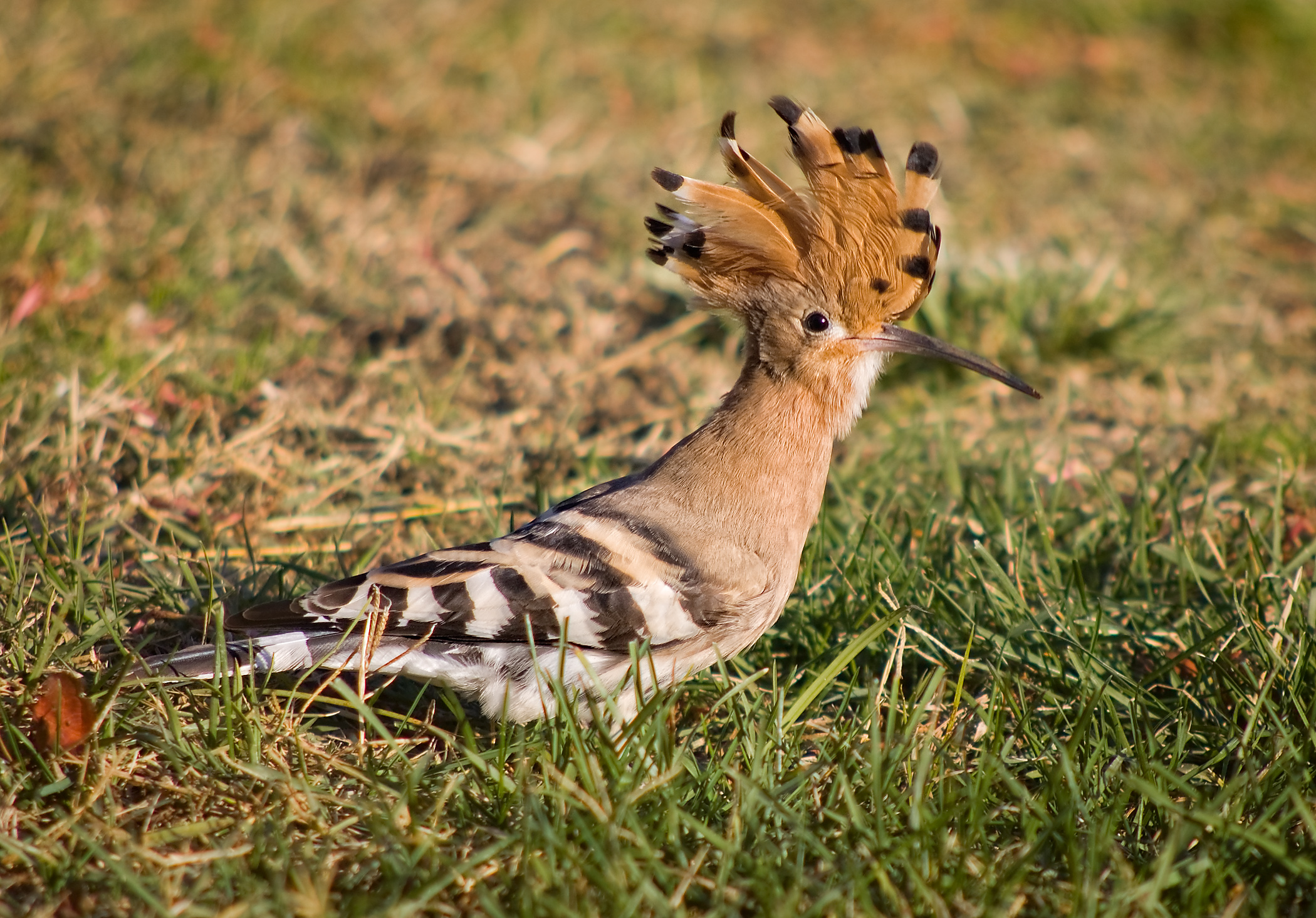
The Eurasian Hoopoe is a distinctive medium-sized bird noted for its striking crown of feathers, often fanned out like a crest, and its unique 'hoo-poo-poo' call. It is a highly recognizable species across its wide range, characterized by its pinkish-cinnamon plumage, black and white barred wings, and long, slender, decurved bill. Hoopoes are primarily insectivorous, foraging on the ground with a characteristic probing action.
Size & lifespan
- Length
- 25-32 cm
- Wingspan
- 44-48 cm
- Weight
- 46-89 g
- Lifespan
- Typically 5-10 years in the wild, with records up to 11 years.
- Diet
- Insectivore, primarily feeding on large insects and their larvae, as well as spiders, worms, and small vertebrates.
Physical characteristics
- Plumage
- Adults have a striking pinkish-cinnamon head, neck, and breast, fading to a paler belly. The wings are broadly barred with black and white, and the tail is black with a broad white band. The most prominent feature is the erectile crest of feathers, tipped with black, which can be raised and lowered.
- Beak shape
- Long (5-6 cm), slender, and strongly decurved (downward-curving) blackish bill, paler at the base of the lower mandible.
- Eye color
- Dark brown
- Leg color
- Greyish-black
- Distinguishing features
- The combination of the erectile crest, pinkish-cinnamon body, and bold black and white wing barring is unmistakable. Its undulating, butterfly-like flight pattern is also highly characteristic.
- Juvenile appearance
- Juveniles resemble adults but have duller plumage, a shorter crest, and a shorter, straighter bill. Their overall coloration is less vibrant, and the black markings may be less intense.
- Seasonal changes
- No significant seasonal plumage changes. The brightness of plumage may vary slightly due to wear and tear, becoming duller before the annual molt.
- Sexual dimorphism
- Males and females are generally similar in plumage, though males may be slightly brighter in coloration and have a slightly longer crest. Differences are subtle and not reliable for field identification.
How to identify
- 1
Crest
Look for the prominent, erectile crest of feathers on the head, tipped with black. It is often fanned out when the bird is excited or lands, but can be folded back, making the bird appear less distinctive.
- 2
Plumage Coloration
Observe the warm pinkish-cinnamon color of the head, neck, and breast, contrasting with the bold black and white barring on the wings and tail.
- 3
Bill Shape
Note the long, thin, and distinctly decurved (downward-curving) bill, which is used for probing.
- 4
Flight Pattern
Watch for its characteristic undulating, 'bouncy' flight, with rapid, rounded wingbeats, resembling a large butterfly or moth.
- 5
Foraging Behavior
Look for it walking on the ground, probing its bill into the soil with a head-bobbing motion.
- 6
Vocalization
Listen for its distinctive, resonant 'hoo-poo-poo' call, which is often the first indication of its presence.
Habitat & range
- Biomes
- Open woodlands, savannas, grasslands, orchards, vineyards, cultivated fields, parks, and gardens.
- Geographic range
- Widespread across Eurasia and North Africa. Breeding range extends from Western Europe and North Africa through Central Asia to Siberia and China. Non-breeding range includes sub-Saharan Africa and parts of Southern Asia.
- Elevation range
- Typically found from sea level up to 2,000 meters, occasionally higher in some mountainous regions.
- Preferred environments
- Prefers open, dry, or semi-arid areas with scattered trees, short grass, and bare ground for foraging. Requires cavities in trees, walls, or rock crevices for nesting.
Behavior
- Activity time
- Diurnal, most active during the day, especially in the morning and late afternoon.
- Feeding habits
- Forages primarily on the ground, walking with a distinctive bobbing head motion. It uses its long, decurved bill to probe into soil, leaf litter, and dung for insects and larvae. It may also glean insects from vegetation or catch them in flight. Larger prey is often beaten against the ground before consumption.
- Social behavior
- Generally solitary or found in pairs during the breeding season. Outside of breeding, they may form small, loose flocks during migration, but are not typically highly social.
- Flight pattern
- Distinctive undulating, 'bouncy' flight, often described as butterfly-like or moth-like, with rapid, rounded wingbeats followed by short glides. The broad, rounded wings with their black and white barring are very conspicuous in flight.
- Migration pattern
- Northern and eastern populations are migratory, moving to warmer climates in Africa and Southern Asia for the winter. Southern populations are largely resident or undertake short-distance movements. Migration occurs mainly at night.
- Territoriality
- Males establish and defend breeding territories through calls and displays. Both sexes participate in defending the nest site.
Song & calls
- Song
- The primary song is a distinctive, soft, far-carrying 'hoo-poo-poo' or 'oop-oop-oop' call, often repeated several times. The number of 'poo' notes can vary (e.g., 'hoo-poo-poo-poo'). It is a low-pitched, resonant sound.
- Call
- In addition to the song, they emit harsh, rasping 'churrr' or 'cherrr' calls, especially when alarmed or agitated. A soft 'whee-oo' may also be heard.
- When they vocalize
- Most vocal during the breeding season, particularly at dawn and dusk. Calls can be heard throughout the day, especially when foraging or interacting with mates/rivals.
Breeding & reproduction
- Breeding season
- Varies geographically, typically from March to August in temperate regions, and earlier in warmer climates.
- Nesting habits
- Nests in natural cavities in trees (often old woodpecker holes), rock crevices, walls, or artificial structures. No nest material is typically added, or only a sparse lining of grass, leaves, or feathers. The nest cavity can become very foul-smelling due to accumulated droppings and a defensive secretion from the female's uropygial gland.
- Clutch size
- Usually 4-8 eggs, but can range from 3 to 12.
- Egg description
- Eggs are oval, smooth, and typically dull greyish-white, pale blue, or olive-buff, often stained brown by the nest environment. They are unspotted.
- Incubation period
- 15-18 days, primarily by the female.
- Fledging period
- 26-32 days after hatching. Young leave the nest fully feathered and capable of flight.
- Parental care
- Female incubates and broods the young. Both parents feed the nestlings, bringing a variety of insects. The female continues to brood for the first week or so after hatching, while the male brings food. Later, both parents forage.
Where to find
Open Woodlands & Edges
Search in areas with scattered trees, clearings, and woodland edges, especially those with mature trees providing nesting cavities.
Agricultural Areas
Check orchards, vineyards, olive groves, and cultivated fields, particularly those with short vegetation and bare patches of soil.
Parks & Gardens
In urban and suburban areas, they can be found in large parks, gardens, and golf courses with suitable foraging and nesting opportunities.
Semi-arid & Dry Grasslands
In drier regions, look for them in open grasslands with sparse vegetation and access to water sources.
Field tips
- Listen for the Call. The 'hoo-poo-poo' call is very distinctive and often heard before the bird is seen. Learn to recognize it.
- Scan Open Ground. Hoopoes spend a lot of time foraging on the ground. Look for them walking and probing in short grass, bare soil, or leaf litter.
- Look for Movement. Their head-bobbing while walking and their undulating flight are good indicators. They can be quite tame in some areas.
- Check Tree Cavities. During the breeding season, observe old trees with holes or crevices, as these are preferred nesting sites.
- Patience and Observation. Hoopoes can be elusive despite their striking appearance. Sit quietly in suitable habitat and observe for their characteristic behaviors.
Quick facts
- Distinctive Feature:
- Erectile crest and 'hoo-poo-poo' call
- Diet:
- Mainly large insects and larvae
- Nesting:
- Cavity nester (trees, walls, rocks)
- Flight:
- Undulating, butterfly-like
- Conservation Status:
- Least Concern (IUCN Red List)
- Migration:
- Partial migrant, northern populations migrate south
Fun facts
- The Hoopoe is the national bird of Israel.
- The scientific name 'Upupa epops' is onomatopoeic, derived from its characteristic call.
- Female Hoopoes and their chicks produce a foul-smelling liquid from a gland near the tail (uropygial gland) as a defense mechanism against predators, giving the nest a strong, unpleasant odor.
- Hoopoes are one of the few bird species that have been observed to 'sunbathe' by spreading their wings and tail flat on the ground, often with their head tilted back.
- In ancient Egypt, the Hoopoe was considered sacred and depicted in hieroglyphs.
Scientific classification
- Kingdom
- Animalia
- Phylum
- Chordata
- Class
- Aves
- Order
- Bucerotiformes
- Family
- Upupidae
- Genus
- Upupa
- Species
- Upupa epops
Explore the Eurasian Hoopoe
Identify birds anywhere
Free on iOS, Android, and Web. Photo & sound identification, full species database, and your personal life list.