
How to identify the Eurasian Hoopoe
Upupa epops
Spotted a bird? Identify it instantly with the Birdby app
Open the appTo correctly identify the Eurasian Hoopoe (Upupa epops), check each of these features. Birds can be tricky: habit, habitat, and call often confirm a sighting that a single photo cannot.
Size at a glance
- Length
- 25-32 cm
- Wingspan
- 44-48 cm
- Weight
- 46-89 g
Physical features to check
- 1
Plumage
Overall feather coloration and pattern.
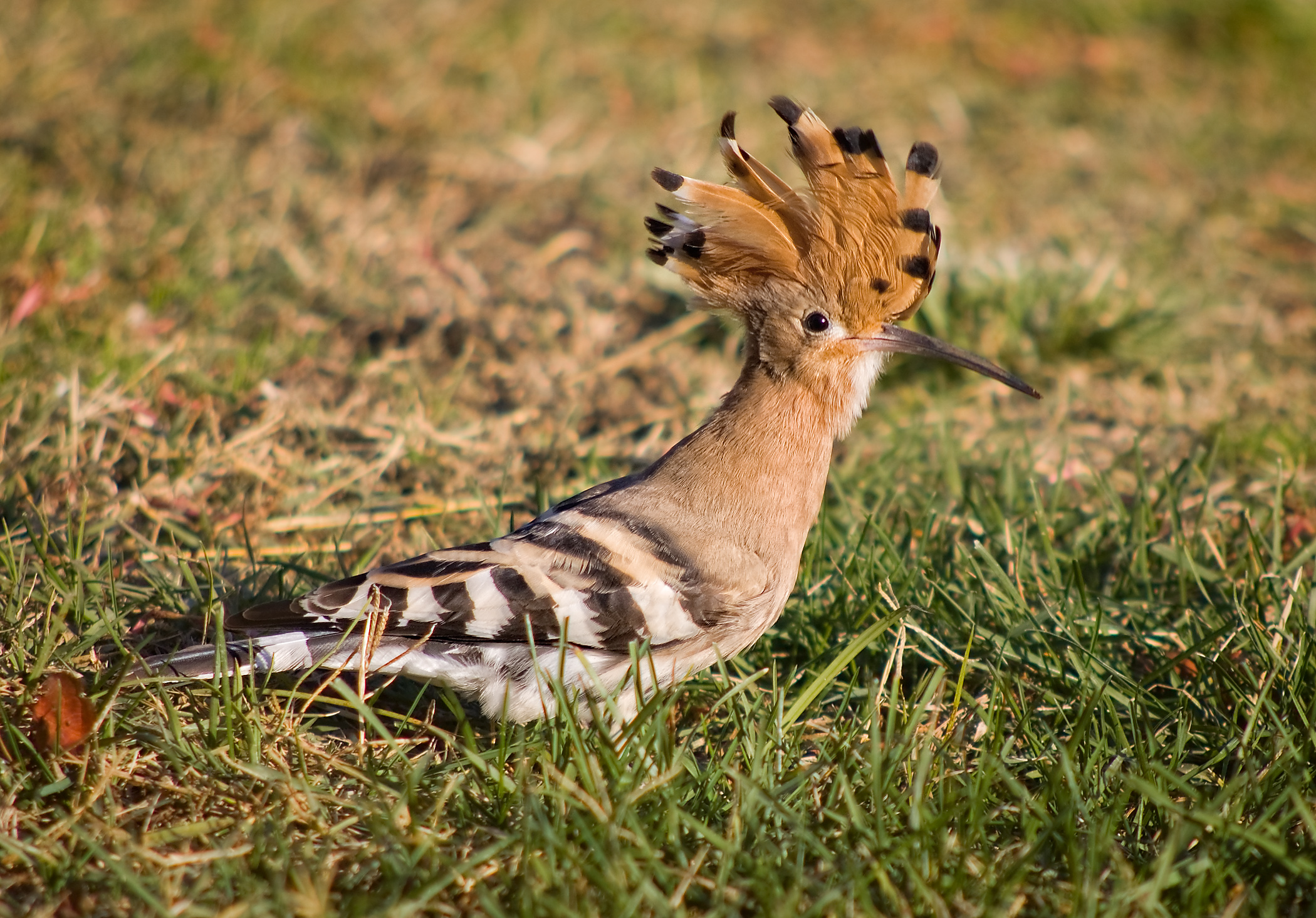
Adults have a striking pinkish-cinnamon head, neck, and breast, fading to a paler belly. The wings are broadly barred with black and white, and the tail is black with a broad white band. The most prominent feature is the erectile crest of feathers, tipped with black, which can be raised and lowered.
- 2
Beak shape
Shape and color of the bill: a key field mark.
Long (5-6 cm), slender, and strongly decurved (downward-curving) blackish bill, paler at the base of the lower mandible.
- 3
Eye color
Iris color and any distinctive eye markings.
Dark brown
- 4
Leg color
Leg and foot color.
Greyish-black
- 5
Distinguishing features
Standout features that separate this species.
The combination of the erectile crest, pinkish-cinnamon body, and bold black and white wing barring is unmistakable. Its undulating, butterfly-like flight pattern is also highly characteristic.
- 6
Juvenile appearance
How young birds differ from adults.
Juveniles resemble adults but have duller plumage, a shorter crest, and a shorter, straighter bill. Their overall coloration is less vibrant, and the black markings may be less intense.
- 7
Seasonal changes
Plumage variation between breeding and non-breeding seasons.
No significant seasonal plumage changes. The brightness of plumage may vary slightly due to wear and tear, becoming duller before the annual molt.
- 8
Sexual dimorphism
How males and females differ.
Males and females are generally similar in plumage, though males may be slightly brighter in coloration and have a slightly longer crest. Differences are subtle and not reliable for field identification.
Key field marks
- Crest. Look for the prominent, erectile crest of feathers on the head, tipped with black. It is often fanned out when the bird is excited or lands, but can be folded back, making the bird appear less distinctive.
- Plumage Coloration. Observe the warm pinkish-cinnamon color of the head, neck, and breast, contrasting with the bold black and white barring on the wings and tail.
- Bill Shape. Note the long, thin, and distinctly decurved (downward-curving) bill, which is used for probing.
- Flight Pattern. Watch for its characteristic undulating, 'bouncy' flight, with rapid, rounded wingbeats, resembling a large butterfly or moth.
- Foraging Behavior. Look for it walking on the ground, probing its bill into the soil with a head-bobbing motion.
- Vocalization. Listen for its distinctive, resonant 'hoo-poo-poo' call, which is often the first indication of its presence.
Explore the Eurasian Hoopoe
Identify birds anywhere
Free on iOS, Android, and Web. Photo & sound identification, full species database, and your personal life list.