
Spotted a bird? Identify it instantly with the Birdby app
Open the appAbout
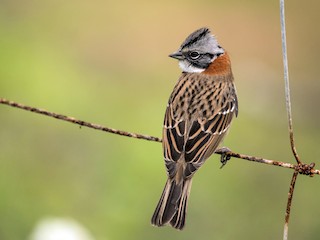
The Rufous-collared Sparrow is a widespread and common New World sparrow, known for its distinctive rufous collar and varied vocalizations. It is a familiar bird across much of Latin America, often found in open, disturbed habitats and urban areas.
Size & lifespan
- Length
- 13-16 cm
- Wingspan
- 20-24 cm
- Weight
- 18-28 g
- Lifespan
- 3-5 years in the wild, up to 8 years recorded
- Diet
- Omnivore (primarily granivorous and insectivorous)
Physical characteristics
- Plumage
- Adults have a gray head with black streaking on the crown and sides, a prominent white supercilium (eyebrow stripe), and a black malar stripe (mustache stripe). The most distinctive feature is the broad rufous (reddish-brown) collar on the nape and sides of the neck. The back and wings are streaked brown and black, with two white wing bars. Underparts are grayish-white, often with a faint buff wash on the flanks. The rump is plain brown.
- Beak shape
- Conical, relatively stout, and dark gray to blackish.
- Eye color
- Dark brown.
- Leg color
- Pinkish-gray to dark gray.
- Distinguishing features
- The rufous collar, gray head with black streaking, and white supercilium are key. The black malar stripe is also a good field mark. Two white wing bars are usually visible.
- Juvenile appearance
- Juveniles are heavily streaked brown and black over most of their body, including the head and underparts, lacking the distinct gray head and rufous collar of adults. The rufous collar begins to develop as they mature, usually appearing as a faint wash initially.
- Seasonal changes
- No significant seasonal plumage changes. Plumage may appear slightly duller when worn before molting.
- Sexual dimorphism
- Males and females are generally monomorphic in plumage, appearing identical. Males may be slightly larger on average, but this is not discernible in the field.
How to identify
- 1
Rufous Collar
Look for the prominent reddish-brown band on the nape and sides of the neck. This is the most distinctive field mark for adults.
- 2
Head Pattern
Note the gray head with fine black streaking on the crown, a clear white supercilium (eyebrow), and a black malar stripe (mustache stripe) extending from the base of the bill.
- 3
Back and Wings
Observe the streaked brown and black back and wings, usually with two noticeable white wing bars.
- 4
Underparts
The underparts are generally grayish-white, sometimes with a faint buff wash on the flanks.
- 5
Song
Listen for its characteristic, often melancholic, whistling song, which varies regionally but is typically a series of clear, sweet notes.
- 6
Behavior
Watch for its ground-foraging behavior, scratching with its feet, and its tendency to perch on low, exposed branches or wires when singing.
Habitat & range
- Biomes
- Forest edges, grasslands, shrublands, agricultural areas, urban and suburban gardens, parks.
- Geographic range
- Widespread throughout Latin America, from southern Mexico south through Central America, and across much of South America, including the Andes, Amazon basin edges, and southern cone countries. Absent from parts of the Amazon rainforest interior and some Caribbean islands.
- Elevation range
- Sea level up to 4,000 meters (13,000 feet) in the Andes, though typically more common at lower to mid-elevations.
- Preferred environments
- Prefers open or semi-open areas with scattered bushes, hedges, and grassy patches. Highly adaptable to human-modified landscapes, often found in gardens, parks, cultivated fields, and roadsides.
Behavior
- Activity time
- Diurnal, most active during early morning and late afternoon.
- Feeding habits
- Forages primarily on the ground, scratching with its feet to uncover seeds, insects, and small invertebrates. Also gleans insects from low vegetation. Diet includes a wide variety of grass seeds, weed seeds, berries, and arthropods such as beetles, ants, and caterpillars.
- Social behavior
- Usually seen singly or in pairs, especially during the breeding season. Outside of breeding, they may form small, loose flocks, sometimes associating with other sparrow species. Can be quite tame in urban environments.
- Flight pattern
- Typically short, undulating flights between perches or across open ground. When alarmed, it may fly into dense cover with a rapid, direct flight.
- Migration pattern
- Generally resident throughout its range, though some populations in the extreme south (e.g., Patagonia) may undertake short-distance altitudinal or partial migrations. High-altitude populations in the Andes may move to lower elevations during harsh winters.
- Territoriality
- Males are territorial during the breeding season, defending their nesting area with songs and displays. They can be aggressive towards other sparrows entering their territory.
Song & calls
- Song
- Highly variable across its vast range, but typically a series of clear, sweet, often melancholic whistles, sometimes described as 'tsee-tsee-tsee-tseee-tseee-tseee' or 'sweet-sweet-sweet-swee-swee-swee'. The song often starts with a few introductory notes followed by a trill or a series of descending or ascending whistles. Regional dialects are pronounced.
- Call
- Common calls include a sharp 'chip' or 'tsip' note, often given when alarmed or in contact with other sparrows. Also a softer 'seep' or 'tseet' call.
- When they vocalize
- Sings most frequently during the breeding season, from prominent perches. Calls are given year-round, especially when foraging or interacting.
Breeding & reproduction
- Breeding season
- Varies geographically, typically coinciding with rainy seasons or warmer months. In tropical regions, it can breed almost year-round. In temperate zones, usually spring and summer (e.g., September-March in southern South America, March-August in Central America).
- Nesting habits
- Nests are typically cup-shaped, built close to the ground in dense vegetation, shrubs, or low trees. They are constructed from grasses, twigs, rootlets, and lined with finer materials like hair or feathers. Both parents participate in nest building.
- Clutch size
- 2-5 eggs, most commonly 3-4.
- Egg description
- 2-5 eggs, typically pale blue or greenish-white, often speckled or blotched with reddish-brown or purplish markings, particularly at the larger end.
- Incubation period
- 11-14 days, primarily by the female.
- Fledging period
- 10-12 days after hatching, young leave the nest but are still fed by parents for some time.
- Parental care
- Both parents feed the nestlings and fledglings. The male often continues to feed the fledglings while the female may begin a second clutch.
Where to find
Urban and Suburban Areas
Common in gardens, parks, city squares, and residential areas with some vegetation.
Agricultural Lands
Frequently found in cultivated fields, pastures, and along hedgerows.
Open Woodlands and Forest Edges
Can be found in clearings, secondary growth, and the edges of more dense forest habitats.
Shrublands and Grasslands
Inhabits open grassy areas with scattered bushes and scrub.
Field tips
- Listen for the Song. Its distinctive song is often the first indication of its presence. Learn the local dialect of its song to aid identification.
- Check Low Perches. They often sing from exposed low perches such as fences, wires, or the tops of small bushes.
- Observe Ground Foraging. Look for them scratching on the ground under bushes or in open grassy patches, often in pairs or small groups.
- Be Patient in Gardens. In urban settings, they can be quite tame and will often visit bird feeders or forage openly in gardens.
Similar species
Stripe-headed Sparrow
Peucaea ruficauda
The Stripe-headed Sparrow has a more complex head pattern with multiple black and white stripes, and lacks the distinct rufous collar of the Rufous-collared Sparrow. Its overall coloration is also generally paler and more buffy.
Black-striped Sparrow
Arremonops conirostris
The Black-striped Sparrow has a plainer gray head with prominent black lateral crown stripes and a black eye-line, but lacks the rufous collar and the streaked back of the Rufous-collared Sparrow. Its underparts are whiter, and it has a more robust bill.
Chipping Sparrow
Spizella passerina
While not directly overlapping in most of their ranges, Chipping Sparrows (found in North and Central America) have a rufous crown and a white supercilium, but lack the rufous collar and black malar stripe of Zonotrichia capensis. Their overall body plumage is also less streaked.
Quick facts
- Global Population:
- Increasing
- Dietary Preference:
- Seeds and Insects
- Nesting Site:
- Low in shrubs or on the ground
- Vocalization:
- Variable, clear whistling song
- Adaptability:
- Highly adaptable to human-modified environments
Fun facts
- The Rufous-collared Sparrow has one of the widest distributions of any passerine bird in the Americas, spanning nearly the entire length of the continent.
- Its song exhibits significant regional variation, with distinct 'dialects' that can be recognized by local birdwatchers.
- In some cultures, its song is associated with specific meanings or omens due to its familiarity and presence near human settlements.
- Despite its common name, it is not closely related to Old World sparrows (family Passeridae) but is a true New World sparrow (family Passerellidae).
- It is often one of the first birds to colonize disturbed habitats, demonstrating its resilience and adaptability.
Scientific classification
- Kingdom
- Animalia
- Phylum
- Chordata
- Class
- Aves
- Order
- Passeriformes
- Family
- Passerellidae
- Genus
- Zonotrichia
- Species
- Zonotrichia capensis
Explore the Rufous-collared Sparrow
Identify birds anywhere
Free on iOS, Android, and Web. Photo & sound identification, full species database, and your personal life list.