
Vogel gesehen? Bestimme ihn sofort mit der Birdby-App
App öffnenÜber den Vogel
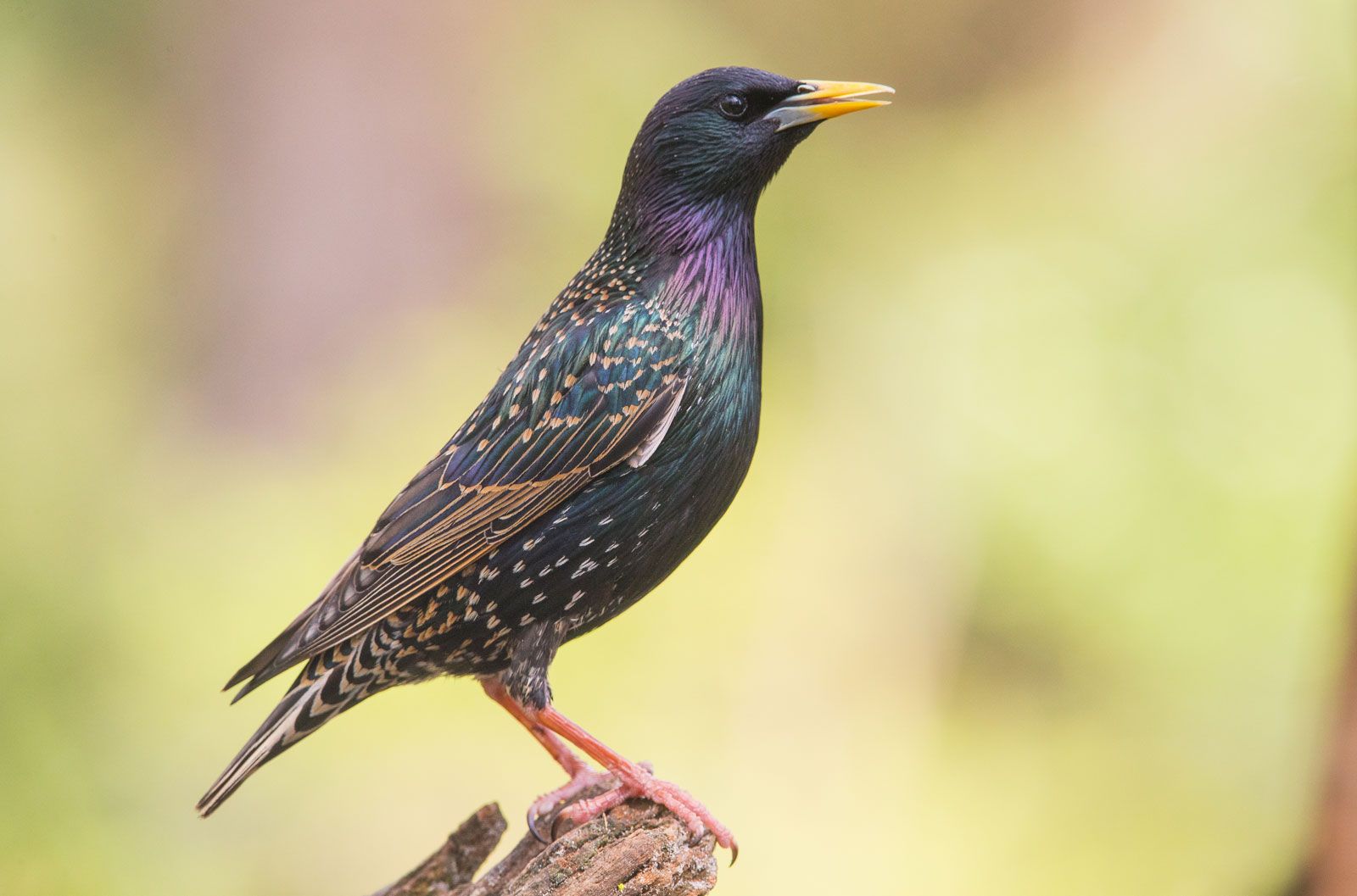
The Common Starling, often simply called Star, is a medium-sized passerine bird in the starling family Sturnidae. It is a highly social bird, forming large flocks, especially outside the breeding season. Known for its iridescent plumage and remarkable vocal mimicry, it is a widespread and adaptable species.
Größe und Lebensdauer
- Länge
- 19-22 cm
- Flügelspannweite
- 31-44 cm
- Gewicht
- 60-90 g
- Lebensdauer
- 2-3 years (up to 15 years in captivity)
- Nahrung
- Omnivore (primarily insects and invertebrates, also fruits, seeds, and human scraps)
Körperliche Merkmale
- Gefieder
- Adults in breeding plumage are glossy black with iridescent purple and green sheens, often appearing speckled with small white spots, especially on the flanks and belly. In non-breeding plumage, the white spots are much more prominent due to pale feather tips, giving a heavily speckled appearance. Juveniles are dull grey-brown overall, with a paler throat and streaked underparts.
- Schnabelform
- Conical and pointed. In breeding season, the bill is bright yellow with a bluish base in males and a pinkish base in females. Outside breeding season, the bill is dark brown to blackish.
- Augenfarbe
- Dark brown.
- Beinfarbe
- Reddish-brown to pinkish-brown.
- Erkennungsmerkmale
- Short tail, triangular wings in flight, distinctive waddling gait on the ground, and highly iridescent plumage. The speckled appearance in winter is a key identifier.
- Jugendkleid
- Uniformly dull grey-brown, lacking iridescence and speckling. They have a darker bill and legs than adults. They undergo a partial molt in late summer/early autumn to acquire first-winter plumage, which resembles adult non-breeding plumage but may retain some juvenile flight feathers.
- Saisonale Veränderungen
- The most significant change is the reduction of white speckling from winter to breeding plumage. This is achieved through wear of the pale feather tips, revealing the glossy black iridescent feathers underneath. The bill also changes from dark to bright yellow during the breeding season.
- Geschlechtsdimorphismus
- Subtle. Males typically have a bluer base to the bill during breeding season and slightly longer, less speckled flank feathers. Females have a pinkish base to the bill and are often more heavily speckled. Sexing is difficult without close examination.
Bestimmung
- 1
Plumage (Adult Breeding)
Look for glossy black plumage with iridescent purple and green sheens. Small white spots may be present but are less prominent than in winter. Bill is bright yellow.
- 2
Plumage (Adult Non-breeding/Winter)
Heavily speckled appearance due to white tips on feathers. The bill is dark brown/black.
- 3
Plumage (Juvenile)
Dull grey-brown overall, lacking iridescence and speckling. Dark bill and legs.
- 4
Shape and Size
Medium-sized, stocky bird with a short tail and pointed, triangular wings in flight. Distinctive waddling walk on the ground.
- 5
Vocalizations
Listen for a complex, chattering song with whistles, clicks, and often mimicry of other birds. Calls include harsh 'churrr' and sharp 'tsit'.
- 6
Behavior
Observe their highly social nature, especially the large, swirling flocks (murmurations) at dusk. They forage actively on the ground, probing with their bills.
Lebensraum und Verbreitung
- Biome
- Temperate forests, grasslands, urban areas, agricultural lands, coastal areas.
- Verbreitungsgebiet
- Native to Europe, Asia, and North Africa. Introduced to North America, Australia, New Zealand, and South Africa, where it is often considered an invasive species.
- Höhenverbreitung
- Sea level up to 2,500 meters, primarily found in lowlands and cultivated areas.
- Bevorzugte Lebensräume
- Highly adaptable, preferring open country with scattered trees, parks, gardens, farmland, and urban environments. Requires cavities for nesting, often found in buildings, tree holes, or nest boxes.
Verhalten
- Aktivitätszeit
- Diurnal.
- Fressgewohnheiten
- Forages primarily on the ground, probing with its bill for invertebrates such as beetles, caterpillars, worms, and snails. Also consumes fruits (cherries, berries), seeds, and nectar. In urban areas, it readily feeds on human food scraps. Often forages in flocks.
- Sozialverhalten
- Highly social, especially outside the breeding season, forming large, often enormous, flocks (murmurations) for roosting and foraging. During breeding, they are more territorial but still often nest in loose colonies.
- Flugmuster
- Strong, direct, and fast flight with rapid wingbeats. In large flocks (murmurations), they perform spectacular aerial displays, twisting and turning in unison.
- Zugverhalten
- Northern and eastern European populations are migratory, moving south and west for the winter. Western and southern European populations are largely resident. Migratory birds can travel thousands of kilometers.
- Territorialverhalten
- During the breeding season, males establish and defend small territories around their nest sites, primarily to attract females and protect the nest. Outside breeding, territoriality is minimal.
Gesang und Rufe
- Gesang
- Complex and varied, consisting of a mixture of whistles, clicks, rattles, chattering, and often remarkable mimicry of other bird species (e.g., curlews, lapwings, even human speech or mechanical sounds). Males sing from prominent perches to attract mates.
- Ruf
- A wide range of calls, including a harsh 'churrr', a sharp 'tsit', and various contact calls within flocks. Alarm calls are typically sharp and abrupt.
- Wann er ruft
- Most vocal during the breeding season (spring and early summer), with males singing frequently. Flocks are noisy year-round, especially at roosts.
Brutverhalten
- Brutzeit
- Typically March to July, with peak activity in April-May. Often raises two broods per year.
- Nistgewohnheiten
- Nests in cavities, such as tree holes, old woodpecker holes, crevices in buildings, under eaves, or in nest boxes. The nest is a messy cup of grass, leaves, twigs, and moss, lined with softer materials like feathers, wool, and sometimes flowers.
- Gelegegröße
- 4-6 eggs
- Eibeschreibung
- 4-6 (occasionally 3-8) eggs, pale blue or greenish-blue, unspotted, glossy.
- Brutdauer
- 11-15 days, primarily by the female, but both parents may participate.
- Nestlingsdauer
- 20-22 days. Young are fed by both parents.
- Elterliche Fürsorge
- Both parents feed and care for the young. After fledging, the young remain dependent on parents for a short period before joining juvenile flocks.
Wo zu finden
Urban and Suburban Areas
Parks, gardens, city centers, and residential areas with trees and buildings are prime locations, especially near food sources.
Agricultural Lands
Farmlands, pastures, and orchards provide abundant insect food and roosting sites.
Coastal Areas
Can be found in coastal towns and cliffs, especially during migration or winter.
Roosts
Look for large concentrations of Starlings at dusk, gathering in trees, reeds, or on buildings before settling into communal roosts.
Feldtipps
- Listen for their calls and songs. Their varied vocalizations, including mimicry, are often the first indication of their presence. They are quite noisy.
- Observe flocks. Outside the breeding season, Starlings are almost always found in flocks. Look for them foraging together on lawns or gathering in trees.
- Watch for murmurations. In late autumn and winter, look for spectacular murmurations (large swirling flocks) at dusk, especially near large roosting sites like reedbeds or urban structures.
- Check open ground. They frequently forage on open ground, probing for insects. Look for them on lawns, fields, and verges.
- Look for nesting sites. During breeding season, check tree cavities, holes in buildings, and nest boxes for activity.
Ähnliche Arten
Spotless Starling
Sturnus unicolor
The Spotless Starling is found in the Iberian Peninsula and North Africa. It is very similar to the Common Starling but lacks the white speckling in all plumages, appearing uniformly glossy black. Its song is also generally harsher and less varied.
Blackbird
Turdus merula
While superficially similar in color (male Blackbirds are all black), Blackbirds are larger, have a longer tail, a more upright posture, and a distinct orange-yellow bill and eye-ring (in males). Their flight is undulating, and their song is flutey and melodic, very different from the Starling's chattering and mimicry.
Common Grackle
Quiscalus quiscula
Found in North America, the Common Grackle is larger than the Starling, with a longer tail and a more slender body. Its iridescence is typically more purplish-blue, and its eyes are pale yellow. Its calls are harsh and unmusical, lacking the Starling's mimicry.
Kurzinfos
- Sociality:
- Highly social, forming large flocks (murmurations)
- Vocal Ability:
- Excellent mimic, incorporating sounds from other birds and environment
- Plumage Iridescence:
- Glossy black with purple and green sheens
- Dietary Flexibility:
- Omnivorous, adapting to available food sources
- Introduced Species:
- Considered invasive in many parts of the world (e.g., North America, Australia)
Wissenswertes
- A group of starlings is called a 'murmuration,' a term that perfectly describes their mesmerizing aerial displays.
- Starlings are one of the most successful invasive bird species globally, largely due to their adaptability and high reproductive rate.
- William Shakespeare is indirectly responsible for the introduction of Starlings to North America. An admirer of his work, Eugene Schieffelin, released 60 Starlings in New York's Central Park in 1890, hoping to introduce all birds mentioned in Shakespeare's plays to the continent.
- Their ability to mimic sounds is so advanced that individual Starlings have been recorded imitating human speech, car alarms, and even telephone rings.
- The iridescent colors of their plumage are not due to pigments but to the microscopic structure of their feathers, which scatters light, creating a shimmering effect.
Systematik
- Reich
- Animalia
- Stamm
- Chordata
- Klasse
- Aves
- Ordnung
- Passeriformes
- Familie
- Sturnidae
- Gattung
- Sturnus
- Art
- Sturnus vulgaris
Den Star entdecken
Vögel überall bestimmen
Kostenlos auf iOS, Android und Web. Foto- und Tonbestimmung, vollständige Artendatenbank und deine persönliche Liste.