
Nägid lindu? Tuvasta see kohe Birdby rakendusega
Ava rakendusKirjeldus
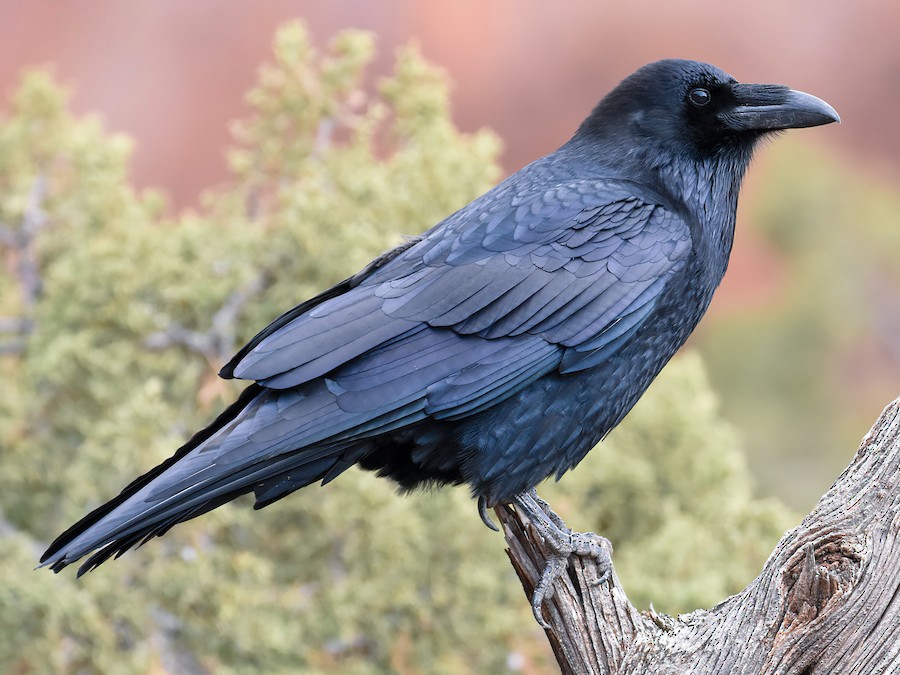
The Common Raven, or Korp, is a large, all-black passerine bird, renowned for its intelligence, adaptability, and complex vocalizations. It is one of the most widespread corvids globally, inhabiting a diverse range of environments.
Suurus ja eluiga
- Pikkus
- 54-67 cm
- Tiivasiruulatus
- 115-150 cm
- Kaal
- 689-1625 g (males typically larger than females)
- Eluiga
- 10-15 years in the wild, up to 40 years in captivity
- Toit
- Omnivore, highly opportunistic, consuming carrion, small mammals, birds, eggs, insects, grains, fruits, and human refuse.
Kehalised tunnused
- Sulestik
- Entirely glossy black, often with a purplish-blue or greenish sheen visible in good light, especially on the head, neck, and wings. The feathers on the throat (hackles) are shaggy and often appear ruffled.
- Noka kuju
- Large, heavy, and powerful, slightly decurved, and entirely black.
- Silmade värv
- Dark brown to black in adults; juveniles may have bluish-grey eyes that darken with age.
- Jalgade värv
- Black
- Eristavad tunnused
- Large size, shaggy throat feathers, wedge-shaped tail (distinctive in flight), and deep, resonant calls. Its flight is powerful and often includes soaring and acrobatic maneuvers.
- Noorlinnu välimus
- Similar to adults but with duller, less glossy black plumage and often with bluish-grey eyes. The throat hackles are less developed.
- Hooajalised muutused
- No significant seasonal plumage changes. Plumage may appear duller when worn or faded before molting.
- Sooline dimorfism
- Males are generally slightly larger and heavier than females, but plumage is identical.
Kuidas tuvastada
- 1
Size and Shape
Look for a very large, all-black bird. In flight, note the long, broad wings and the distinctive wedge-shaped tail. The head appears relatively small compared to the body.
- 2
Plumage
Entirely glossy black. In good light, a purplish or bluish sheen may be visible. The shaggy throat feathers (hackles) are a key identifier, especially when perched or calling.
- 3
Bill
Observe the large, heavy, and powerful black bill, which is slightly decurved.
- 4
Flight
Watch for powerful, deliberate wing beats, often interspersed with long glides and soaring. They are capable of impressive aerial maneuvers. The wedge-shaped tail is most evident during flight.
- 5
Vocalizations
Listen for the deep, resonant 'cronk' or 'kraa' calls. Their varied vocal repertoire is a strong indicator.
- 6
Behavior
Their intelligent and curious behavior, often seen investigating objects or interacting with other animals, can be a clue.
Elupaik ja levik
- Biokoosluskonnad
- Highly adaptable, found in a wide range of biomes including forests (coniferous, deciduous, mixed), mountains, deserts, tundra, coastal areas, grasslands, and increasingly in urban and suburban environments.
- Levila
- Holarctic distribution, found across the Northern Hemisphere. This includes North America, Europe, Asia, and North Africa. It is one of the most widespread naturally occurring birds.
- Kõrgusvahemik
- Sea level to over 6,000 meters in mountainous regions.
- Eelistatud keskkonnad
- Prefers areas with a mix of open country for foraging and tall structures (cliffs, large trees, human structures) for nesting and roosting. Often associated with human activity due to food availability.
Käitumine
- Aktiivsusaeg
- Diurnal, active from dawn to dusk.
- Toitumisharjumused
- Highly intelligent and opportunistic scavenger and predator. Uses problem-solving skills to access food. Often caches food. Feeds on carrion, small mammals (rodents, rabbits), birds, eggs, insects, amphibians, reptiles, fish, grains, berries, and human refuse. Known to cooperate in hunting and scavenging.
- Sotsiaalne käitumine
- Typically seen in pairs or small family groups, especially during the breeding season. Outside of breeding, they may form larger communal roosts, sometimes numbering in the hundreds. Highly social and intelligent, exhibiting complex communication and problem-solving.
- Lennustiil
- Powerful, direct flight with deep, deliberate wing beats. Often soars on thermals, sometimes at great heights. Capable of impressive aerial acrobatics, including rolls and dives, especially during courtship or play.
- Ränne
- Generally resident throughout its range, though some northern populations may undertake short-distance altitudinal or irruptive movements in response to harsh weather or food scarcity. Juveniles may disperse widely.
- Territoriaalsus
- Breeding pairs are highly territorial, defending their nesting and foraging areas vigorously. Non-breeding individuals may range more widely.
Laul ja hääled
- Laul
- Ravens do not have a true song in the typical passerine sense. Their vocalizations are highly varied and complex, often described as a 'language' rather than a song. They can mimic other birds and sounds.
- Hüüd
- Known for a deep, resonant 'kraa-kraa-kraa' or 'cronk-cronk' call. Also produces a wide array of other sounds including gurgles, croaks, clicks, whistles, bell-like tones, and mimicry. Calls vary depending on context (alarm, contact, territorial display).
- Millal hääletab
- Vocalizes throughout the day, particularly active during dawn and dusk, and when communicating with mates or rivals.
Pesitsus
- Pesitsusperiood
- Varies geographically, typically late winter to early spring (February-April) in temperate regions, earlier in warmer climates.
- Pesitsuskombed
- Nests are large, bulky structures made of sticks, branches, and twigs, lined with mud, hair, wool, grass, and other soft materials. Built on cliffs, in tall trees, on human-made structures (e.g., power pylons, bridges). Both sexes participate in nest building.
- Kurna suurus
- 3-7 eggs, most commonly 4-6.
- Muna kirjeldus
- Typically 3-7 eggs, pale bluish-green to olive-green, heavily marked with brown, olive, or purplish spots and blotches, especially at the larger end. Approximately 49 x 33 mm.
- Haudumisperiood
- 18-21 days, primarily by the female, fed by the male.
- Pesast lahkumise periood
- 35-49 days. Young remain dependent on parents for several weeks after fledging.
- Vanemlik hoolitsus
- Both parents care for the young. The female incubates, and the male brings food. After hatching, both parents feed the nestlings and continue to care for fledglings.
Kus leida
Mountainous Regions
Often found soaring along cliff faces and over valleys in mountainous terrain.
Coastal Areas
Common along coastlines, scavenging for food washed ashore.
Forests and Woodlands
Especially in areas with tall trees for nesting and roosting, adjacent to open foraging areas.
Deserts and Arid Lands
Adaptable to harsh environments, often found near water sources or human settlements.
Urban and Suburban Areas
Increasingly common in human-modified landscapes, utilizing refuse as a food source and tall buildings for nesting.
Välitööde nõuanded
- Listen for Calls. Their distinctive deep 'cronk' calls are often heard before the bird is seen. Learn to distinguish it from crow calls.
- Look Up. Ravens frequently soar at high altitudes or perch on prominent vantage points like power poles, tall trees, or cliff edges.
- Observe Scavenging Sites. Check around roadkill, landfills, or other areas where carrion might be present, as they are primary scavengers.
- Watch for Aerial Displays. During courtship or play, ravens perform impressive aerial acrobatics, which can be a good way to spot them.
- Early Morning/Late Evening. They are often most active and vocal during these times, especially when leaving or returning to communal roosts.
Sarnased liigid
Carrion Crow
Corvus corone
The Common Raven is significantly larger than the Carrion Crow. Key field marks include the Raven's wedge-shaped tail (Crow's tail is fan-shaped), shaggy throat feathers (Crow's throat is smooth), and heavier bill. In flight, Ravens often soar, while Crows typically flap more continuously. Raven calls are deeper and more resonant ('cronk') compared to the Crow's harsher 'caw'.
Rook
Corvus frugilegus
Rooks are slightly smaller than Ravens. Adults have a distinctive bare, whitish-grey patch of skin at the base of the bill, which Ravens lack. Rooks have a more pointed head shape and a less robust bill. Their calls are typically a higher-pitched 'kaah' or 'caw'. Rooks are also more gregarious, often seen in large flocks, especially outside the breeding season.
Chough
Pyrrhocorax pyrrhocorax
Choughs are smaller than Ravens and have a distinctive bright red, decurved bill and red legs. Their flight is more buoyant and acrobatic, often near cliffs. Their calls are high-pitched 'chee-ow' or 'chough' sounds, very different from a Raven's deep croaks.
Kiired faktid
- Intelligence:
- Among the most intelligent birds, capable of problem-solving, tool use, and mimicry.
- Social Structure:
- Monogamous pairs, but may form large communal roosts outside breeding season.
- Vocalization Range:
- Possess a vast repertoire of calls, estimated to be over 100 distinct vocalizations.
- Flight Style:
- Powerful fliers, often soaring and performing acrobatic displays.
- Dietary Flexibility:
- Highly opportunistic omnivores, adapting their diet to available resources.
Huvitavad faktid
- Ravens are known to play, engaging in activities like sliding down snowy roofs, dropping and catching objects in flight, and even playing with wolves and otters.
- They can mimic a wide range of sounds, including human speech, other bird calls, and even animal noises.
- Ravens have been observed using tools, such as dropping stones on eggs to break them or using sticks to probe for food.
- In many cultures, ravens hold significant symbolic meaning, often associated with wisdom, prophecy, or death.
- They are one of the few bird species known to cache food and remember its location for extended periods.
Teaduslik klassifikatsioon
- Riik
- Animalia
- Hõimkond
- Chordata
- Klass
- Aves
- Selts
- Passeriformes
- Sugukond
- Corvidae
- Perekond
- Corvus
- Liik
- Corvus corax
Uuri Korp lähemalt
Tuvasta linde igal pool
Tasuta iOS-is, Androidis ja veebis. Foto- ja häältuvastus, täielik liikide andmebaas ja sinu isiklik vaatluste loend.