
Nägid lindu? Tuvasta see kohe Birdby rakendusega
Ava rakendusKirjeldus
The Common Cuckoo is a medium-sized, brood-parasitic bird found across Eurasia and Africa. It is renowned for its distinctive two-note call and its unique reproductive strategy of laying eggs in the nests of other bird species.
Suurus ja eluiga
- Pikkus
- 32-34 cm
- Tiivasiruulatus
- 55-60 cm
- Kaal
- 105-130 g (male), 95-115 g (female)
- Eluiga
- 6-8 years (up to 12 years recorded)
- Toit
- Primarily insectivorous, specializing in large, hairy caterpillars that are avoided by most other birds. Also consumes other insects, larvae, and occasionally small invertebrates.
Kehalised tunnused
- Sulestik
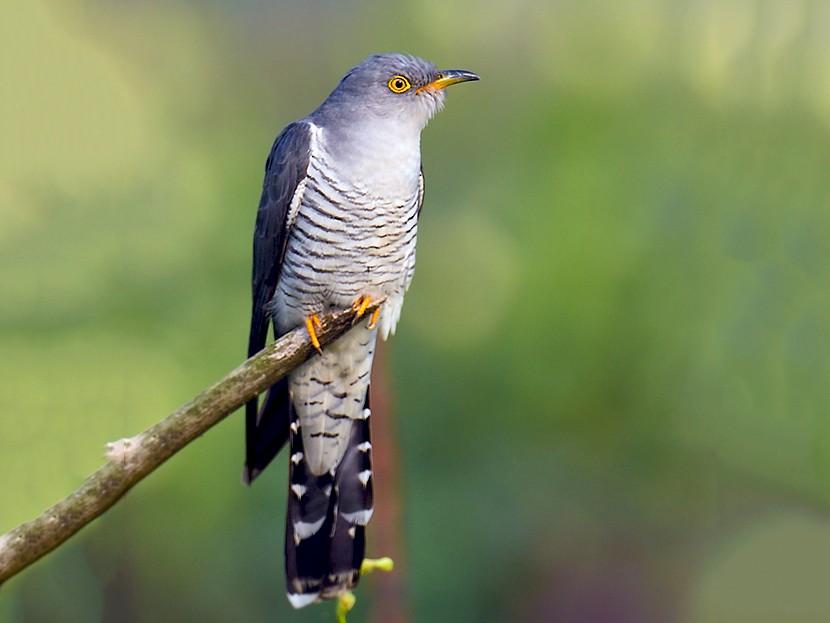
- Adult males typically have slate-grey upperparts, head, and chest, with white underparts barred with dark grey. The tail is dark grey with white spots and a white tip. Adult females can be similar to males (grey morph) or have a rufous-brown plumage with dark barring on the upperparts and head (hepatic morph).
- Noka kuju
- Relatively short, slightly down-curved, and stout bill; greyish-black with a yellowish base to the lower mandible.
- Silmade värv
- Bright yellow eye-ring and iris in adults; juveniles have a duller, brownish iris and eye-ring.
- Jalgade värv
- Short, yellowish-orange legs and feet.
- Eristavad tunnused
- Long, pointed wings, long tail, and a hawk-like silhouette in flight. The grey plumage and barred underparts are characteristic. Hepatic morph females are distinctive with their rufous coloration.
- Noorlinnu välimus
- Juveniles are heavily barred with dark brown on a rufous-brown or greyish-brown background, including the head and upperparts. They have a prominent white nape patch and a white throat, often with a pale yellow gape. The eye-ring is duller than adults.
- Hooajalised muutused
- No significant seasonal plumage changes in adults. Juveniles molt into adult plumage during their first winter.
- Sooline dimorfism
- Males are generally slightly larger and heavier than females. Females exhibit two distinct plumage morphs: grey (similar to male) and hepatic (rufous-brown with barring).
Kuidas tuvastada
- 1
Vocalization
The male's distinctive 'cu-coo' call is the most reliable and often the first sign of its presence. Listen for the bubbling trill of the female.
- 2
Flight Silhouette
Observe its hawk-like flight with long, pointed wings and a long tail. Note the lack of a raptor's hooked bill or broad wings.
- 3
Plumage (Adult Male)
Look for slate-grey upperparts, head, and chest, with white underparts barred with dark grey. Yellow eye-ring is a good field mark.
- 4
Plumage (Adult Female - Hepatic Morph)
Identify the rufous-brown upperparts and head, heavily barred with dark brown, and barred underparts. This morph is unmistakable.
- 5
Plumage (Juvenile)
Note the heavily barred rufous or grey-brown plumage, white nape patch, and duller eye-ring. Often seen being fed by much smaller host parents.
- 6
Behavior
Watch for its characteristic perching posture, often on an exposed branch, and its habit of flicking its tail. Observe if it's being mobbed by smaller birds, a common reaction to cuckoos.
Elupaik ja levik
- Biokoosluskonnad
- Forests, woodlands, scrublands, heathlands, grasslands, agricultural areas, and open country with scattered trees.
- Levila
- Breeds across most of Europe and Asia, from the Atlantic to the Pacific. Winters in sub-Saharan Africa and parts of southern Asia.
- Kõrgusvahemik
- Sea level up to 3,000 meters in some mountainous regions, though typically found at lower to mid-elevations.
- Eelistatud keskkonnad
- Requires a mosaic of open habitats for foraging and areas with suitable host species for breeding. Often found near edges of woodlands, clearings, and areas with dense vegetation.
Käitumine
- Aktiivsusaeg
- Diurnal, most active during daylight hours.
- Toitumisharjumused
- Forages by gleaning insects from foliage, branches, and the ground. Specializes in consuming hairy caterpillars, including those with urticating hairs, which are often regurgitated after the digestible parts are consumed. Also takes beetles, grasshoppers, and other invertebrates.
- Sotsiaalne käitumine
- Generally solitary outside of the breeding season. During the breeding season, males are territorial and call to attract females. Females are also solitary in their brood-parasitic activities.
- Lennustiil
- Strong, direct, and often hawk-like flight with rapid wing beats, interspersed with glides. Can appear similar to a small raptor, especially a Eurasian Sparrowhawk, due to its shape and flight style.
- Ränne
- Long-distance migratory species. European populations migrate south to sub-Saharan Africa, while Asian populations winter in southern Asia and Africa. Migration occurs primarily at night.
- Territoriaalsus
- Males establish and defend large breeding territories, primarily through vocalizations. Females do not defend territories but range widely to find suitable host nests.
Laul ja hääled
- Laul
- The iconic 'cu-coo' call, typically given by the male. It is a clear, resonant two-note call, often repeated multiple times. The pitch of the second note is slightly lower than the first. Can be heard from April to July.
- Hüüd
- Females have a bubbling, trilling call, often described as 'kwik-kwik-kwik' or 'whi-whi-whi', particularly when agitated or seeking a mate. Both sexes may give a harsh 'hark-hark-hark' alarm call.
- Millal hääletab
- Males call most frequently in the early morning and late evening, but can be heard throughout the day during the breeding season. Female calls are less frequent and often associated with breeding activity.
Pesitsus
- Pesitsusperiood
- April to July in temperate regions.
- Pesitsuskombed
- Obligate brood parasite. Does not build its own nest. Females lay their eggs individually in the nests of various host species, typically small passerines. Each female specializes in parasitizing a particular host species, mimicking the host's egg color and pattern.
- Kurna suurus
- One egg per host nest. A female cuckoo can lay 12-25 eggs in a breeding season.
- Muna kirjeldus
- Eggs are typically small, oval, and highly variable in color and pattern, mimicking the eggs of the specific host species. Common host eggs include those of Dunnocks, Reed Warblers, Meadow Pipits, and Pied Wagtails. A female cuckoo can lay up to 25 eggs in a season, each in a different host nest.
- Haudumisperiood
- Approximately 11-13 days, which is often shorter than that of its host species.
- Pesast lahkumise periood
- The cuckoo chick typically hatches before the host's eggs. Within hours or days of hatching, the cuckoo chick ejects the host's eggs or young from the nest. It then remains in the host nest for about 17-21 days, being fed exclusively by the host parents.
- Vanemlik hoolitsus
- No parental care from the biological parents. The cuckoo chick is entirely raised by its host parents.
Kus leida
Woodland Edges
Often found at the interface between woodlands and open areas, providing both cover and foraging opportunities.
Heathlands and Moorlands
Open, shrubby habitats are favored, especially where host species like Meadow Pipits are abundant.
Reedbeds
Areas with extensive reedbeds are important for host species like Reed Warblers, making them good places to find cuckoos.
Agricultural Landscapes
Can be found in cultivated areas with hedgerows, scattered trees, and patches of natural vegetation.
Välitööde nõuanded
- Listen for the Call. The male's 'cu-coo' call is the most effective way to locate this species, especially from April to July. Learn to distinguish it from other bird calls.
- Scan Open Perches. Cuckoos often perch conspicuously on exposed branches, wires, or posts, especially when calling. Use binoculars to scan such spots.
- Look for Mobbing Behavior. Smaller birds, particularly host species, will often mob cuckoos to drive them away from their nests. This commotion can draw attention to a cuckoo's presence.
- Observe Host Nests. During the breeding season, observing the behavior of potential host species (e.g., Dunnocks, Reed Warblers) around their nests might reveal a cuckoo's presence, particularly a female looking for a nest to parasitize.
- Early Morning/Late Evening. Males are most vocal during these times, increasing your chances of hearing and locating them.
Sarnased liigid
Eurasian Sparrowhawk
Accipiter nisus
The Common Cuckoo's flight can resemble a Sparrowhawk. However, cuckoos have longer, more pointed wings, a longer tail, and a less prominent head in flight. Sparrowhawks have broader, more rounded wings, a shorter tail, and a more robust build. Cuckoos also lack the hooked bill and strong talons of a raptor.
Great Spotted Cuckoo
Clamator glandarius
The Great Spotted Cuckoo is larger, has a crest, and is heavily spotted on the upperparts. Its distribution is primarily southern Europe, Africa, and parts of Asia, with limited overlap in breeding areas with the Common Cuckoo. Its host species are typically corvids.
Oriental Cuckoo
Cuculus optatus
Very similar in appearance to the Common Cuckoo, especially the grey morph. Distinguished by subtle differences in vocalization (a three-note call 'hoo-hoo-hoop' or 'hoo-hoo-hoo') and a slightly different tail pattern. Its breeding range is primarily eastern Asia.
Kiired faktid
- Brood Parasite:
- Lays eggs in other birds' nests.
- Diet Specialization:
- Eats hairy caterpillars.
- Migration:
- Long-distance migrant to Africa and Asia.
- Call:
- Iconic 'cu-coo' call of the male.
- Mimicry:
- Female cuckoos mimic host eggs.
Huvitavad faktid
- The word 'cuckoo' is onomatopoeic, derived directly from the male's distinctive call.
- A female cuckoo can lay up to 25 eggs in a single breeding season, each in a different host nest.
- The cuckoo chick, often just hours old, instinctively pushes the host's eggs or young out of the nest, ensuring it receives all the parental care.
- Some female cuckoos specialize in parasitizing a single host species, and their eggs have evolved to closely mimic the eggs of that specific host.
- Despite being raised by different species, young cuckoos somehow know to migrate to their ancestral wintering grounds and return to their species' breeding grounds.
Teaduslik klassifikatsioon
- Riik
- Animalia
- Hõimkond
- Chordata
- Klass
- Aves
- Selts
- Cuculiformes
- Sugukond
- Cuculidae
- Perekond
- Cuculus
- Liik
- Cuculus canorus
Uuri Common Cuckoo lähemalt
Tuvasta linde igal pool
Tasuta iOS-is, Androidis ja veebis. Foto- ja häältuvastus, täielik liikide andmebaas ja sinu isiklik vaatluste loend.