
Melihat burung? Identifikasi seketika dengan aplikasi Birdby
Buka aplikasiTentang
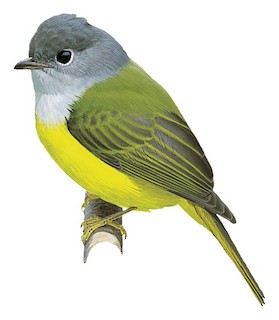
The Grey-headed Canary-flycatcher, locally known as Sikatan Kepala Merah, is a small, active passerine bird characterized by its distinctive grey head, bright yellow underparts, and olive-green back. It is a common resident breeder across a wide range of tropical Asia, typically found in forest and woodland habitats, where it actively forages for insects.
Ukuran dan masa hidup
- Panjang
- 10-12 cm
- Bentang sayap
- 15-18 cm
- Berat
- 5-8 g
- Masa hidup
- 3-5 years (estimated in the wild)
- Makanan
- Insectivore
Ciri fisik
- Bulu
- Adults have a distinctive grey head and nape, contrasting sharply with a bright yellow throat, breast, and belly. The back, wings, and tail are olive-green. The rump is also olive-green, often slightly brighter. The flight feathers are dusky with olive-green edgings. The undertail coverts are yellow.
- Bentuk paruh
- Small, flattened, and broad-based bill, typical of a flycatcher, adapted for catching insects in flight. The bill is blackish-brown, often paler at the base of the lower mandible.
- Warna mata
- Dark brown
- Warna kaki
- Dark grey to blackish
- Ciri pembeda
- The combination of a grey head, bright yellow underparts, and olive-green back is unique among small flycatchers in its range. It also has a small, often barely visible, white crescent or ring around the eye.
- Penampilan muda
- Juveniles are duller overall, with a less vibrant yellow on the underparts and a more brownish-grey head. The olive-green on the back may also be duller. They gradually acquire adult plumage.
- Perubahan musiman
- No significant seasonal plumage changes. Plumage remains consistent throughout the year, though it may appear slightly worn before molting.
- Dimorfisme seksual
- None significant; males and females are virtually identical in plumage.
Cara identifikasi
- 1
Head Color
Look for the distinct grey head and nape, which contrasts sharply with the rest of the body.
- 2
Underparts Color
Observe the bright, vibrant yellow on the throat, breast, and belly.
- 3
Back Color
Note the olive-green coloration on the back and wings.
- 4
Behavior
Watch for its active flycatching behavior, sallying out from a perch to catch insects in mid-air, often with a quick return to the same or a nearby perch.
- 5
Size and Shape
It is a very small, slender bird with a relatively short tail and a small, flattened bill.
- 6
Vocalization
Listen for its high-pitched, thin, and often rapid 'swee-swee-swee' song or sharp 'chip' calls.
Habitat dan persebaran
- Bioma
- Tropical and subtropical moist broadleaf forests, montane forests, secondary forests, woodlands, and well-wooded gardens.
- Persebaran geografis
- Widely distributed across tropical Asia, from the Himalayas (northern India, Nepal, Bhutan) through Southeast Asia (Myanmar, Thailand, Laos, Vietnam, Cambodia, Malaysia, Indonesia) to parts of southern China and the Philippines. It is also found in Sri Lanka.
- Rentang ketinggian
- Typically found from lowlands up to 2,000 meters (6,500 feet) above sea level, occasionally higher in some parts of its range.
- Lingkungan yang disukai
- Prefers the mid-canopy and understory of dense forests, often near streams or clearings. It is also found in bamboo thickets and forest edges.
Perilaku
- Waktu aktivitas
- Diurnal, most active during the morning and late afternoon.
- Kebiasaan makan
- Primarily insectivorous, feeding on small flying insects such as gnats, mosquitoes, small beetles, and flies. It is an active feeder, sallying out from a perch to catch insects in mid-air (flycatching) or gleaning them from foliage. It often hovers briefly while foraging.
- Perilaku sosial
- Usually seen singly or in pairs. During the non-breeding season, it may join mixed-species foraging flocks, particularly with other small insectivorous birds.
- Pola terbang
- Flight is typically short, erratic, and agile, especially when sallying for insects. It has a buoyant, undulating flight when moving between perches.
- Pola migrasi
- Mostly resident throughout its range, though some populations in the northern parts of its distribution (e.g., Himalayas) may undertake altitudinal movements, descending to lower elevations during winter. No long-distance migration is known.
- Teritorialitas
- Pairs are territorial during the breeding season, defending their nesting area. They can be quite vocal in defending their territory.
Kicauan dan suara
- Kicauan
- The song is a series of high-pitched, thin, and often rapid 'swee-swee-swee' or 'twee-twee-twee' notes, sometimes accelerating into a trill. It can be quite musical and distinctive, though often subtle.
- Panggilan
- Common calls include a sharp, high-pitched 'chip' or 'tsip', and a soft, plaintive 'swee-it' or 'twee-it'. Alarm calls are typically sharper and more insistent.
- Kapan bersuara
- Most vocal during the breeding season, but calls can be heard year-round, especially when foraging or interacting with other birds.
Reproduksi
- Musim kawin
- Varies geographically, but generally from March to July in most parts of its range, extending into August in some areas.
- Kebiasaan bersarang
- Builds a small, neat, cup-shaped nest, typically placed in a fork of a small tree or shrub, often covered with moss and lichen for camouflage. The nest is usually located at a height of 1-5 meters above the ground.
- Jumlah telur
- 2-4 eggs
- Deskripsi telur
- Typically 2-4 eggs, which are whitish or pale cream, often speckled or blotched with reddish-brown or purplish markings, particularly at the broader end.
- Masa inkubasi
- Approximately 12-14 days, primarily by the female.
- Masa terbang
- Chicks fledge around 12-15 days after hatching. Both parents feed the young.
- Perawatan orang tua
- Both male and female participate in nest building, incubation (though female does most), and feeding of the nestlings and fledglings.
Di mana ditemukan
Forests and Woodlands
Primary habitat, especially in the mid-canopy and understory of broadleaf and montane forests.
Forest Edges and Clearings
Often found at the edges of forests or near clearings where insect activity is high.
Well-wooded Gardens and Parks
Can be found in larger, mature gardens and parks with ample tree cover, particularly in suburban areas adjacent to natural habitats.
Near Streams and Rivers
Frequently observed near water bodies within forested areas, as these attract insects.
Tips lapangan
- Look for movement. These are very active birds. Scan the mid-canopy and understory for quick, darting movements as they sally for insects.
- Listen for calls. Their high-pitched calls and songs are often the first indication of their presence. Learn to recognize their distinctive 'swee-swee-swee' song.
- Check mixed-species flocks. During the non-breeding season, they often join mixed-species foraging flocks. Look for them among other small insectivores.
- Patience and binoculars. Due to their small size and active nature, patience and good binoculars are essential for a clear view.
- Focus on specific habitat layers. Concentrate your search in the mid-canopy and lower branches of trees and shrubs, rather than the very top canopy or ground.
Spesies serupa
Yellow-bellied Fantail
Chelidorhynx hypoxantha
The Yellow-bellied Fantail is smaller, has a longer tail that is often fanned, and a prominent yellow supercilium (eyebrow) which the Grey-headed Canary-flycatcher lacks. Its head is also more olive-yellow, not distinctly grey.
Small Niltava
Niltava macgrigoriae
Small Niltavas are generally larger, have a more robust build, and males are distinctly blue and orange. Females are brownish with a blue rump and tail, lacking the bright yellow underparts and grey head of the Grey-headed Canary-flycatcher.
Pygmy Blue Flycatcher
Ficedula hodgsoni
The Pygmy Blue Flycatcher is also small but has a more upright posture. Males are blue and white, while females are brownish with a rufous tail and lack the grey head and bright yellow underparts.
Fakta singkat
- Size:
- Very small (10-12 cm)
- Coloration:
- Grey head, yellow underparts, olive-green back
- Diet:
- Insects (flycatcher)
- Habitat:
- Forests, woodlands, gardens
- Status:
- Least Concern
- Behavior:
- Active, sallying flycatcher
- Vocalization:
- High-pitched 'swee-swee-swee' song
Fakta menarik
- Despite its common name 'Canary-flycatcher', it is not closely related to true canaries (family Fringillidae) nor true flycatchers (family Muscicapidae). It belongs to the family Stenostiridae, sometimes called 'fairy-flycatchers' or 'stenostirid-flycatchers'.
- Its active foraging style, constantly darting out to catch insects, makes it a challenging but rewarding bird to observe for birdwatchers.
- The species name 'ceylonensis' refers to Ceylon (now Sri Lanka), where the type specimen was originally collected, highlighting its presence in the Indian subcontinent.
- Its small size and bright coloration make it a 'jewel' of the forest understory, often overlooked due to its quick movements.
Klasifikasi ilmiah
- Kerajaan
- Animalia
- Filum
- Chordata
- Kelas
- Aves
- Ordo
- Passeriformes
- Famili
- Stenostiridae
- Genus
- Culicicapa
- Spesies
- Culicicapa ceylonensis
Jelajahi Grey-headed Canary-flycatcher
Identifikasi burung di mana saja
Gratis di iOS, Android, dan Web. Identifikasi foto & suara, database spesies lengkap, dan daftar pribadi Anda.