
Melihat burung? Identifikasi seketika dengan aplikasi Birdby
Buka aplikasiTentang
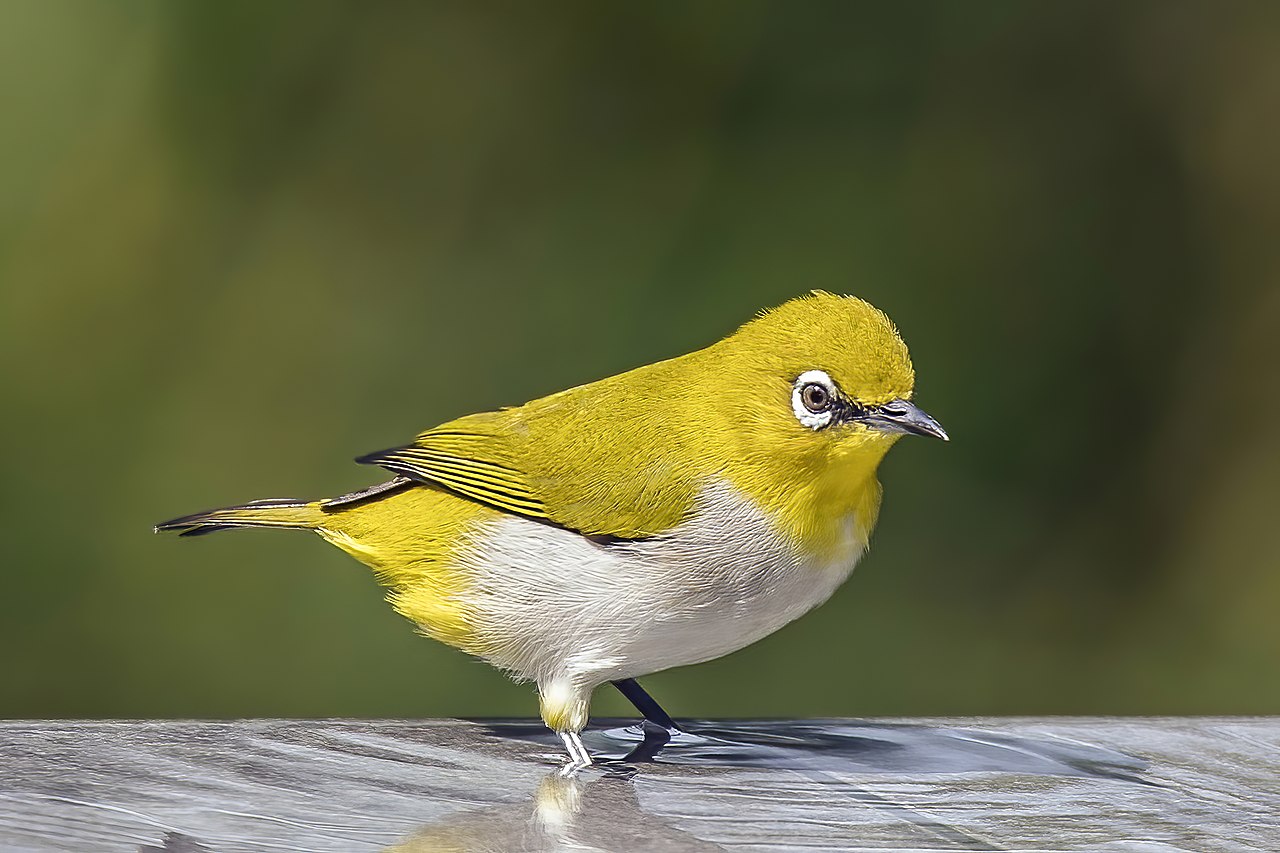
The Oriental White-eye, commonly known as 'Burung Pleci' in Indonesia, is a small passerine bird characterized by its distinctive white eye-ring. It is a highly active and vocal species, often found in small flocks foraging in trees and shrubs. Known for its melodious song, it is a popular cage bird in some regions, though this practice raises conservation concerns.
Ukuran dan masa hidup
- Panjang
- 8-11 cm
- Bentang sayap
- 13-16 cm
- Berat
- 6-12 g
- Masa hidup
- 3-5 years in the wild, up to 10 years in captivity
- Makanan
- Omnivore (primarily insectivorous and nectivorous)
Ciri fisik
- Bulu
- Upperparts are bright olive-green, underparts are yellowish-white to greyish-white, often with a bright yellow throat and vent. The flanks can be greyish. The most prominent feature is the conspicuous white eye-ring, which is complete and encircles the eye.
- Bentuk paruh
- Small, slender, slightly decurved, and pointed beak, typically dark grey or blackish.
- Warna mata
- Dark brown.
- Warna kaki
- Dark grey to blackish.
- Ciri pembeda
- The prominent white eye-ring is the definitive field mark. Its small size, active foraging behavior, and olive-green upperparts also aid identification.
- Penampilan muda
- Juveniles resemble adults but may have a slightly duller plumage, and their white eye-ring might be less distinct or slightly incomplete initially.
- Perubahan musiman
- No significant seasonal plumage changes. Plumage remains consistent throughout the year.
- Dimorfisme seksual
- Males and females are monomorphic in plumage, appearing identical. Sexing typically requires behavioral observation during breeding or genetic testing.
Cara identifikasi
- 1
White Eye-ring
The most crucial field mark. Look for a complete, distinct ring of white feathers around the eye. This is present in all ages and sexes.
- 2
Plumage Coloration
Observe the bright olive-green upperparts and the yellowish-white to greyish-white underparts, often with a bright yellow throat and vent. The contrast between the green back and lighter belly is key.
- 3
Size and Shape
Note its very small size (sparrow-sized or smaller), slender build, and short tail. It has a delicate, pointed beak.
- 4
Behavior
Watch for its active, acrobatic foraging style, constantly moving through foliage. It often hangs upside down or probes flowers. They are usually seen in flocks outside the breeding season.
- 5
Vocalizations
Listen for its characteristic sweet, warbling song and high-pitched 'tsee-tsee' contact calls. These are often the first indication of its presence.
Habitat dan persebaran
- Bioma
- Forests, woodlands, scrublands, mangroves, gardens, plantations, and urban parks.
- Persebaran geografis
- Widely distributed across the Indian subcontinent, Southeast Asia, and parts of East Asia. Its range extends from India, Nepal, and Sri Lanka eastward through Myanmar, Thailand, Malaysia, Singapore, Indonesia (Sumatra, Java, Borneo, Sulawesi, Lesser Sundas), and the Philippines, reaching southern China and Taiwan.
- Rentang ketinggian
- Sea level up to 2,000 meters, occasionally higher in some parts of its range.
- Lingkungan yang disukai
- Prefers open woodlands, forest edges, secondary growth, orchards, and cultivated areas with scattered trees and shrubs. It is highly adaptable and thrives in human-modified landscapes.
Perilaku
- Waktu aktivitas
- Diurnal, most active during the morning and late afternoon.
- Kebiasaan makan
- Forages actively in the canopy and undergrowth, gleaning insects and spiders from leaves and branches. It also feeds extensively on nectar from various flowers, fruits, and berries. Often seen probing flowers with its brush-tipped tongue. They move quickly and acrobatically through foliage.
- Perilaku sosial
- Highly social, usually found in small to large flocks (5-30 individuals or more) outside the breeding season. These flocks often join mixed-species foraging parties. During the breeding season, they become more territorial and are seen in pairs.
- Pola terbang
- Flight is typically short, undulating, and direct between trees or shrubs. They are agile fliers within dense vegetation.
- Pola migrasi
- Generally resident throughout its range, though some localized altitudinal movements or short-distance dispersal may occur, particularly in mountainous regions or in response to food availability.
- Teritorialitas
- Pairs establish and defend small breeding territories during the nesting season. Outside of breeding, they are less territorial and forage communally.
Kicauan dan suara
- Kicauan
- The song is a characteristic, sweet, high-pitched, and melodious warble, often described as a series of clear, liquid trills and whistles. It can be quite varied and prolonged, especially during the breeding season. Often includes mimicry of other bird calls.
- Panggilan
- Common calls include a soft, high-pitched 'tsee-tsee-tsee' or 'cheep-cheep' contact call, used to maintain flock cohesion. Also emits a sharper 'chip' or 'zit' alarm call.
- Kapan bersuara
- Vocalizes frequently throughout the day, especially in the morning and late afternoon. Songs are most prominent during the breeding season.
Reproduksi
- Musim kawin
- Varies geographically, typically during the warmer months or rainy season. In India, March-September; in Southeast Asia, often April-August.
- Kebiasaan bersarang
- Nests are small, neat, cup-shaped structures made of fine grass, moss, spider silk, and plant fibers, suspended from a fork in a small branch or twig, usually 1-3 meters above the ground in a bush or small tree. Both parents participate in nest building.
- Jumlah telur
- 2-4 eggs.
- Deskripsi telur
- Typically 2-4 eggs, pale blue or bluish-white, unspotted. Approximately 15 x 11 mm.
- Masa inkubasi
- 10-12 days, primarily by the female, though the male may assist.
- Masa terbang
- 10-12 days after hatching. Young are altricial and cared for by both parents.
- Perawatan orang tua
- Both parents share duties of incubation (to a lesser extent for the male), brooding, and feeding the nestlings and fledglings.
Di mana ditemukan
Gardens and Parks
Common in urban and suburban green spaces with trees and flowering shrubs.
Orchards and Plantations
Frequently found in fruit orchards, coffee plantations, and other agricultural areas with suitable vegetation.
Forest Edges and Secondary Growth
Look along the margins of forests, in regenerating clearings, and in areas with dense scrub.
Mangroves
Certain subspecies or populations can be found in mangrove habitats, particularly in coastal regions.
Tips lapangan
- Look for movement in foliage. These birds are constantly on the move, flitting between branches. Scan the canopy and mid-story for small, active birds.
- Listen for calls and songs. Their distinctive 'tsee-tsee' calls and melodious warbling song are often easier to detect than seeing the bird itself, especially in dense vegetation.
- Visit flowering trees and shrubs. They are attracted to nectar, so check flowering plants, especially those with small, tubular flowers.
- Observe mixed-species flocks. Outside the breeding season, they often join other small passerines in foraging flocks. If you find one flock, look for white-eyes among them.
- Use binoculars. Their small size and active nature make binoculars essential for observing their key features, especially the eye-ring.
Spesies serupa
Swinhoe's White-eye
Zosterops simplex
Historically considered a subspecies of Oriental White-eye, Z. simplex (often referred to as Japanese White-eye in some contexts, though that name is more accurately Z. japonicus) is now recognized as a distinct species. Z. simplex generally has brighter yellow underparts, especially on the belly, and often a more extensive yellow wash on the flanks compared to the Oriental White-eye's typically whiter or greyish-white belly and flanks. Vocalizations also differ. Field identification can be challenging where ranges overlap.
Everett's White-eye
Zosterops everetti
Found in the Philippines and parts of Borneo. It is generally darker olive-green above and has a more prominent yellow vent. The white eye-ring is also present but can sometimes appear narrower or less stark than in Z. palpebrosus. Its song and calls also differ.
Lemon-bellied White-eye
Zosterops chloris
Found in eastern Indonesia. It is generally larger and has a more extensive yellow wash on the underparts, often extending to the belly, and a broader yellow band on the forehead. The white eye-ring is also present but the overall coloration is more intensely yellow.
Fakta singkat
- Distinguishing Mark:
- Prominent white eye-ring
- Diet:
- Insects, nectar, fruits
- Sociality:
- Highly social, forms flocks
- Vocalization:
- Melodious warbling song, 'tsee-tsee' calls
- Habitat:
- Forests, gardens, scrub, urban areas
Fakta menarik
- The genus name 'Zosterops' comes from Ancient Greek, meaning 'girdle-eye', referring to the distinctive white eye-ring.
- In Indonesia, 'Burung Pleci' is a highly popular cage bird, valued for its singing ability, leading to significant trapping pressure in some areas.
- They play an important ecological role as pollinators due to their nectar-feeding habits and as insect controllers.
- Despite their small size, they are very agile and can hang upside down to access nectar or insects.
- The taxonomy of white-eyes (Zosteropidae) is complex and has undergone significant revisions, with many former subspecies now recognized as distinct species.
Klasifikasi ilmiah
- Kerajaan
- Animalia
- Filum
- Chordata
- Kelas
- Aves
- Ordo
- Passeriformes
- Famili
- Zosteropidae
- Genus
- Zosterops
- Spesies
- Zosterops palpebrosus
Jelajahi Oriental White-eye
Identifikasi burung di mana saja
Gratis di iOS, Android, dan Web. Identifikasi foto & suara, database spesies lengkap, dan daftar pribadi Anda.