
Visto un uccello? Identificalo all'istante con l'app Birdby
Apri l'appInformazioni
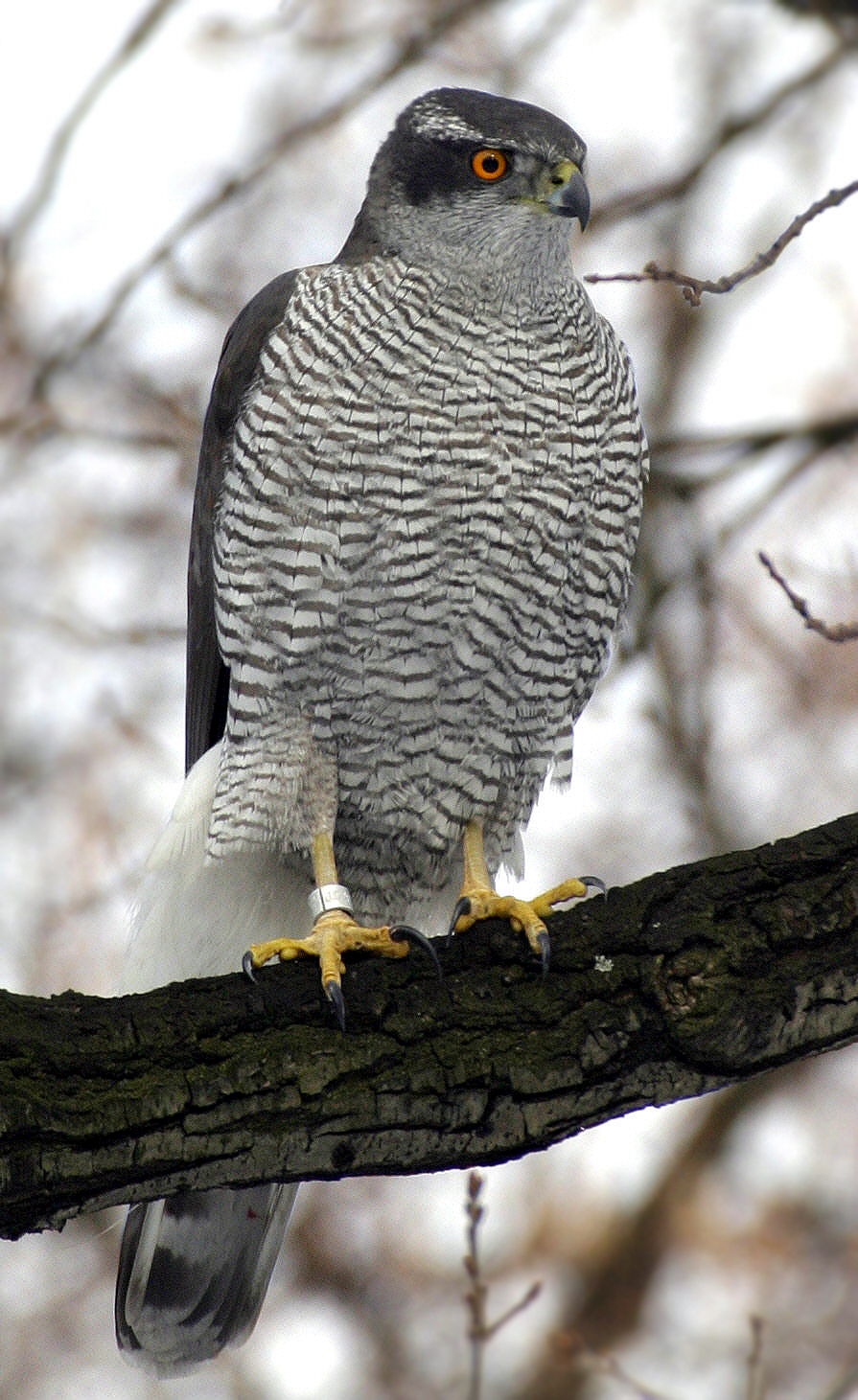
The Northern Goshawk is a powerful, medium-large raptor known for its fierce hunting prowess and agile flight through dense forests. It is a highly territorial and secretive bird of prey, often difficult to observe due to its preference for mature woodlands.
Dimensioni e longevità
- Lunghezza
- 46-63 cm (18-25 in)
- Apertura alare
- 89-122 cm (35-48 in)
- Peso
- Males: 500-1100 g (1.1-2.4 lbs), Females: 800-1600 g (1.8-3.5 lbs)
- Longevità
- Typically 10-12 years in the wild, up to 20 years recorded
- Dieta
- Carnivore (primarily birds and mammals)
Caratteristiche fisiche
- Piumaggio
- Adults have dark slate-grey to brownish-grey upperparts, with finely barred white underparts. The barring is typically dense and wavy. They have a prominent white supercilium (eyebrow stripe) that extends behind the eye, and a dark cap. Juveniles are brown above with streaked underparts, often with a buffy wash.
- Forma del becco
- Strong, hooked beak, dark grey to black with a yellow cere.
- Colore degli occhi
- Adults have bright orange to deep red eyes, becoming more intense with age. Juveniles have yellow eyes.
- Colore delle zampe
- Yellow
- Caratteristiche distintive
- Broad, rounded wings and a relatively long tail, often appearing square-tipped or slightly notched. The flight profile shows a distinctive 'S' curve to the trailing edge of the wing. Powerful build and fierce expression.
- Aspetto giovanile
- Juveniles are distinctly different from adults. They have brown upperparts with buffy feather edgings, and creamy-white underparts heavily streaked with dark brown. Their eyes are yellow, gradually changing to orange/red over 2-3 years.
- Cambiamenti stagionali
- No significant seasonal plumage changes. Plumage becomes more worn and faded towards the end of the breeding season before molting.
- Dimorfismo sessuale
- Females are significantly larger and heavier than males (reverse sexual dimorphism), often by 25-50% in weight and 10-15% in length and wingspan. Plumage is similar, though females may appear slightly browner on the back.
Come identificare
- 1
Size and Build
Look for a large, powerful accipiter. Females are notably larger than males. Its robust build and broad wings are key.
- 2
Plumage (Adult)
Dark grey back, finely barred white underparts, and a striking white supercilium. Red eyes are a strong indicator in adults.
- 3
Plumage (Juvenile)
Brown back, heavily streaked brown on buffy-white underparts, and yellow eyes. The streaking is coarser than in juvenile sparrowhawks.
- 4
Tail Shape
Relatively long tail, often appearing square-tipped or slightly notched at the end, unlike the rounded tail of Cooper's Hawk.
- 5
Flight Style
Powerful, direct flight with rapid wing beats and glides. Agile maneuvering through dense forest. When soaring, wings are held flat or slightly bowed.
- 6
Vocalization
Listen for the characteristic rapid 'kek-kek-kek' call, especially near nesting sites.
Habitat e areale
- Biomi
- Temperate and boreal forests, taiga, mixed woodlands, deciduous and coniferous forests.
- Areale geografico
- Holarctic distribution, found across North America, Europe, and Asia. In Europe, it is widespread from Scandinavia south to the Mediterranean, and east across Russia. In North America, it ranges from Alaska and Canada south through the western mountains to Mexico, and in the northeastern US.
- Fascia altitudinale
- Sea level up to 3,000 meters (10,000 ft), depending on local forest availability.
- Ambienti preferiti
- Mature or old-growth forests with a mix of dense canopy and open understory, often near clearings or forest edges for hunting. Requires large, undisturbed tracts of forest for breeding.
Comportamento
- Periodo di attività
- Diurnal, most active during daylight hours, particularly morning and late afternoon.
- Abitudini alimentari
- A powerful and opportunistic predator. Hunts primarily birds (e.g., pigeons, jays, grouse, pheasants, woodpeckers) and mammals (e.g., squirrels, rabbits, hares, voles). Hunts by surprise attack, often flying low and fast through dense cover, or from a perch. Known for its aggressive pursuit of prey.
- Comportamento sociale
- Generally solitary outside the breeding season. Monogamous pairs form during breeding. Highly territorial, especially around the nest site, and will aggressively defend against intruders, including humans.
- Tipo di volo
- Powerful and agile flight, characterized by rapid wing beats interspersed with glides. Can fly at high speed through dense forest, maneuvering expertly around obstacles. Soars on thermals during migration or display flights, but typically flies low when hunting.
- Migrazione
- Northern populations are migratory, moving south for the winter. Southern populations are largely resident. Juveniles tend to disperse more widely than adults. Migration is often irruptive in response to prey availability.
- Territorialità
- Highly territorial, especially during the breeding season. Pairs defend a large breeding territory, often several square kilometers, with aggressive displays and vocalizations.
Canto e richiami
- Canto
- Not a true songbird. Vocalizations are primarily calls.
- Richiamo
- The most common call is a rapid, chattering 'kek-kek-kek-kek' or 'gik-gik-gik-gik', often given when agitated or defending the nest. Also a harsh 'kyak' or 'skyaaa' call. During courtship, a softer 'coo-woo' may be heard.
- Quando vocalizza
- Most vocal during the breeding season, particularly when defending the nest or during courtship. Less vocal outside of breeding.
Riproduzione
- Stagione riproduttiva
- March to June, with egg-laying typically in April-May.
- Abitudini di nidificazione
- Builds a large stick nest, often 60-150 cm (2-5 ft) in diameter, high in a tall tree (conifer or deciduous) in a dense forest stand. Nests are typically reused for many years, with new material added annually. Both sexes participate in nest building.
- Dimensione della covata
- 2-4 eggs
- Descrizione dell'uovo
- 2-4 (occasionally 1-5) eggs, dull white or pale bluish-white, sometimes faintly marked with brown. Roughly oval, about 58 x 45 mm.
- Periodo di incubazione
- 35-42 days, primarily by the female, while the male provides food.
- Periodo di involo
- 35-42 days after hatching. Young remain dependent on parents for several weeks after fledging.
- Cure parentali
- Both parents care for the young. The female incubates and broods, while the male hunts and brings food to the nest. After hatching, both parents feed the chicks.
Dove trovarlo
Mature Forests
Focus on large tracts of mature coniferous, deciduous, or mixed forests, particularly those with old-growth characteristics.
Forest Edges/Clearings
While they nest deep in forests, they often hunt along forest edges, clearings, or near open areas adjacent to woodlands.
Mountainous Regions
In some areas, they prefer mountainous forests, especially during the breeding season.
Consigli sul campo
- Stealth and Patience. Goshawks are very secretive. Move slowly and quietly through suitable habitat. Patience is key, as they can be elusive.
- Listen for Calls. During the breeding season (spring/early summer), listen for their distinctive 'kek-kek-kek' calls, which can indicate a nearby nest.
- Look for Signs. Look for signs of raptor activity, such as plucking posts (where they pluck feathers from prey) or whitewash (droppings) under potential perches or nest trees.
- Scan the Canopy. Scan the upper canopy of tall trees for perched birds, especially in the early morning or late afternoon.
- Respect Nesting Areas. If you suspect a nest, maintain a respectful distance to avoid disturbing these sensitive birds. They can be very aggressive in defense of their young.
Specie simili
Eurasian Sparrowhawk
Accipiter nisus
The Eurasian Sparrowhawk is significantly smaller than the Goshawk. It has a shorter, more rounded tail and a less prominent supercilium. Its flight is often more buoyant. Juveniles are also smaller and have finer streaking on the underparts.
Cooper's Hawk
Accipiter cooperii
In North America, the Cooper's Hawk is smaller and has a more rounded head (Goshawk's head often appears flatter). The tail of a Cooper's Hawk is rounded, while the Goshawk's is typically square-tipped or slightly notched. The supercilium of the Goshawk is more prominent. Juveniles of both can be tricky, but Goshawks are larger and more heavily built.
Northern Harrier
Circus hudsonius
While also a raptor, the Northern Harrier has a very different flight style (low, buoyant, with wings held in a dihedral) and habitat preference (open grasslands, marshes). It also has a distinctive white rump patch and an owl-like facial disc.
Fatti rapidi
- Diet:
- Birds and small to medium-sized mammals
- Habitat:
- Dense, mature forests
- Hunting Style:
- Ambush predator, agile pursuit through cover
- Sexual Dimorphism:
- Females significantly larger than males
- Conservation Status:
- Least Concern (globally)
Curiosità
- The name 'Goshawk' comes from 'goose hawk', reflecting its ability to hunt large birds.
- Northern Goshawks are renowned for their ferocity and courage, often referred to as 'phantom of the forest' due to their elusive nature.
- They are one of the most highly prized birds in falconry, particularly for hunting in wooded areas.
- Their bright red eyes in adults are a striking feature and are thought to intensify with age.
- Goshawks are known to build multiple nests within their territory, often alternating between them in different years.
Classificazione scientifica
- Regno
- Animalia
- Phylum
- Chordata
- Classe
- Aves
- Ordine
- Accipitriformes
- Famiglia
- Accipitridae
- Genere
- Accipiter
- Specie
- Accipiter gentilis
Esplora Northern Goshawk
Identifica uccelli ovunque
Gratis su iOS, Android e Web. Identificazione per foto e suono, database completo e la tua lista personale.