
Come identificare Northern Goshawk
Accipiter gentilis
Visto un uccello? Identificalo all'istante con l'app Birdby
Apri l'appPer identificare correttamente Northern Goshawk (Accipiter gentilis), controlla ciascuna di queste caratteristiche. Gli uccelli possono essere complicati da riconoscere, perché comportamento, habitat e canto spesso confermano ciò che una sola foto non può.
Dimensioni a colpo d'occhio
- Lunghezza
- 46-63 cm (18-25 in)
- Apertura alare
- 89-122 cm (35-48 in)
- Peso
- Males: 500-1100 g (1.1-2.4 lbs), Females: 800-1600 g (1.8-3.5 lbs)
Caratteristiche fisiche da controllare
- 1
Piumaggio
Colorazione e disegno generale del piumaggio.
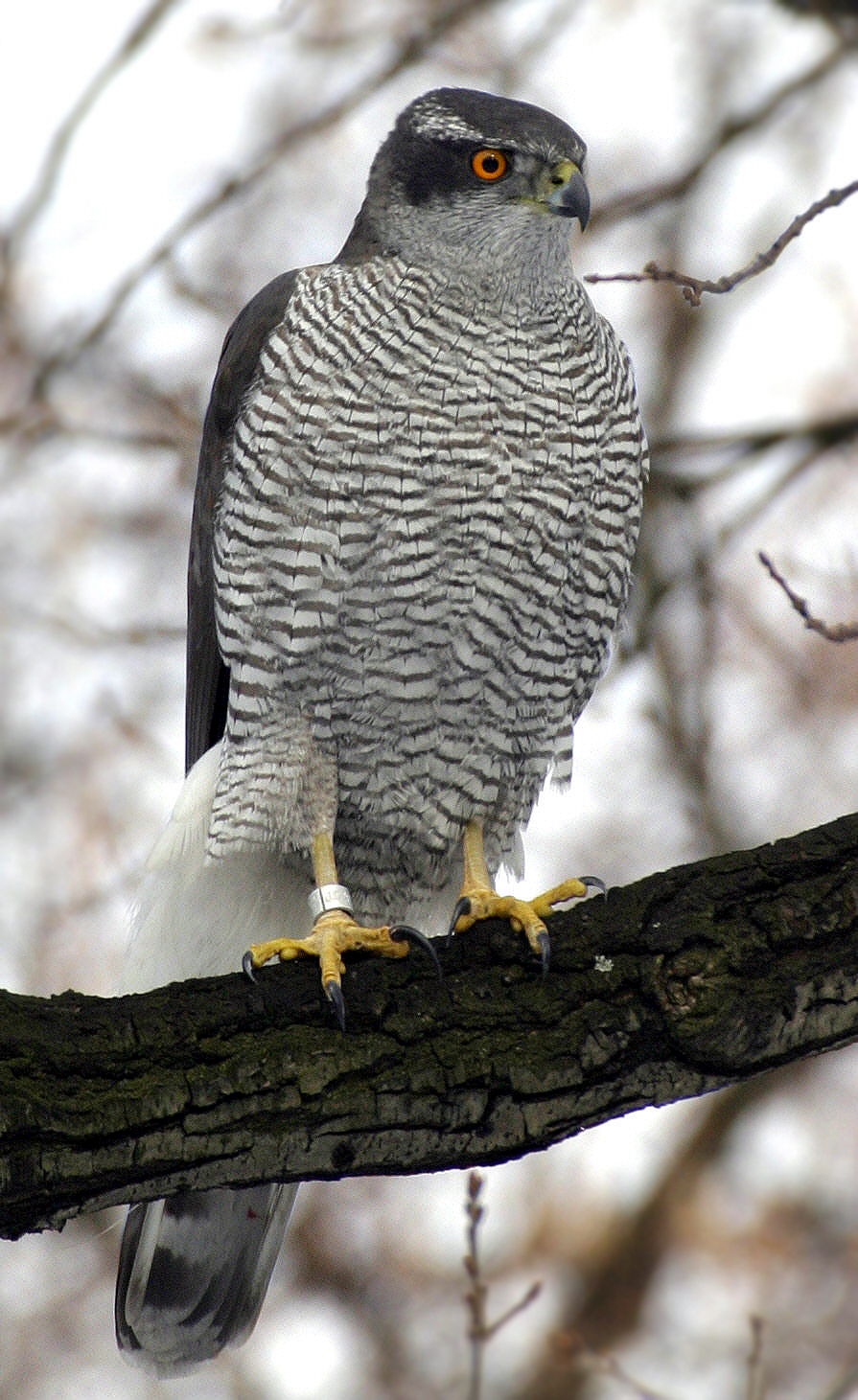
Adults have dark slate-grey to brownish-grey upperparts, with finely barred white underparts. The barring is typically dense and wavy. They have a prominent white supercilium (eyebrow stripe) that extends behind the eye, and a dark cap. Juveniles are brown above with streaked underparts, often with a buffy wash.
- 2
Forma del becco
Forma e colore del becco, un segno di campo chiave.
Strong, hooked beak, dark grey to black with a yellow cere.
- 3
Colore degli occhi
Colore dell'iride e segni distintivi sugli occhi.
Adults have bright orange to deep red eyes, becoming more intense with age. Juveniles have yellow eyes.
- 4
Colore delle zampe
Colore di zampe e piedi.
Yellow
- 5
Caratteristiche distintive
Tratti distintivi che separano questa specie.
Broad, rounded wings and a relatively long tail, often appearing square-tipped or slightly notched. The flight profile shows a distinctive 'S' curve to the trailing edge of the wing. Powerful build and fierce expression.
- 6
Aspetto giovanile
Come i giovani si differenziano dagli adulti.
Juveniles are distinctly different from adults. They have brown upperparts with buffy feather edgings, and creamy-white underparts heavily streaked with dark brown. Their eyes are yellow, gradually changing to orange/red over 2-3 years.
- 7
Cambiamenti stagionali
Variazione del piumaggio tra stagione riproduttiva e non.
No significant seasonal plumage changes. Plumage becomes more worn and faded towards the end of the breeding season before molting.
- 8
Dimorfismo sessuale
Differenze tra maschi e femmine.
Females are significantly larger and heavier than males (reverse sexual dimorphism), often by 25-50% in weight and 10-15% in length and wingspan. Plumage is similar, though females may appear slightly browner on the back.
Segni di campo chiave
- Size and Build. Look for a large, powerful accipiter. Females are notably larger than males. Its robust build and broad wings are key.
- Plumage (Adult). Dark grey back, finely barred white underparts, and a striking white supercilium. Red eyes are a strong indicator in adults.
- Plumage (Juvenile). Brown back, heavily streaked brown on buffy-white underparts, and yellow eyes. The streaking is coarser than in juvenile sparrowhawks.
- Tail Shape. Relatively long tail, often appearing square-tipped or slightly notched at the end, unlike the rounded tail of Cooper's Hawk.
- Flight Style. Powerful, direct flight with rapid wing beats and glides. Agile maneuvering through dense forest. When soaring, wings are held flat or slightly bowed.
- Vocalization. Listen for the characteristic rapid 'kek-kek-kek' call, especially near nesting sites.
Esplora Northern Goshawk
Identifica uccelli ovunque
Gratis su iOS, Android e Web. Identificazione per foto e suono, database completo e la tua lista personale.