
Visto un uccello? Identificalo all'istante con l'app Birdby
Apri l'appInformazioni
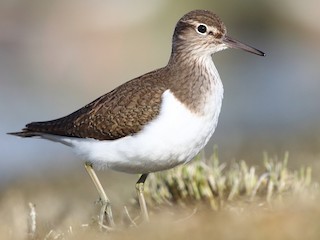
The Common Sandpiper is a small, migratory wader found across much of Eurasia. It is characterized by its distinctive bobbing gait and low, stiff-winged flight over water. It is a widespread and familiar species, often seen along the edges of freshwater and coastal habitats.
Dimensioni e longevità
- Lunghezza
- 18-20 cm
- Apertura alare
- 32-35 cm
- Peso
- 30-80 g
- Longevità
- Up to 10 years in the wild
- Dieta
- Insectivore
Caratteristiche fisiche
- Piumaggio
- Upperparts are dull olive-brown with fine dark streaking, particularly on the crown and mantle. Underparts are white, with a distinctive white wedge extending up the side of the breast, separating the brown upperparts from the white underparts. The breast sides are mottled brownish-grey. The rump and tail sides are white, contrasting with the dark central tail feathers.
- Forma del becco
- Relatively short, slender, and straight bill, dark grey to blackish.
- Colore degli occhi
- Dark brown, with a faint pale supercilium (eyebrow stripe) above it.
- Colore delle zampe
- Dull greenish-grey to yellowish-grey.
- Caratteristiche distintive
- Key features include the white wedge extending up the side of the breast, the constant 'teetering' or bobbing motion of its rear body, and its characteristic low, stiff-winged flight with shallow wingbeats, often interspersed with short glides.
- Aspetto giovanile
- Juveniles resemble adults but have more distinct, fine buffish-white fringes to the feathers of the upperparts, giving them a slightly scaly appearance. Their legs may be slightly paler and more yellowish.
- Cambiamenti stagionali
- There is very little seasonal variation in plumage. Breeding plumage is slightly fresher and more distinctly marked, while non-breeding plumage may appear slightly duller and more worn, but the overall pattern remains consistent.
- Dimorfismo sessuale
- Males and females are monomorphic in plumage and size, making them indistinguishable in the field.
Come identificare
- 1
Plumage Pattern
Look for the dull olive-brown upperparts and pure white underparts, crucially separated by a distinctive white wedge extending up the side of the breast. This white wedge is a key field mark.
- 2
Behavior - Teetering
Observe its characteristic constant 'teetering' or bobbing motion of its rear body and tail, even when standing still. This is almost diagnostic for the species.
- 3
Flight Style
Note its low, stiff-winged flight with rapid, shallow wingbeats, often interspersed with short glides on bowed wings. It typically flies close to the water surface.
- 4
Vocalization
Listen for its sharp, high-pitched 'twee-wee-wee' call, especially when flushed or in flight.
- 5
Habitat
It is almost always found near water, particularly along the edges of rivers, streams, lakes, and coastal areas.
Habitat e areale
- Biomi
- Temperate forests, taiga, grasslands, coastal areas, wetlands.
- Areale geografico
- Breeds across most of temperate and boreal Eurasia, from Western Europe to Japan. Winters in Africa, the Middle East, South Asia, and Australasia.
- Fascia altitudinale
- Typically found from sea level up to 2,000 meters, occasionally higher in mountainous regions during migration.
- Ambienti preferiti
- Prefers freshwater habitats such as rivers, streams, lakes, ponds, and reservoirs with stony or sandy banks. Also found in coastal areas, estuaries, and rocky shores during migration and winter.
Comportamento
- Periodo di attività
- Diurnal, though some nocturnal migration occurs.
- Abitudini alimentari
- Forages by picking insects and other small invertebrates from the surface of mud, sand, or stones, often at the water's edge. It uses a characteristic 'run-and-peck' method, often wading in shallow water. Diet includes insects (beetles, flies, larvae), crustaceans, molluscs, and occasionally small fish.
- Comportamento sociale
- Generally solitary or found in small, loose groups, especially during migration and in wintering areas. Breeding pairs are territorial.
- Tipo di volo
- Distinctive low, stiff-winged flight with rapid, shallow wingbeats, often interspersed with short glides on bowed wings. It typically flies just above the water surface, often following the contours of a river or shoreline.
- Migrazione
- A long-distance migratory species. European breeders typically migrate south to Africa, while Asian populations winter in South Asia and Australasia. Migration occurs primarily at night.
- Territorialità
- Highly territorial during the breeding season, defending a stretch of riverbank or shoreline. Displays include aerial pursuits and vocalizations.
Canto e richiami
- Canto
- The song is a series of high-pitched, piping notes, often described as 'twee-wee-wee' or 'twee-twee-twee'. It is typically given in flight or from a prominent perch.
- Richiamo
- The most common call is a sharp, high-pitched 'twee-wee-wee' or 'tsee-wee-wee', often given when flushed or in alarm. It can also produce a softer 'chip' call.
- Quando vocalizza
- Most vocal during the breeding season, particularly when displaying or alarmed. Calls are also frequently heard during migration.
Riproduzione
- Stagione riproduttiva
- May to July in most of its range.
- Abitudini di nidificazione
- Nests on the ground, typically in a shallow scrape lined with grass, leaves, or other vegetation, often concealed among vegetation near water. Both parents participate in nest site selection and construction.
- Dimensione della covata
- Usually 4 eggs.
- Descrizione dell'uovo
- Typically 4 eggs, pear-shaped, pale buff to greenish-buff with dark brown or purplish-brown spots and blotches, often concentrated at the broad end.
- Periodo di incubazione
- 21-22 days, shared by both parents.
- Periodo di involo
- 22-28 days. Chicks are precocial and leave the nest shortly after hatching, able to feed themselves.
- Cure parentali
- Both parents share incubation duties and care for the young. Chicks are led to foraging areas by parents and are capable of feeding themselves, though parents remain vigilant and protect them.
Dove trovarlo
Rivers and Streams
Look along the banks of slow-moving to moderately fast-flowing rivers and streams, especially those with stony or sandy edges.
Lakes and Ponds
Check the shorelines of freshwater lakes, reservoirs, and larger ponds, particularly where there are exposed mudflats or shingle.
Coastal Areas
During migration and in winter, they can be found on rocky shores, estuaries, and sheltered coastal lagoons.
Wetlands
Any wetland habitat with open water and suitable foraging substrate can attract Common Sandpipers.
Consigli sul campo
- Scan water edges. Common Sandpipers are often inconspicuous, blending with their surroundings. Systematically scan the water's edge, especially where there are stones, mud, or sparse vegetation.
- Look for movement. Their constant teetering motion is often the first thing that catches the eye, even before you fully discern the bird. Look for this subtle movement.
- Listen for calls. Their distinctive 'twee-wee-wee' call is often given when they are disturbed or take flight, alerting you to their presence.
- Observe flight. If a bird flies off, pay attention to its flight pattern – the low, stiff-winged flight is very characteristic.
- Be patient and quiet. Approach quietly and use binoculars to observe them from a distance to avoid flushing them.
Specie simili
Spotted Sandpiper
Actitis macularius
The Spotted Sandpiper (North American counterpart) has distinct black spots on its underparts during breeding plumage, which the Common Sandpiper lacks. In non-breeding plumage, they are very similar, but the Spotted Sandpiper typically shows a less distinct white wedge on the breast side and often has a slightly shorter primary projection. The flight call of the Spotted Sandpiper is a softer 'peet-weet' compared to the Common Sandpiper's 'twee-wee-wee'.
Green Sandpiper
Tringa ochropus
The Green Sandpiper is generally darker overall, with a more uniform dark brown upperparts and a striking white rump that contrasts sharply with its dark tail. It lacks the white breast wedge of the Common Sandpiper. Its flight is more direct and powerful, and its call is a loud 'tlu-eet'.
Wood Sandpiper
Tringa glareola
The Wood Sandpiper is paler and more finely spotted on the upperparts, with a more prominent supercilium. It has longer, yellowish legs and a less distinct white rump patch. Its flight is more buoyant, and its call is a rapid 'chiff-iff-iff'.
Fatti rapidi
- Distinctive Behavior:
- Constant 'teetering' or bobbing of the rear body.
- Flight Style:
- Low, stiff-winged flight with shallow wingbeats.
- Key Plumage Mark:
- White wedge extending up the side of the breast.
- Habitat Preference:
- Freshwater edges (rivers, lakes) and coastal areas.
- Diet:
- Mainly insects and small invertebrates.
Curiosità
- The Common Sandpiper is one of the most widespread waders in the world, breeding across a vast area of Eurasia.
- Its scientific name 'Actitis' comes from the Greek word 'aktites', meaning 'coast-dweller', referring to its preferred habitat.
- Despite its name, it is often found far from sandy beaches, preferring stony or muddy riverbanks.
- The 'teetering' behavior is thought to help them scan for predators or prey, or perhaps to maintain balance on uneven terrain.
Classificazione scientifica
- Regno
- Animalia
- Phylum
- Chordata
- Classe
- Aves
- Ordine
- Charadriiformes
- Famiglia
- Scolopacidae
- Genere
- Actitis
- Specie
- Actitis hypoleucos
Esplora Common Sandpiper
Identifica uccelli ovunque
Gratis su iOS, Android e Web. Identificazione per foto e suono, database completo e la tua lista personale.