
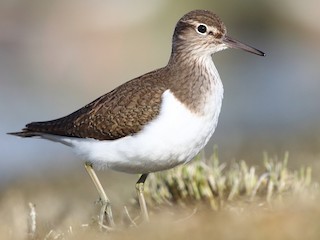
Come identificare Common Sandpiper
Actitis hypoleucos
Visto un uccello? Identificalo all'istante con l'app Birdby
Apri l'appPer identificare correttamente Common Sandpiper (Actitis hypoleucos), controlla ciascuna di queste caratteristiche. Gli uccelli possono essere complicati da riconoscere, perché comportamento, habitat e canto spesso confermano ciò che una sola foto non può.
Dimensioni a colpo d'occhio
- Lunghezza
- 18-20 cm
- Apertura alare
- 32-35 cm
- Peso
- 30-80 g
Caratteristiche fisiche da controllare
- 1
Piumaggio
Colorazione e disegno generale del piumaggio.
Upperparts are dull olive-brown with fine dark streaking, particularly on the crown and mantle. Underparts are white, with a distinctive white wedge extending up the side of the breast, separating the brown upperparts from the white underparts. The breast sides are mottled brownish-grey. The rump and tail sides are white, contrasting with the dark central tail feathers.
- 2
Forma del becco
Forma e colore del becco, un segno di campo chiave.
Relatively short, slender, and straight bill, dark grey to blackish.
- 3
Colore degli occhi
Colore dell'iride e segni distintivi sugli occhi.
Dark brown, with a faint pale supercilium (eyebrow stripe) above it.
- 4
Colore delle zampe
Colore di zampe e piedi.
Dull greenish-grey to yellowish-grey.
- 5
Caratteristiche distintive
Tratti distintivi che separano questa specie.
Key features include the white wedge extending up the side of the breast, the constant 'teetering' or bobbing motion of its rear body, and its characteristic low, stiff-winged flight with shallow wingbeats, often interspersed with short glides.
- 6
Aspetto giovanile
Come i giovani si differenziano dagli adulti.
Juveniles resemble adults but have more distinct, fine buffish-white fringes to the feathers of the upperparts, giving them a slightly scaly appearance. Their legs may be slightly paler and more yellowish.
- 7
Cambiamenti stagionali
Variazione del piumaggio tra stagione riproduttiva e non.
There is very little seasonal variation in plumage. Breeding plumage is slightly fresher and more distinctly marked, while non-breeding plumage may appear slightly duller and more worn, but the overall pattern remains consistent.
- 8
Dimorfismo sessuale
Differenze tra maschi e femmine.
Males and females are monomorphic in plumage and size, making them indistinguishable in the field.
Segni di campo chiave
- Plumage Pattern. Look for the dull olive-brown upperparts and pure white underparts, crucially separated by a distinctive white wedge extending up the side of the breast. This white wedge is a key field mark.
- Behavior - Teetering. Observe its characteristic constant 'teetering' or bobbing motion of its rear body and tail, even when standing still. This is almost diagnostic for the species.
- Flight Style. Note its low, stiff-winged flight with rapid, shallow wingbeats, often interspersed with short glides on bowed wings. It typically flies close to the water surface.
- Vocalization. Listen for its sharp, high-pitched 'twee-wee-wee' call, especially when flushed or in flight.
- Habitat. It is almost always found near water, particularly along the edges of rivers, streams, lakes, and coastal areas.
Esplora Common Sandpiper
Identifica uccelli ovunque
Gratis su iOS, Android e Web. Identificazione per foto e suono, database completo e la tua lista personale.