
Visto un uccello? Identificalo all'istante con l'app Birdby
Apri l'appInformazioni
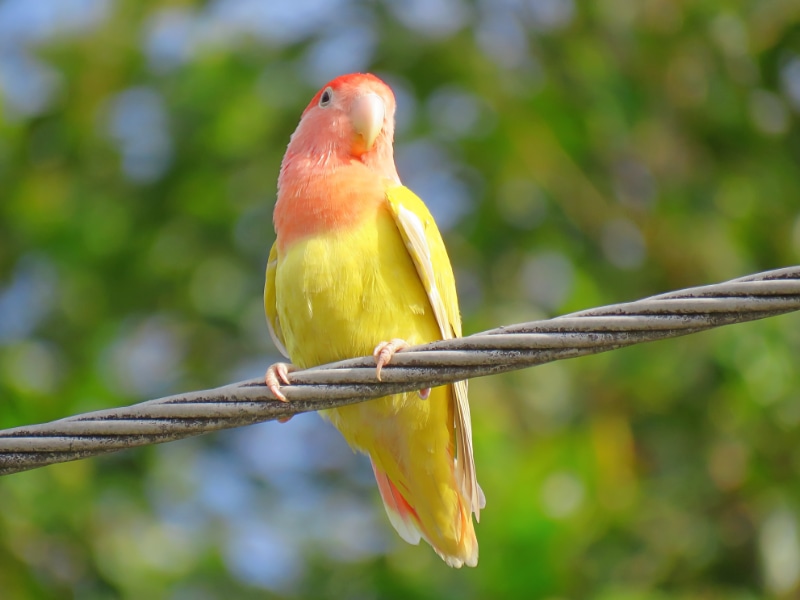
The Rosy-faced Lovebird, also known as the Peach-faced Lovebird, is a small species of parrot native to southwestern Africa. Renowned for its vibrant plumage and social nature, it is a popular pet bird worldwide. In the wild, they are highly gregarious, forming large flocks and exhibiting strong pair bonds.
Dimensioni e longevità
- Lunghezza
- 15-18 cm (6-7 inches)
- Apertura alare
- 25-30 cm (10-12 inches)
- Peso
- 45-60 g (1.6-2.1 oz)
- Longevità
- 10-15 years in the wild; up to 20 years in captivity
- Dieta
- Herbivore (primarily granivorous and frugivorous)
Caratteristiche fisiche
- Piumaggio
- Predominantly bright green body plumage. The face, from the forehead to the throat, is a distinctive rosy-pink (peach-colored). The rump is bright blue. The flight feathers are green with black tips, and the tail feathers are green with blue and black markings, often with red at the base.
- Forma del becco
- Strong, hooked, and relatively large for its size. Color is horn-colored (pale yellowish-brown).
- Colore degli occhi
- Dark brown with a prominent white periophthalmic ring (bare skin around the eye).
- Colore delle zampe
- Greyish-pink to grey.
- Caratteristiche distintive
- The most distinctive feature is the rosy-pink face and throat, contrasting sharply with the green body. The blue rump is also a key field mark.
- Aspetto giovanile
- Juveniles have duller plumage overall. The rosy-pink on the face is less intense, often appearing paler or more orange-tinged. The blue rump may also be less vibrant, and the beak often has a blackish marking at the base, which fades with maturity.
- Cambiamenti stagionali
- No significant seasonal plumage changes. Plumage remains consistent throughout the year.
- Dimorfismo sessuale
- Generally considered monomorphic, meaning males and females look alike. While some subtle differences in head shape or size might be observed by experienced breeders, these are not reliable for field identification. DNA sexing is often required for definitive sex determination.
Come identificare
- 1
Facial Coloration
Look for the distinctive rosy-pink (peach) coloration covering the forehead, cheeks, and throat. This is the most reliable field mark.
- 2
Rump Color
Observe the lower back and rump; it should be a vibrant blue, contrasting with the green body.
- 3
Eye-ring
Note the prominent white bare skin ring around the dark eyes.
- 4
Body Plumage
The rest of the body is bright green. Look for this overall green coloration.
- 5
Beak Color
The beak is horn-colored (pale yellowish-brown), not red or black.
- 6
Social Behavior
Often seen in pairs or small to large flocks, exhibiting close pair bonding.
- 7
Vocalizations
Listen for their characteristic high-pitched, chattering, and screeching calls.
Habitat e areale
- Biomi
- Arid and semi-arid regions, including dry woodlands, savannas, scrublands, and riverine forests.
- Areale geografico
- Native to southwestern Africa, primarily found in Namibia, Angola, and parts of South Africa. Feral populations exist in various urban areas worldwide due to escaped pet birds.
- Fascia altitudinale
- Typically found from sea level up to 1,600 meters (5,250 feet).
- Ambienti preferiti
- Prefers areas with scattered trees (especially acacia and mopane), shrubs, and access to water sources. They often inhabit rocky outcrops and gorges, utilizing crevices for nesting.
Comportamento
- Periodo di attività
- Diurnal, most active during the early morning and late afternoon, resting during the hottest parts of the day.
- Abitudini alimentari
- Feeds primarily on seeds, especially grass seeds, and seeds from acacia and mopane trees. Also consumes fruits, berries, buds, and occasionally insects. They forage in flocks, often on the ground or in trees and shrubs.
- Comportamento sociale
- Highly social and gregarious, typically found in small family groups or large flocks of 20 to 100 individuals, sometimes even larger. They form strong, monogamous pair bonds, often seen perched closely together, preening each other.
- Tipo di volo
- Fast, direct, and undulating flight with rapid wing beats. They are agile flyers, especially when navigating through trees.
- Migrazione
- Resident throughout its range, but may undertake local nomadic movements in response to food and water availability, especially during dry seasons.
- Territorialità
- While nesting pairs may defend their immediate nest site, they are generally not highly territorial outside the breeding season, living cooperatively in flocks.
Canto e richiami
- Canto
- Does not have a complex song. Vocalizations are primarily calls.
- Richiamo
- A variety of high-pitched, chattering, twittering, and screeching calls. Calls are often loud and repetitive, used for communication within the flock, alarm, and contact. They can be quite noisy, especially when in large groups.
- Quando vocalizza
- Vocalizes frequently throughout the day, particularly when feeding, flying, or interacting within the flock.
Riproduzione
- Stagione riproduttiva
- Typically between February and May in Namibia, but can vary depending on rainfall and food availability. In some areas, they may breed opportunistically after good rains.
- Abitudini di nidificazione
- Colonial nesters, often utilizing crevices in rocks, cliffs, or tree hollows. They are unique among lovebirds for building a covered, enclosed nest within these cavities, using strips of bark, leaves, and other plant material carried tucked into their rump feathers.
- Dimensione della covata
- 4-6 eggs, occasionally up to 8.
- Descrizione dell'uovo
- Small, white, and oval-shaped. Typically unspotted.
- Periodo di incubazione
- Approximately 22-25 days, primarily by the female.
- Periodo di involo
- Young fledge (leave the nest) around 38-44 days after hatching.
- Cure parentali
- Both parents participate in feeding the chicks after hatching. The female incubates, and the male often feeds the female during incubation.
Dove trovarlo
Dry Woodlands and Savannas
Look in areas with scattered acacia and mopane trees, especially near water sources in Namibia and Angola.
Rocky Gorges and Outcrops
These provide nesting sites and shelter. Check cliffs and rock faces.
Riverine Forests
Areas along rivers with denser vegetation can also host populations.
Urban and Suburban Areas (Feral Populations)
In many parts of the world, escaped pet lovebirds have established feral colonies in parks, gardens, and urban green spaces.
Consigli sul campo
- Look for Flocks. Rosy-faced Lovebirds are highly social; spotting one often means spotting many. Look for groups feeding or flying together.
- Listen for Calls. Their loud, chattering calls often give away their presence before they are seen. Follow the sound.
- Check Water Sources. In arid environments, they frequently visit waterholes, especially in the morning and late afternoon.
- Observe Feeding Behavior. They often feed on the ground or in trees, so scan these areas carefully.
- Patience and Binoculars. Like all birdwatching, patience is key. Binoculars will help in observing their distinct features from a distance.
Specie simili
Fischer's Lovebird
Agapornis fischeri
Fischer's Lovebird has an orange face that transitions to yellow on the head, a red beak, and a prominent white eye-ring. Its body is also predominantly green, but lacks the distinct rosy-pink face and blue rump of the Rosy-faced Lovebird.
Yellow-collared Lovebird (Masked Lovebird)
Agapornis personatus
The Masked Lovebird has a black head and face, a yellow collar, and a red beak. Its body is green, and it also has a white eye-ring. The black face is a clear distinction from the rosy face of A. roseicollis.
Lilian's Lovebird (Nyasa Lovebird)
Agapornis lilianae
Lilian's Lovebird has an orange-red face and throat, a red beak, and a green body. It lacks the blue rump and the distinct rosy-pink coloration of A. roseicollis, and its facial coloration is more intensely orange-red.
Fatti rapidi
- Common Name:
- Rosy-faced Lovebird, Peach-faced Lovebird, Inseparabile Faccia Rosa
- Scientific Name:
- Agapornis roseicollis
- Native Range:
- Southwestern Africa (Namibia, Angola, South Africa)
- Diet:
- Seeds, fruits, berries, buds
- Sociality:
- Highly social, forms strong pair bonds and large flocks
- Conservation Status:
- Least Concern (IUCN Red List)
- Distinguishing Feature:
- Rosy-pink face and blue rump
Curiosità
- The name 'lovebird' comes from their strong, monogamous pair bonds and the affectionate behavior they show towards their mates, often perching closely and preening each other.
- Rosy-faced Lovebirds are one of the most popular pet parrot species globally due to their vibrant colors, playful nature, and ability to bond with humans.
- They are unique among lovebirds for carrying nesting material tucked into their rump feathers, rather than in their beaks.
- Despite their small size, they are quite hardy and adaptable, which has contributed to the establishment of feral populations in various parts of the world.
- In their native habitat, they are important seed dispersers, playing a role in the ecosystem.
Classificazione scientifica
- Regno
- Animalia
- Phylum
- Chordata
- Classe
- Aves
- Ordine
- Psittaciformes
- Famiglia
- Psittaculidae
- Genere
- Agapornis
- Specie
- Agapornis roseicollis
Esplora Rosy-faced Lovebird
Identifica uccelli ovunque
Gratis su iOS, Android e Web. Identificazione per foto e suono, database completo e la tua lista personale.