
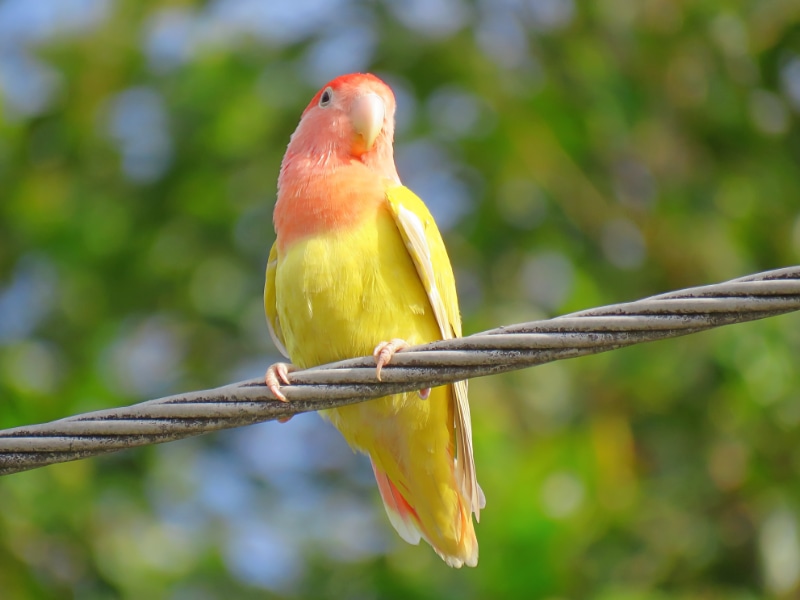
Come identificare Rosy-faced Lovebird
Agapornis roseicollis
Visto un uccello? Identificalo all'istante con l'app Birdby
Apri l'appPer identificare correttamente Rosy-faced Lovebird (Agapornis roseicollis), controlla ciascuna di queste caratteristiche. Gli uccelli possono essere complicati da riconoscere, perché comportamento, habitat e canto spesso confermano ciò che una sola foto non può.
Dimensioni a colpo d'occhio
- Lunghezza
- 15-18 cm (6-7 inches)
- Apertura alare
- 25-30 cm (10-12 inches)
- Peso
- 45-60 g (1.6-2.1 oz)
Caratteristiche fisiche da controllare
- 1
Piumaggio
Colorazione e disegno generale del piumaggio.
Predominantly bright green body plumage. The face, from the forehead to the throat, is a distinctive rosy-pink (peach-colored). The rump is bright blue. The flight feathers are green with black tips, and the tail feathers are green with blue and black markings, often with red at the base.
- 2
Forma del becco
Forma e colore del becco, un segno di campo chiave.
Strong, hooked, and relatively large for its size. Color is horn-colored (pale yellowish-brown).
- 3
Colore degli occhi
Colore dell'iride e segni distintivi sugli occhi.
Dark brown with a prominent white periophthalmic ring (bare skin around the eye).
- 4
Colore delle zampe
Colore di zampe e piedi.
Greyish-pink to grey.
- 5
Caratteristiche distintive
Tratti distintivi che separano questa specie.
The most distinctive feature is the rosy-pink face and throat, contrasting sharply with the green body. The blue rump is also a key field mark.
- 6
Aspetto giovanile
Come i giovani si differenziano dagli adulti.
Juveniles have duller plumage overall. The rosy-pink on the face is less intense, often appearing paler or more orange-tinged. The blue rump may also be less vibrant, and the beak often has a blackish marking at the base, which fades with maturity.
- 7
Cambiamenti stagionali
Variazione del piumaggio tra stagione riproduttiva e non.
No significant seasonal plumage changes. Plumage remains consistent throughout the year.
- 8
Dimorfismo sessuale
Differenze tra maschi e femmine.
Generally considered monomorphic, meaning males and females look alike. While some subtle differences in head shape or size might be observed by experienced breeders, these are not reliable for field identification. DNA sexing is often required for definitive sex determination.
Segni di campo chiave
- Facial Coloration. Look for the distinctive rosy-pink (peach) coloration covering the forehead, cheeks, and throat. This is the most reliable field mark.
- Rump Color. Observe the lower back and rump; it should be a vibrant blue, contrasting with the green body.
- Eye-ring. Note the prominent white bare skin ring around the dark eyes.
- Body Plumage. The rest of the body is bright green. Look for this overall green coloration.
- Beak Color. The beak is horn-colored (pale yellowish-brown), not red or black.
- Social Behavior. Often seen in pairs or small to large flocks, exhibiting close pair bonding.
- Vocalizations. Listen for their characteristic high-pitched, chattering, and screeching calls.
Esplora Rosy-faced Lovebird
Identifica uccelli ovunque
Gratis su iOS, Android e Web. Identificazione per foto e suono, database completo e la tua lista personale.