
Visto un uccello? Identificalo all'istante con l'app Birdby
Apri l'appInformazioni
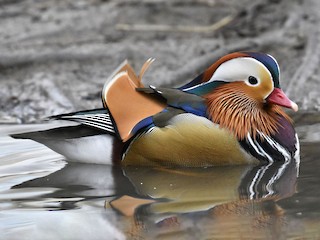
The Mandarin Duck is a medium-sized, perching duck, native to East Asia. It is renowned for the strikingly ornate and colorful plumage of the male, making it one of the most distinctive and aesthetically pleasing waterfowl species. While native to Asia, feral populations exist in various parts of the world, particularly in Europe, due to escapes from captivity.
Dimensioni e longevità
- Lunghezza
- 41-49 cm (16-19 in)
- Apertura alare
- 65-75 cm (26-30 in)
- Peso
- 428-693 g (15.1-24.4 oz)
- Longevità
- 6-10 years in the wild, up to 20 years in captivity
- Dieta
- Omnivore
Caratteristiche fisiche
- Piumaggio
- Male breeding plumage is extraordinarily vibrant: iridescent green-purple crest, white supercilium, rufous face and 'whiskers', orange-red bill, white breast with two vertical black bars, rufous flanks, and two prominent orange 'sails' (modified tertial feathers) on the back. Female plumage is much duller: grey head with a white eye-ring and stripe extending back from the eye, mottled grey-brown body, white belly, and a small white flank stripe. Both sexes have a small crest.
- Forma del becco
- Relatively small, conical bill. Male's bill is bright orange-red with a pale tip; female's bill is dull grey with a pale tip.
- Colore degli occhi
- Dark brown in both sexes.
- Colore delle zampe
- Dull orange-yellow in males, duller yellow-brown in females.
- Caratteristiche distintive
- Male's 'sails' on the back, rufous 'whiskers', and vibrant crest are unmistakable. Female's distinct white eye-ring and post-ocular stripe are key identifiers.
- Aspetto giovanile
- Juveniles resemble adult females but are duller, with a less distinct white eye-ring and stripe, and often have some streaking on the breast and flanks.
- Cambiamenti stagionali
- Males undergo an eclipse plumage after breeding, which closely resembles the female's plumage, though they retain their orange-red bill and some residual rufous on the head. This eclipse plumage is typically held from late summer through early autumn.
- Dimorfismo sessuale
- Highly pronounced. Males are far more colorful and ornate than females, especially during breeding season. Females are cryptically colored for camouflage during nesting.
Come identificare
- 1
Male Plumage (Breeding)
Look for the unmistakable combination of the iridescent green-purple crest, white supercilium, rufous 'whiskers', orange 'sails' on the back, and the orange-red bill. No other duck species has this combination.
- 2
Female Plumage
Focus on the grey head with a prominent white eye-ring and a distinct white stripe extending backward from the eye. The body is mottled grey-brown with a white belly and a small white flank stripe. The bill is dull grey.
- 3
Behavior
Observe their preference for wooded water bodies. They are often seen perching on branches over water, a characteristic shared with their close relative, the Wood Duck, but uncommon for most other duck species.
- 4
Vocalization
Listen for the male's soft 'wheep' or 'creak' and the female's low 'geck' call. The absence of a typical 'quack' is a good indicator.
Habitat e areale
- Biomi
- Temperate forests, wetlands, riparian zones.
- Areale geografico
- Native to East Asia (China, Japan, Korea, parts of Russia). Feral populations established in Western Europe (e.g., UK, Germany, France) and isolated areas in North America.
- Fascia altitudinale
- Typically found at low to moderate elevations, generally below 1,000 meters.
- Ambienti preferiti
- Dense, wooded areas near freshwater, such as rivers, streams, ponds, and lakes, particularly those with overhanging trees and dense undergrowth. They prefer areas with abundant aquatic vegetation and tree cavities for nesting.
Comportamento
- Periodo di attività
- Diurnal, most active during dawn and dusk for feeding.
- Abitudini alimentari
- Primarily forages by dabbling at the water's surface or grazing on land. Diet includes seeds (especially acorns, beech nuts, and grains), aquatic plants, insects, snails, small fish, and frogs. They are particularly fond of acorns.
- Comportamento sociale
- Typically seen in pairs or small family groups during the breeding season. Outside of breeding, they can form larger flocks, sometimes mixing with other duck species. They are generally shy and secretive.
- Tipo di volo
- Fast and direct flight with rapid wingbeats. Agile in flight, especially when navigating through trees. Often flies low over water.
- Migrazione
- Native populations in northern parts of their range are migratory, moving south for winter. Southern populations are largely resident. Feral populations in Europe are mostly resident.
- Territorialità
- Males can be territorial during the breeding season, defending nesting sites and mates. They are generally less aggressive than some other duck species.
Canto e richiami
- Canto
- Males produce a soft, whistling 'wheep' or 'creak' during courtship. They lack the typical 'quack' of many ducks.
- Richiamo
- Females emit a soft, low 'geck' or 'kek' call, especially when alarmed or communicating with ducklings. Both sexes can produce a sharp, high-pitched alarm call when startled.
- Quando vocalizza
- Most vocal during the breeding season and when alarmed. Males' courtship calls are heard during pair formation.
Riproduzione
- Stagione riproduttiva
- Typically April to May in their native range, slightly earlier in some feral populations (e.g., March-April in Europe).
- Abitudini di nidificazione
- Nests are usually located in tree cavities, often high above the ground (up to 10 meters or more), sometimes in old woodpecker holes or hollows. They line the nest with down feathers. They are secondary cavity nesters.
- Dimensione della covata
- 8-12 eggs.
- Descrizione dell'uovo
- 8-12 (occasionally up to 14) oval, smooth, creamy-white to buff-colored eggs, measuring approximately 50 x 38 mm.
- Periodo di incubazione
- 28-30 days, primarily by the female.
- Periodo di involo
- Ducklings are precocial; they fledge (become capable of flight) at about 40-45 days after hatching. They jump from the tree cavity shortly after hatching.
- Cure parentali
- The female alone incubates the eggs and cares for the ducklings. The male typically leaves the female once incubation begins, though he may remain in the vicinity for a short period.
Dove trovarlo
Wooded Ponds and Lakes
Look for them in areas with dense tree cover, especially deciduous trees, bordering calm freshwater bodies. They prefer quiet, undisturbed locations.
Rivers and Streams
Areas with slow-moving water, overhanging vegetation, and fallen logs provide ideal habitat.
Urban Parks (Feral Populations)
In regions with feral populations (e.g., parts of Europe), they can often be found in ornamental ponds and lakes within urban parks, where they may be more accustomed to human presence.
Consigli sul campo
- Early Morning/Late Evening. Mandarin Ducks are often most active and visible during dawn and dusk when they come out to feed.
- Scan Tree Branches. Unlike many ducks, they frequently perch on tree branches, sometimes quite high up. Always check the trees surrounding water bodies.
- Look for Movement in Dense Cover. They are shy and often stay hidden in dense vegetation along the water's edge. Patience and careful scanning of these areas can reveal them.
- Listen for Calls. Their distinctive calls, particularly the male's 'wheep', can help locate them even when hidden from view.
Specie simili
Wood Duck
Aix sponsa
The Wood Duck (native to North America) is the closest relative and shares the genus 'Aix'. Males are similarly ornate but have a different head pattern (more extensive white lines on a green-purple head), a red eye, and lack the prominent orange 'sails' of the Mandarin Duck. Female Wood Ducks have a more teardrop-shaped white eye-patch compared to the Mandarin's distinct eye-ring and stripe.
Other small dabbling ducks (e.g., Teal species)
Anas spp.
While some teal species are small, none possess the unique crests, 'sails', or highly contrasting plumage patterns of the male Mandarin Duck. Female Mandarin Ducks can be distinguished from female teals by their distinct white eye-ring and stripe, and their more upright posture.
Fatti rapidi
- Native Range:
- East Asia
- Diet:
- Omnivorous (seeds, nuts, aquatic plants, insects)
- Nesting Site:
- Tree cavities
- Male Plumage:
- Extremely colorful with 'sails' and crest
- Female Plumage:
- Grey with white eye-ring and stripe
- Conservation Status:
- Least Concern
Curiosità
- In Asian cultures, Mandarin Ducks are symbols of conjugal affection and fidelity, often depicted in art and used in wedding ceremonies, as they are believed to mate for life (though scientific evidence suggests they form seasonal pair bonds).
- The male's prominent 'sails' are actually modified tertial feathers that stand upright, adding to their unique appearance.
- Despite their vibrant plumage, male Mandarin Ducks are surprisingly cryptic when still among foliage, blending into the dappled light and shadows.
- Ducklings, shortly after hatching, must jump from their high tree cavity nests to the ground or water below, a remarkable feat of survival.
Classificazione scientifica
- Regno
- Animalia
- Phylum
- Chordata
- Classe
- Aves
- Ordine
- Anseriformes
- Famiglia
- Anatidae
- Genere
- Aix
- Specie
- Aix galericulata
Esplora Mandarin Duck
Identifica uccelli ovunque
Gratis su iOS, Android e Web. Identificazione per foto e suono, database completo e la tua lista personale.