
Come identificare Mandarin Duck
Aix galericulata
Visto un uccello? Identificalo all'istante con l'app Birdby
Apri l'appPer identificare correttamente Mandarin Duck (Aix galericulata), controlla ciascuna di queste caratteristiche. Gli uccelli possono essere complicati da riconoscere, perché comportamento, habitat e canto spesso confermano ciò che una sola foto non può.
Dimensioni a colpo d'occhio
- Lunghezza
- 41-49 cm (16-19 in)
- Apertura alare
- 65-75 cm (26-30 in)
- Peso
- 428-693 g (15.1-24.4 oz)
Caratteristiche fisiche da controllare
- 1
Piumaggio
Colorazione e disegno generale del piumaggio.
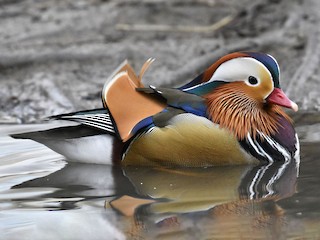
Male breeding plumage is extraordinarily vibrant: iridescent green-purple crest, white supercilium, rufous face and 'whiskers', orange-red bill, white breast with two vertical black bars, rufous flanks, and two prominent orange 'sails' (modified tertial feathers) on the back. Female plumage is much duller: grey head with a white eye-ring and stripe extending back from the eye, mottled grey-brown body, white belly, and a small white flank stripe. Both sexes have a small crest.
- 2
Forma del becco
Forma e colore del becco, un segno di campo chiave.
Relatively small, conical bill. Male's bill is bright orange-red with a pale tip; female's bill is dull grey with a pale tip.
- 3
Colore degli occhi
Colore dell'iride e segni distintivi sugli occhi.
Dark brown in both sexes.
- 4
Colore delle zampe
Colore di zampe e piedi.
Dull orange-yellow in males, duller yellow-brown in females.
- 5
Caratteristiche distintive
Tratti distintivi che separano questa specie.
Male's 'sails' on the back, rufous 'whiskers', and vibrant crest are unmistakable. Female's distinct white eye-ring and post-ocular stripe are key identifiers.
- 6
Aspetto giovanile
Come i giovani si differenziano dagli adulti.
Juveniles resemble adult females but are duller, with a less distinct white eye-ring and stripe, and often have some streaking on the breast and flanks.
- 7
Cambiamenti stagionali
Variazione del piumaggio tra stagione riproduttiva e non.
Males undergo an eclipse plumage after breeding, which closely resembles the female's plumage, though they retain their orange-red bill and some residual rufous on the head. This eclipse plumage is typically held from late summer through early autumn.
- 8
Dimorfismo sessuale
Differenze tra maschi e femmine.
Highly pronounced. Males are far more colorful and ornate than females, especially during breeding season. Females are cryptically colored for camouflage during nesting.
Segni di campo chiave
- Male Plumage (Breeding). Look for the unmistakable combination of the iridescent green-purple crest, white supercilium, rufous 'whiskers', orange 'sails' on the back, and the orange-red bill. No other duck species has this combination.
- Female Plumage. Focus on the grey head with a prominent white eye-ring and a distinct white stripe extending backward from the eye. The body is mottled grey-brown with a white belly and a small white flank stripe. The bill is dull grey.
- Behavior. Observe their preference for wooded water bodies. They are often seen perching on branches over water, a characteristic shared with their close relative, the Wood Duck, but uncommon for most other duck species.
- Vocalization. Listen for the male's soft 'wheep' or 'creak' and the female's low 'geck' call. The absence of a typical 'quack' is a good indicator.
Esplora Mandarin Duck
Identifica uccelli ovunque
Gratis su iOS, Android e Web. Identificazione per foto e suono, database completo e la tua lista personale.