
Visto un uccello? Identificalo all'istante con l'app Birdby
Apri l'appInformazioni
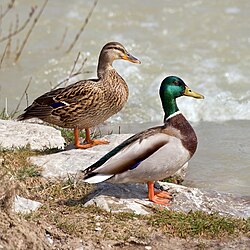
The Mallard is a dabbling duck that is the ancestor of most domestic duck breeds. It is highly adaptable and widely distributed across the Northern Hemisphere, inhabiting a variety of wetland environments. Males are easily recognizable by their iridescent green head, while females have a mottled brown plumage.
Dimensioni e longevità
- Lunghezza
- 50-65 cm (20-26 in)
- Apertura alare
- 81-98 cm (32-39 in)
- Peso
- 720-1580 g (1.6-3.5 lbs)
- Longevità
- 5-10 years in the wild, up to 20 years in captivity
- Dieta
- Omnivore, primarily consuming seeds, aquatic vegetation, insects, larvae, worms, gastropods, and small fish.
Caratteristiche fisiche
- Piumaggio
- Male (drake) in breeding plumage: iridescent green head and neck, white neck ring, chestnut breast, grey flanks, black rear, and a curled black central tail feather. Female (hen): mottled brown plumage with a dark eye-stripe and an orange-brown bill. Both sexes have a distinctive iridescent blue speculum (wing patch) bordered by white.
- Forma del becco
- Spatulate (flat and broad) bill. Male's bill is yellowish-green, female's is orange with a dark saddle or blotches.
- Colore degli occhi
- Dark brown.
- Colore delle zampe
- Orange to reddish-orange in both sexes.
- Caratteristiche distintive
- The male's green head and white neck ring are unmistakable. The blue speculum on the wing is a key identifier for both sexes in flight or when wings are partially open. The female's mottled brown plumage is typical of many dabbling ducks, but the orange bill with dark markings and blue speculum help distinguish it.
- Aspetto giovanile
- Juveniles resemble adult females, but are generally duller with less distinct markings. Young males may show hints of green on the head and chestnut on the breast as they mature.
- Cambiamenti stagionali
- Males undergo an 'eclipse' plumage after breeding (late summer to early autumn), where they resemble females, becoming duller brown with some residual green on the head. They regain their vibrant breeding plumage by late autumn/early winter.
- Dimorfismo sessuale
- Pronounced. Males are much more brightly colored with the distinctive green head, white neck ring, and chestnut breast. Females are cryptically colored in mottled browns for camouflage during nesting.
Come identificare
- 1
Male Plumage (Breeding)
Look for the iridescent green head, white neck ring, chestnut breast, and grey body. The yellow-green bill is also distinctive.
- 2
Female Plumage
Observe the mottled brown body, dark eye-stripe, and orange bill with dark markings. The overall pattern is less uniform than some other brown ducks.
- 3
Speculum
Both sexes have a bright iridescent blue speculum (wing patch) bordered by white. This is visible in flight or when the wings are slightly open, and is a key field mark.
- 4
Bill Color and Shape
Males have a yellowish-green bill; females have an orange bill with a dark saddle or blotches. The bill is broad and flat (spatulate).
- 5
Vocalization
Listen for the female's classic loud 'quack' series. Males have a softer, rasping 'raeb' and a courtship whistle.
- 6
Behavior
Observe their dabbling feeding behavior, tipping head-first into shallow water. They are often seen in mixed-species flocks with other dabbling ducks.
Habitat e areale
- Biomi
- Wetlands, including freshwater and brackish marshes, ponds, lakes, rivers, estuaries, and coastal areas. Also found in urban parks and agricultural lands.
- Areale geografico
- Holarctic distribution, breeding across temperate and subtropical regions of North America, Europe, Asia, and parts of North Africa. Introduced to Australia, New Zealand, and other areas.
- Fascia altitudinale
- Primarily lowlands, but can be found at moderate elevations where suitable water bodies exist.
- Ambienti preferiti
- Shallow, calm waters with abundant aquatic vegetation for feeding and cover. Often found in close proximity to human settlements.
Comportamento
- Periodo di attività
- Diurnal, most active during dawn and dusk, but can be active throughout the day.
- Abitudini alimentari
- Dabbling duck, feeding by tipping forward to submerge its head and neck, sifting food from the water or mud with its bill. Also grazes on land. Feeds on a wide variety of plant material (seeds, roots, stems, leaves) and invertebrates.
- Comportamento sociale
- Highly social, often found in large flocks, especially outside the breeding season. During breeding, pairs are formed, but they may still forage in small groups.
- Tipo di volo
- Strong, direct flight with rapid wingbeats. Can take off almost vertically from water. Often flies in V-formations or lines during migration.
- Migrazione
- Partial migrant. Northern populations are migratory, moving south for winter. Southern populations are resident year-round. Migration occurs primarily at night.
- Territorialità
- Males can be territorial during the breeding season, defending their mate and nesting area, though not as aggressively as some other duck species.
Canto e richiami
- Canto
- Males have a softer, rasping 'raeb' or 'quack' and a distinctive high-pitched whistle used in courtship. Females produce the classic loud, descending 'quack-quack-quack-quack' series, which is the most recognizable duck call.
- Richiamo
- Female's loud 'quack' series is used for communication, alarm, and attracting mates. Males have a quieter, more guttural 'quack' and a variety of whistles and grunts during courtship.
- Quando vocalizza
- Vocalize year-round, with increased calling during the breeding season and when disturbed.
Riproduzione
- Stagione riproduttiva
- Typically March to July, varying by geographic location.
- Abitudini di nidificazione
- Nests are usually built on the ground, often hidden in dense vegetation near water, but can also be found in tree cavities or elevated structures. The nest is a shallow depression lined with grass, leaves, and down feathers plucked from the female's breast.
- Dimensione della covata
- Usually 8-13 eggs.
- Descrizione dell'uovo
- 6-15 eggs, typically pale greenish-buff to creamy white, unspotted. Average size is 57 x 41 mm.
- Periodo di incubazione
- 27-28 days, incubated solely by the female.
- Periodo di involo
- Ducklings are precocial, leaving the nest within hours of hatching. They are able to fly at 50-60 days old.
- Cure parentali
- Only the female cares for the ducklings, leading them to water and teaching them to forage. Males typically abandon the female after incubation begins.
Dove trovarlo
Urban Parks and Ponds
Mallards are highly accustomed to humans and are frequently found in city parks, ornamental ponds, and golf courses.
Lakes and Rivers
Look for them on the edges of freshwater lakes, slow-moving rivers, and streams, especially where there is emergent vegetation.
Marshes and Wetlands
Natural wetland habitats, including freshwater and brackish marshes, provide ideal foraging and nesting grounds.
Estuaries and Coastal Areas
During winter or migration, they can be found in sheltered coastal bays and estuaries.
Consigli sul campo
- Look for movement on the water. Mallards are often seen dabbling, swimming, or resting on the water's surface. Their distinctive head-dipping feeding behavior is a good clue.
- Listen for calls. The female's loud 'quack' is unmistakable and can often lead you to a group of Mallards before you see them.
- Check for mixed flocks. Mallards often associate with other dabbling ducks like American Wigeons, Northern Pintails, and Green-winged Teals, especially outside the breeding season.
- Observe plumage details. Pay close attention to the head color, bill color, and the blue speculum on the wing to confirm identification, especially for females and eclipse males.
Specie simili
American Black Duck
Anas rubripes
Similar in size and shape, but the American Black Duck is uniformly dark sooty-brown with a paler head and a dark crown. It lacks the Mallard's iridescent green head (male) or mottled brown pattern (female). The speculum is purple, not blue, and often lacks white borders.
Mottled Duck
Anas fulvigula
Resembles a female Mallard but is darker overall, with a more uniform brown body and a less distinct eye-stripe. The bill is typically yellow to orange with a dark spot at the base, and the speculum is blue-green without white borders.
Mexican Duck
Anas diazi
Often considered a subspecies of Mallard (Anas platyrhynchos diazi). It is similar to the female Mallard but generally darker, with a less distinct eye-stripe and a blue-green speculum that may or may not have white borders. Males lack the green head of the Mallard drake.
Domestic Ducks
Anas platyrhynchos domesticus
Many domestic duck breeds are derived from Mallards and can interbreed, leading to a wide variety of plumages. Domestic ducks are often larger, heavier, and come in various colors (white, black, pied) not typically seen in wild Mallards. They may also have different bill shapes or crests.
Fatti rapidi
- Type:
- Dabbling Duck
- Diet:
- Omnivore
- Habitat:
- Wetlands, Ponds, Rivers
- Conservation Status:
- Least Concern
- Sexual Dimorphism:
- Pronounced
- Migration:
- Partial Migrant
Curiosità
- The Mallard is the most abundant and widespread duck species in the world.
- Almost all domestic duck breeds, except for the Muscovy Duck, are descended from the Mallard.
- Mallards can interbreed with many other duck species, producing fertile hybrids.
- The male Mallard's curled tail feather is a unique characteristic not found in females or most other duck species.
- Mallards are highly adaptable and can thrive in both wild and urban environments, often becoming quite tame around humans.
Classificazione scientifica
- Regno
- Animalia
- Phylum
- Chordata
- Classe
- Aves
- Ordine
- Anseriformes
- Famiglia
- Anatidae
- Genere
- Anas
- Specie
- Anas platyrhynchos
Esplora Mallard
Identifica uccelli ovunque
Gratis su iOS, Android e Web. Identificazione per foto e suono, database completo e la tua lista personale.