
Visto un uccello? Identificalo all'istante con l'app Birdby
Apri l'appInformazioni
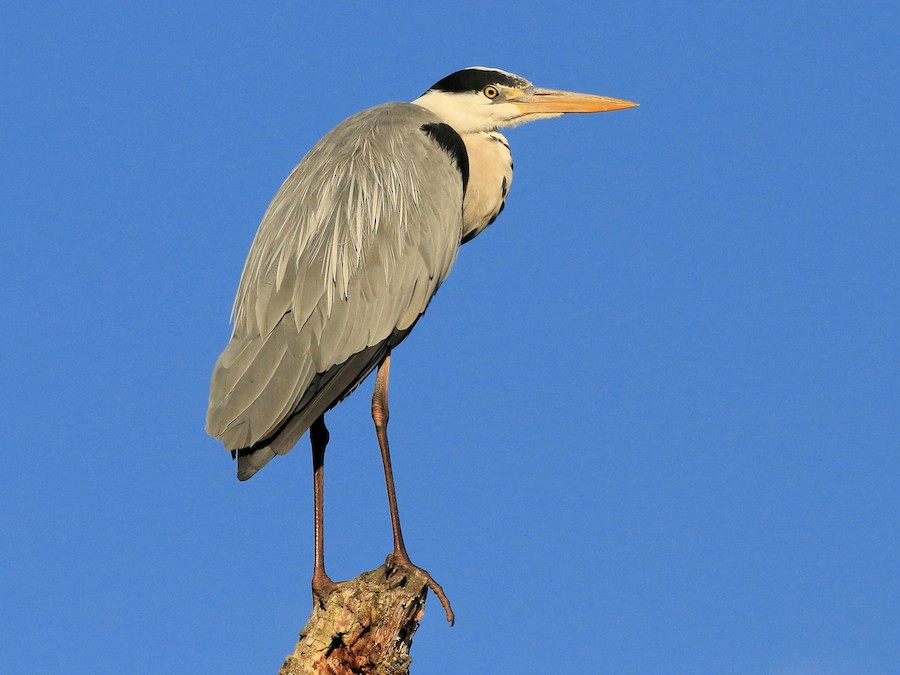
The Grey Heron (Ardea cinerea) is a large, long-legged, long-necked wading bird, common throughout temperate Europe and Asia and also parts of Africa. It is a highly adaptable species, found in a wide variety of wetland habitats. Known for its patient hunting style, it often stands motionless in shallow water, waiting for prey to come within striking distance.
Dimensioni e longevità
- Lunghezza
- 90-100 cm (35-39 in)
- Apertura alare
- 175-195 cm (69-77 in)
- Peso
- 1.0-2.1 kg (2.2-4.6 lb)
- Longevità
- Typically 5-15 years in the wild, with records up to 25 years.
- Dieta
- Carnivore, primarily piscivorous (fish-eating), but highly opportunistic.
Caratteristiche fisiche
- Piumaggio
- Adults have a predominantly grey back and wings, with white underparts. The neck is whitish with black streaks running down the front. The head is white with a broad black stripe extending from above the eye to form a crest of elongated black plumes at the nape. The flight feathers are blackish.
- Forma del becco
- Long, strong, dagger-like, and yellowish-pink to orange-yellow, becoming brighter orange during breeding season.
- Colore degli occhi
- Yellow with a greenish tinge.
- Colore delle zampe
- Dull greenish-grey, becoming reddish during breeding season.
- Caratteristiche distintive
- Its large size, grey and white plumage, long S-curved neck, and slow, deliberate flight with retracted neck are highly distinctive. The black crest plumes are prominent in adults.
- Aspetto giovanile
- Juveniles are duller overall, with a more uniform grey head and neck, lacking the distinct black stripe and crest plumes of adults. Their plumage is browner-grey, and the beak is duller, often greyish-yellow.
- Cambiamenti stagionali
- Breeding adults develop longer, more prominent black crest plumes and scapular plumes (long feathers on the back). The beak and legs become brighter, often reddish-orange, during the breeding season. Non-breeding plumage is similar but lacks the enhanced plumes and vibrant coloration.
- Dimorfismo sessuale
- Males and females are generally monomorphic in plumage, though males can be slightly larger. During breeding season, males may exhibit slightly more prominent crest plumes and brighter leg/beak coloration.
Come identificare
- 1
Size and Shape
Look for a very large, tall bird with long legs, a long S-curved neck, and a dagger-like bill. In flight, the neck is retracted, and legs trail behind.
- 2
Plumage Coloration
Adults are predominantly grey on the back and wings, white underneath, with a white head and a prominent black stripe extending from the eye to the nape, forming a crest. Juveniles are duller, browner-grey, with a less defined head pattern.
- 3
Behavior
Often seen standing motionless at the water's edge, patiently waiting for prey. Its slow, deliberate movements are characteristic.
- 4
Flight
Observe its slow, powerful wing beats and the distinctive S-shaped neck in flight. This distinguishes it from storks or cranes, which fly with extended necks.
- 5
Call
Listen for its harsh, croaking 'fraaank' call, especially when disturbed or in flight.
Habitat e areale
- Biomi
- Wetlands, including freshwater, brackish, and coastal environments.
- Areale geografico
- Widespread across Europe, Asia (from the Urals to Japan), and parts of Africa (south of the Sahara, Madagascar). Also found in some Atlantic islands.
- Fascia altitudinale
- Primarily lowlands, but can be found up to 2,000 meters (6,500 ft) in some mountainous regions if suitable water bodies are present.
- Ambienti preferiti
- Lakes, rivers, ponds, marshes, estuaries, coastal lagoons, flooded meadows, canals, reservoirs, and even garden ponds. Requires shallow water for foraging and nearby trees for nesting.
Comportamento
- Periodo di attività
- Diurnal, primarily active during the day, especially at dawn and dusk. May hunt nocturnally during full moon or in urban areas with artificial light.
- Abitudini alimentari
- A patient ambush predator. It typically stands motionless in shallow water, waiting for prey to pass, then strikes with a rapid thrust of its neck and bill. It also stalks slowly through water or on land. Diet includes fish, amphibians (frogs, newts), reptiles (snakes, lizards), small mammals (voles, shrews), insects, crustaceans, and occasionally small birds.
- Comportamento sociale
- Generally solitary when foraging, but often forms communal roosts and breeds in colonies (heronries), sometimes with other heron species. Juveniles may form small groups.
- Tipo di volo
- Slow, deliberate wing beats with its long neck retracted into an S-shape and legs trailing behind. Appears large and somewhat ungainly in flight, but powerful.
- Migrazione
- Northern populations are migratory, moving south to warmer regions in winter (e.g., from Scandinavia to southern Europe or Africa). Central and southern European populations are largely resident or undertake short-distance dispersal. African populations are mostly resident.
- Territorialità
- Defends a small foraging territory when hunting, especially against other herons. Breeding colonies are communal, but individual nests are defended.
Canto e richiami
- Canto
- Does not have a true song. Vocalizations are generally harsh and guttural.
- Richiamo
- Most common call is a loud, harsh, croaking 'fraaank' or 'kraaak', often given in flight or when disturbed. Also produces a variety of squawks, grunts, and hisses at the nest, especially by chicks and during courtship displays.
- Quando vocalizza
- Mainly vocal during flight, when disturbed, or at the breeding colony. Less vocal when foraging alone.
Riproduzione
- Stagione riproduttiva
- Varies geographically, typically February to July in temperate Europe, earlier in warmer regions. Can be year-round in tropical areas.
- Abitudini di nidificazione
- Nests colonially in heronries, often high in trees (deciduous or coniferous), but sometimes in reedbeds or on cliffs. Nests are large, bulky platforms made of sticks, twigs, and reeds, lined with finer material. Nests are reused and added to each year.
- Dimensione della covata
- Typically 3-5 eggs.
- Descrizione dell'uovo
- 3-5 (occasionally 2-7) pale blue-green, unmarked eggs. Oval to sub-elliptical shape.
- Periodo di incubazione
- 25-26 days, incubated by both parents.
- Periodo di involo
- Chicks fledge (leave the nest) at 50-55 days, but remain dependent on parents for several weeks thereafter.
- Cure parentali
- Both parents share incubation duties and feed the young by regurgitation. Young are altricial (helpless at birth) and require extensive parental care.
Dove trovarlo
Lakes and Ponds
Look along the edges of freshwater lakes, ponds, and reservoirs, especially where there are reeds or emergent vegetation.
Rivers and Canals
Often found along slow-moving rivers, canals, and drainage ditches, particularly in areas with shallow water.
Coastal Areas
Estuaries, tidal flats, saltmarshes, and coastal lagoons are favored habitats, especially during low tide.
Flooded Fields and Marshes
Will forage in temporarily flooded agricultural fields or extensive marshlands.
Urban Parks and Gardens
Increasingly common in urban environments with suitable water features, including large garden ponds.
Consigli sul campo
- Patience is Key. Grey Herons are often very still when hunting. Scan the water's edge carefully, looking for their distinctive silhouette.
- Look for Roosts and Colonies. In winter, look for communal roosts in tall trees. During breeding season, locate heronries (colonies) in large trees near water bodies.
- Dawn and Dusk. While diurnal, they are often most active and visible during the quieter hours of dawn and dusk.
- Check Urban Water Bodies. Don't overlook city parks, golf courses, or even large garden ponds, as they have adapted well to human presence.
- Listen for Calls. Their harsh 'fraaank' call is often the first indication of their presence, especially when they take flight.
Specie simili
Great Blue Heron
Ardea herodias
Found in North America. Very similar in appearance but generally larger, with a more bluish-grey plumage and often a rufous wash on the neck and thighs. The black stripe on the head is typically narrower and less extensive than in the Grey Heron.
Purple Heron
Ardea purpurea
Smaller and more slender than the Grey Heron. Plumage is distinctly darker, with a reddish-brown neck and chest, and a more purplish-grey back. The neck is often held more extended in flight. Prefers denser reedbeds.
Goliath Heron
Ardea goliath
Much larger (the largest heron in the world) and found in Africa. Distinctive rufous neck and underparts, with a grey back and wings. Its sheer size and coloration easily distinguish it.
Fatti rapidi
- Diet:
- Fish, amphibians, small mammals, insects
- Habitat:
- Various wetlands, fresh and saltwater
- Nesting:
- Colonial, in trees or reedbeds
- Flight:
- Slow wing beats, S-curved neck
- Conservation Status:
- Least Concern
Curiosità
- The Grey Heron can swallow fish surprisingly large for its size, thanks to its flexible neck and expandable throat.
- They have specialized 'powder down' feathers that continuously grow and fray, producing a fine powder used to clean fish slime and other oils from their plumage.
- Despite their large size, Grey Herons are relatively light, with hollow bones, which aids in flight.
- In some cultures, the Grey Heron is seen as a symbol of patience and tranquility due to its motionless hunting style.
- They are known to 'fish' using bait, dropping feathers or insects onto the water surface to attract fish, a rare behavior among birds.
Classificazione scientifica
- Regno
- Animalia
- Phylum
- Chordata
- Classe
- Aves
- Ordine
- Pelecaniformes
- Famiglia
- Ardeidae
- Genere
- Ardea
- Specie
- Ardea cinerea
Esplora Grey Heron
Identifica uccelli ovunque
Gratis su iOS, Android e Web. Identificazione per foto e suono, database completo e la tua lista personale.