
Visto un uccello? Identificalo all'istante con l'app Birdby
Apri l'appInformazioni
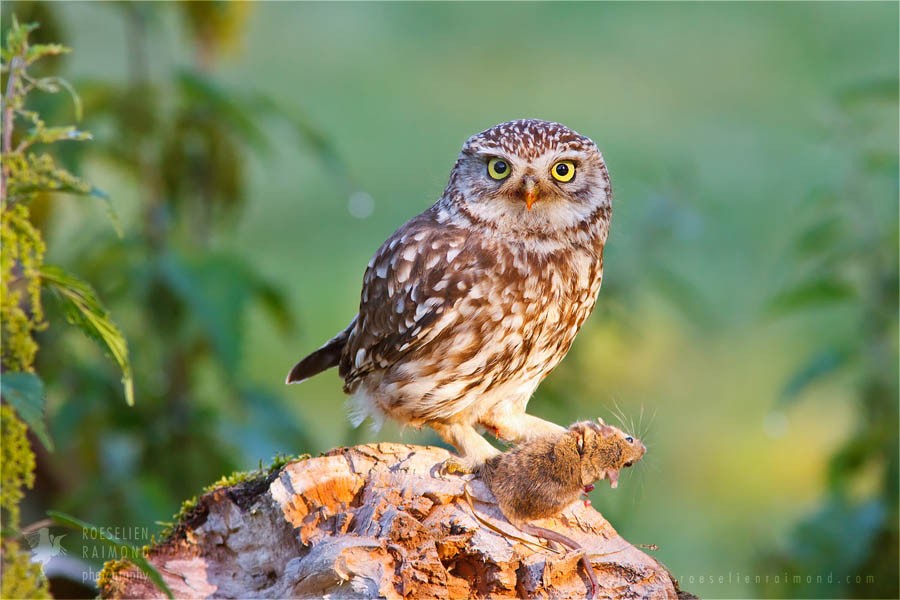
The Little Owl (Athene noctua) is a small, compact owl with a flattened head and long legs. It is primarily crepuscular and nocturnal but can often be seen hunting during the day, especially in overcast weather or when feeding young. Known for its distinctive 'bobbing' head movement when alert, it is a widespread and adaptable species across much of Eurasia and North Africa.
Dimensioni e longevità
- Lunghezza
- 21-27 cm
- Apertura alare
- 54-58 cm
- Peso
- 100-220 g (males typically smaller than females)
- Longevità
- Up to 15 years in the wild, typically 3-6 years
- Dieta
- Carnivore (primarily insects, small mammals, and birds)
Caratteristiche fisiche
- Piumaggio
- Upperparts are grey-brown, heavily streaked and spotted with white or pale buff. Underparts are whitish with broad, dark brown streaks. The facial disc is not well-defined, and it lacks ear tufts. Distinctive white 'eyebrows' give it a stern expression.
- Forma del becco
- Short, strongly hooked, and pale yellowish-horn to greenish-yellow.
- Colore degli occhi
- Bright yellow, giving it a piercing gaze.
- Colore delle zampe
- Feathered legs down to the toes, which are yellowish-grey with dark claws.
- Caratteristiche distintive
- Small size, flattened head, bright yellow eyes, prominent white 'eyebrows', heavily spotted upperparts, and a characteristic 'bobbing' head movement when agitated or curious. Often perches conspicuously on posts, rocks, or buildings.
- Aspetto giovanile
- Similar to adults but generally duller, with less distinct spotting and streaking. The plumage can appear softer and fluffier, and the facial markings may be less pronounced.
- Cambiamenti stagionali
- No significant seasonal plumage changes. Plumage remains consistent year-round.
- Dimorfismo sessuale
- Minimal; females are typically slightly larger and heavier than males, but plumage is identical.
Come identificare
- 1
Size and Shape
Look for a small, compact owl with a relatively flat head and long legs. It often appears 'squat' when perched.
- 2
Eyes and Facial Expression
Bright yellow eyes with prominent white 'eyebrows' give it a distinctive, stern, or 'frowning' expression. No ear tufts.
- 3
Plumage Pattern
Grey-brown upperparts heavily spotted with white/buff, and whitish underparts with bold dark streaks. This mottled pattern provides excellent camouflage.
- 4
Perching Behavior
Often perches conspicuously on exposed sites like fence posts, telephone poles, rocks, or low branches, even during the day.
- 5
Head Bobbing
A characteristic behavior when alert or curious is to bob its head up and down or swivel it from side to side.
- 6
Vocalization
Listen for its distinctive, mournful 'goo-ek' or 'kiew' call, especially at dusk and dawn.
Habitat e areale
- Biomi
- Temperate grasslands, shrublands, agricultural lands, open woodlands, semi-deserts, and urban/suburban areas.
- Areale geografico
- Widespread across Europe (excluding northern Scandinavia and Ireland), North Africa, and much of Asia, extending east to Korea and China. Introduced to New Zealand and parts of the UK.
- Fascia altitudinale
- Sea level up to 3,000 meters, though typically found at lower to mid-elevations.
- Ambienti preferiti
- Open, cultivated landscapes with scattered trees, old orchards, ruins, stone walls, farm buildings, quarries, and rocky outcrops. Requires suitable nesting cavities and perches for hunting.
Comportamento
- Periodo di attività
- Primarily crepuscular (dawn and dusk) and nocturnal, but frequently active and hunts during the day, particularly when food is scarce or during the breeding season to feed young.
- Abitudini alimentari
- Opportunistic predator. Hunts from a perch, swooping down on prey, or by running on the ground. Diet includes a wide range of invertebrates (beetles, crickets, earthworms) and small vertebrates (voles, mice, shrews, small birds, lizards, frogs). Pellets are regularly regurgitated.
- Comportamento sociale
- Generally solitary or found in pairs during the breeding season. Highly territorial, especially around nesting sites. Can be quite bold and tolerant of human presence in some areas.
- Tipo di volo
- Undulating, rather 'bouncy' flight with rapid wing beats, often close to the ground. Can hover briefly. When disturbed, it often flies a short distance and perches conspicuously.
- Migrazione
- Mostly sedentary and resident throughout its range. Juveniles may disperse short distances from their natal territories, but long-distance migration is rare.
- Territorialità
- Highly territorial, especially during the breeding season. Pairs defend their nesting and hunting territories vigorously against intruders, often using vocalizations and aggressive displays.
Canto e richiami
- Canto
- The male's primary song is a mournful, drawn-out 'goo-ek' or 'kiew' repeated at intervals, often with a slight upward inflection. It can also produce a more rapid, hooting 'hoo-hoo-hoo' series.
- Richiamo
- A variety of calls including sharp 'kew-kew' alarm calls, a harsh 'chick-chick' when agitated, and a soft 'hoo' contact call. Juveniles emit a persistent, high-pitched 'psss-psss' begging call.
- Quando vocalizza
- Most vocal during the breeding season (late winter to early summer), particularly at dusk and dawn. Can also be heard throughout the night and occasionally during the day.
Riproduzione
- Stagione riproduttiva
- Typically March to July, with peak egg-laying in April-May.
- Abitudini di nidificazione
- Nests in cavities, often in old trees (especially fruit trees), rock crevices, abandoned burrows (e.g., rabbit burrows), stone walls, ruins, and nest boxes. No nest material is added, eggs are laid directly on the substrate.
- Dimensione della covata
- 3-5 eggs, occasionally 2-8.
- Descrizione dell'uovo
- White, smooth, and slightly glossy. Oval to roundish in shape. Average size: 34.5 x 29.5 mm.
- Periodo di incubazione
- 28-29 days, primarily by the female.
- Periodo di involo
- Young fledge at around 30-35 days old but remain dependent on parents for several weeks thereafter.
- Cure parentali
- Both parents care for the young. The female incubates and broods, while the male provides food. After hatching, both parents hunt to feed the growing owlets.
Dove trovarlo
Agricultural Land
Look in areas with old farm buildings, stone walls, hedgerows, and scattered trees.
Old Orchards and Vineyards
These provide ideal nesting cavities in old trees and good hunting grounds.
Quarries and Rocky Outcrops
Natural rock crevices offer excellent nesting and roosting sites.
Ruins and Historic Buildings
Old structures with cavities and sheltered spots are often favored.
Suburban Gardens and Parks
In some regions, they adapt well to human-modified landscapes, especially if old trees or suitable structures are present.
Consigli sul campo
- Scan Perches. Systematically scan fence posts, telephone wires, low branches, and prominent rocks, especially at dawn and dusk, or on overcast days.
- Listen for Calls. Learn their distinctive calls. Listening for their 'goo-ek' can often lead you to their location before you see them.
- Look for Pellets. Check beneath favored perches or potential roosting sites for regurgitated pellets, which indicate their presence.
- Observe Behavior. Watch for their characteristic head-bobbing or short, undulating flights between perches.
- Check Cavities. During the breeding season, observe old trees, walls, or burrows for signs of activity, such as parents bringing food.
Specie simili
Tawny Owl
Strix aluco
Tawny Owls are significantly larger (37-43 cm), lack yellow eyes (dark eyes), have a more rounded head, and a more defined facial disc. They are strictly nocturnal and typically inhabit denser woodlands.
Pygmy Owl
Glaucidium passerinum
Pygmy Owls are much smaller (15-19 cm), have a more upright posture, and often show 'false eyes' on the back of their head. They are primarily diurnal and found in coniferous forests.
Short-eared Owl
Asio flammeus
Short-eared Owls are larger (34-43 cm), have longer wings, a more buoyant flight, and typically inhabit open grasslands and marshes. They have small ear tufts (often not visible) and a different facial pattern.
Fatti rapidi
- Activity:
- Crepuscular/Nocturnal (often diurnal)
- Diet:
- Insects, small mammals, small birds
- Nesting:
- Cavity nester (trees, rocks, buildings)
- Migration:
- Resident
- Conservation:
- Least Concern
Curiosità
- The Little Owl is associated with the Greek goddess Athena, symbolizing wisdom, and is often depicted on ancient Greek coins.
- Despite its small size, it is a fierce predator and can take prey almost as large as itself.
- They are known to store food, especially during periods of abundance, caching prey in their nesting or roosting cavities.
- Their ability to hunt during the day makes them one of the most frequently observed owl species in many parts of their range.
- In some areas, they have adapted well to urban environments, nesting in buildings and hunting in gardens.
Classificazione scientifica
- Regno
- Animalia
- Phylum
- Chordata
- Classe
- Aves
- Ordine
- Strigiformes
- Famiglia
- Strigidae
- Genere
- Athene
- Specie
- Athene noctua
Esplora Little Owl
Identifica uccelli ovunque
Gratis su iOS, Android e Web. Identificazione per foto e suono, database completo e la tua lista personale.