
Visto un uccello? Identificalo all'istante con l'app Birdby
Apri l'appInformazioni
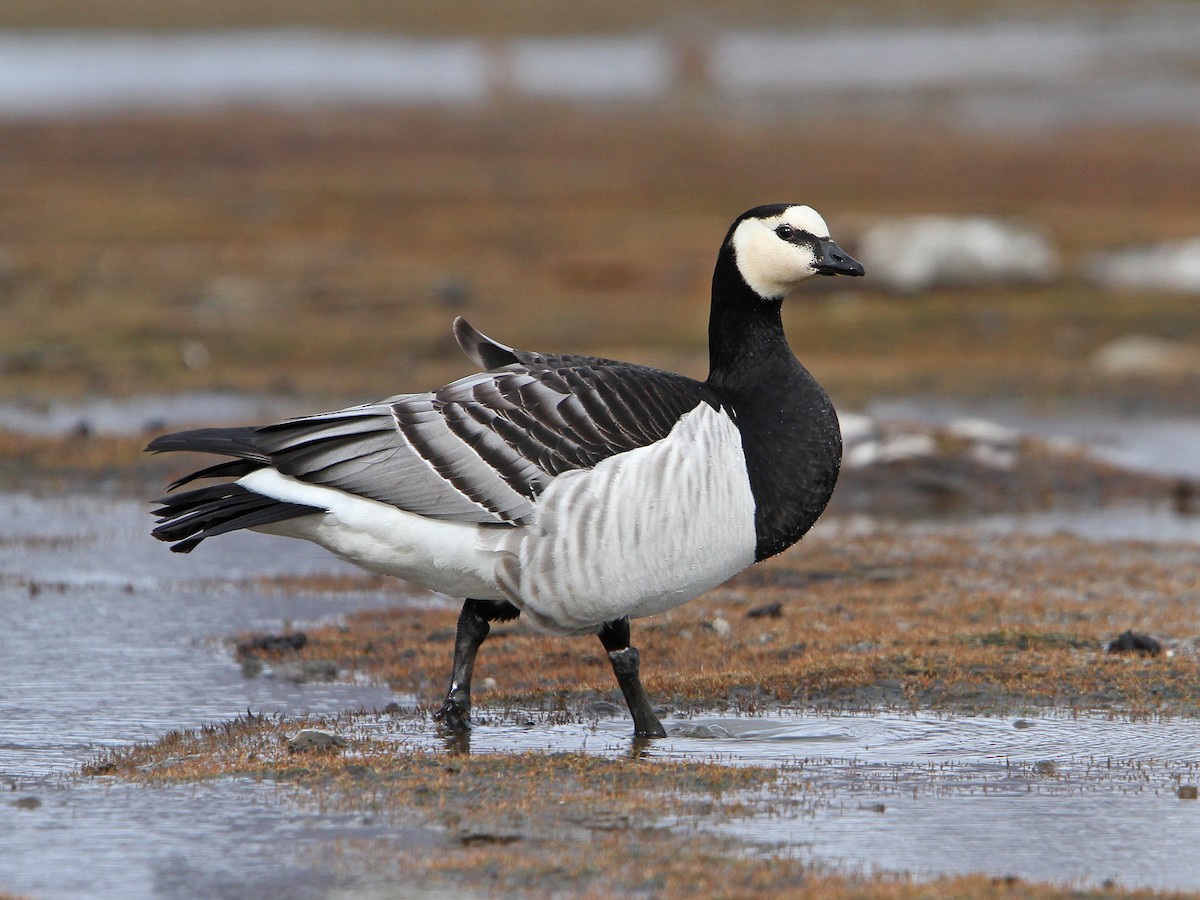
The Barnacle Goose is a medium-sized goose, easily recognized by its striking black, white, and grey plumage. It is a migratory species, breeding in the Arctic regions and wintering in temperate coastal areas of northwestern Europe. Known for its distinctive 'barnacle' facial pattern, it often forms large flocks outside the breeding season.
Dimensioni e longevità
- Lunghezza
- 55-70 cm (22-28 in)
- Apertura alare
- 130-145 cm (51-57 in)
- Peso
- 1.2-2.2 kg (2.6-4.9 lbs)
- Longevità
- Up to 18 years in the wild, typically 10-15 years.
- Dieta
- Herbivore
Caratteristiche fisiche
- Piumaggio
- Adults have a black neck, breast, and crown, contrasting sharply with a white face and forehead. The back and upperwings are barred grey and black, giving a 'barnacled' appearance, while the underparts are white. The tail is black.
- Forma del becco
- Short, triangular, and black.
- Colore degli occhi
- Dark brown
- Colore delle zampe
- Black
- Caratteristiche distintive
- The prominent white face, bordered by black, is the most distinctive feature. The black neck and breast, and the grey-barred back, further aid identification. In flight, the white underparts and dark wingtips are noticeable.
- Aspetto giovanile
- Juveniles resemble adults but have duller plumage. The black areas are often tinged with brown, and the white face may be smudged with grey or black. The barring on the back is less distinct, and the white underparts may appear dirtier. The bill and legs are also duller.
- Cambiamenti stagionali
- No significant seasonal plumage changes. The plumage remains consistent throughout the year, though wear and tear can make it appear slightly duller towards the end of the non-breeding season before the annual molt.
- Dimorfismo sessuale
- Males and females are virtually identical in plumage and size, making them difficult to distinguish visually in the field. Males may be slightly larger on average, but this is not a reliable field mark.
Come identificare
- 1
Facial Pattern
Look for the bright white face contrasting sharply with the black crown, neck, and breast. This is the most definitive field mark.
- 2
Plumage Coloration
Note the black neck and breast, the grey-barred back and upperwings, and the clean white underparts. The tail is black.
- 3
Size and Shape
Medium-sized goose, smaller than a Greylag but larger than a Brent Goose. It has a relatively short neck and a compact body.
- 4
Vocalization
Listen for the distinctive, high-pitched, yapping 'kow-ark' calls, often given repeatedly, especially by flying flocks.
- 5
Behavior
Observe its grazing behavior in open fields or coastal areas. They are often found in large, cohesive flocks.
Habitat e areale
- Biomi
- Tundra, coastal wetlands, saltmarshes, agricultural grasslands, estuaries.
- Areale geografico
- Breeds in Arctic regions of Greenland, Svalbard, Novaya Zemlya, and occasionally northern Russia. Winters primarily along the coasts of Ireland, Great Britain, the Netherlands, Germany, and Denmark, with smaller numbers in other parts of northwestern Europe.
- Fascia altitudinale
- Typically found at sea level to low elevations, especially during wintering. Breeding grounds can be at higher altitudes on cliffs.
- Ambienti preferiti
- During breeding, they prefer rocky cliffs, islands, and tundra near freshwater. In winter, they favor coastal grasslands, saltmarshes, estuaries, and increasingly, agricultural fields (e.g., pastures, winter cereals) for grazing.
Comportamento
- Periodo di attività
- Diurnal. They feed during daylight hours and roost communally at night, often on water or safe open ground.
- Abitudini alimentari
- Strictly herbivorous, primarily grazing on short grasses, sedges, and other low-growing vegetation. They will also consume agricultural crops like winter wheat and oilseed rape in wintering areas. They feed by plucking vegetation with their short bills.
- Comportamento sociale
- Highly gregarious, especially outside the breeding season. They form large, often noisy, flocks for feeding and roosting. During breeding, they are more dispersed but still often nest in loose colonies.
- Tipo di volo
- Strong, direct flight with relatively rapid wingbeats. They fly in V-formations or irregular lines during migration, often at considerable altitudes. Their flight call is distinctive.
- Migrazione
- Long-distance migratory. They breed in the high Arctic during the short summer and undertake extensive migrations south to their wintering grounds in temperate Europe. Migration occurs in large flocks, typically from September to November and March to May.
- Territorialità
- During the breeding season, pairs defend a small territory around their nest site, particularly against other Barnacle Geese. In wintering areas, they are not territorial and feed communally.
Canto e richiami
- Canto
- Barnacle Geese do not have a complex song. Their vocalizations are primarily calls.
- Richiamo
- The most characteristic call is a loud, yapping, dog-like 'kow-ark' or 'rark-rark', often given in a rapid series. This call is highly distinctive and can be heard from considerable distances, especially from flying flocks. They also produce softer conversational honks and hisses.
- Quando vocalizza
- Vocalize frequently, especially when in flocks, during flight, and when disturbed. Calls are heard year-round but are particularly prominent during migration and in wintering flocks.
Riproduzione
- Stagione riproduttiva
- May to July, with egg-laying typically in late May to early June.
- Abitudini di nidificazione
- Nests are typically built on inaccessible cliffs, rocky outcrops, or small islands, often in loose colonies, providing protection from ground predators. The nest is a shallow scrape lined with moss, lichens, and down feathers.
- Dimensione della covata
- Usually 3-7 eggs, most commonly 4-6.
- Descrizione dell'uovo
- Typically 4-6 eggs, smooth, elliptical, and creamy white, becoming stained during incubation. Average size is about 73 x 48 mm.
- Periodo di incubazione
- 24-26 days, primarily by the female.
- Periodo di involo
- 40-45 days. Goslings are precocial and leave the nest shortly after hatching, often making a perilous jump from cliff nests. They are able to fly at about 6-7 weeks old.
- Cure parentali
- Both parents care for the goslings, leading them to feeding areas and protecting them from predators. Family groups remain together for the first year, often migrating together.
Dove trovarlo
Coastal Wetlands and Estuaries
Prime wintering habitat, especially in northwestern Europe. Look for them grazing on saltmarshes and mudflats at low tide.
Agricultural Grasslands
Increasingly common in winter on pastures and fields planted with winter cereals, often near coastal areas.
Arctic Breeding Grounds
During summer, they can be found on rocky cliffs and islands in Greenland, Svalbard, and Novaya Zemlya.
Nature Reserves and Bird Sanctuaries
Many protected areas along the European coast provide safe havens for wintering flocks.
Consigli sul campo
- Scan large flocks. Barnacle Geese are highly gregarious. Look for them among other geese species or in pure flocks in open areas.
- Listen for calls. Their distinctive yapping calls are often heard before the birds are seen, especially when they are flying overhead.
- Use optics. Binoculars or a spotting scope are essential for observing details of their plumage and distinguishing them from similar species, especially at a distance.
- Check coastal areas in winter. Focus your search on coastal regions of Ireland, Great Britain, and the Wadden Sea during the non-breeding season (October-March).
- Observe flight patterns. Migrating flocks often fly in V-formations, and their calls are particularly noticeable during these movements.
Specie simili
Canada Goose
Branta canadensis
The Canada Goose is generally larger, has a brown body, a black neck, and a distinctive white 'chinstrap' across its throat, rather than the Barnacle Goose's entirely white face.
Brent Goose (Dark-bellied)
Branta bernicla bernicla
The Brent Goose is smaller and darker overall, with a very dark grey-brown body and a small white patch on the side of its neck, not a full white face. Its call is a low, guttural 'rronk'.
Greylag Goose
Anser anser
The Greylag Goose is larger and entirely grey-brown, lacking the striking black and white pattern of the Barnacle Goose. It has an orange bill and pink legs, contrasting with the Barnacle Goose's black bill and legs.
Fatti rapidi
- Etymology:
- Named after the medieval belief that they hatched from barnacles.
- Migration Distance:
- Can migrate thousands of kilometers between Arctic breeding grounds and European wintering areas.
- Nesting Challenge:
- Goslings often have to jump from high cliff nests shortly after hatching to reach feeding grounds below.
- Social Structure:
- Highly social, forming strong family bonds that last through the first year.
- Population Growth:
- Populations have generally increased in recent decades due to conservation efforts and adaptation to agricultural landscapes.
Curiosità
- In medieval times, it was believed that Barnacle Geese were born from barnacles attached to driftwood, hence their name. This myth allowed them to be eaten during Lent, as they were not considered 'meat'.
- Barnacle Goose goslings are famous for their perilous first journey, often jumping from cliffs hundreds of feet high to reach the ground and their parents below.
- There are three main populations of Barnacle Geese, each with distinct breeding and wintering grounds: the Greenland population, the Svalbard population, and the Baltic/North Sea population (breeding in Novaya Zemlya and Russia).
- They are known for their strong pair bonds, often mating for life, and family groups stay together for the entire first year, including during migration.
- Barnacle Geese have adapted well to human-modified landscapes, increasingly utilizing agricultural fields for grazing during winter, which has contributed to their population recovery.
Classificazione scientifica
- Regno
- Animalia
- Phylum
- Chordata
- Classe
- Aves
- Ordine
- Anseriformes
- Famiglia
- Anatidae
- Genere
- Branta
- Specie
- Branta leucopsis
Esplora Barnacle Goose
Identifica uccelli ovunque
Gratis su iOS, Android e Web. Identificazione per foto e suono, database completo e la tua lista personale.