
Visto un uccello? Identificalo all'istante con l'app Birdby
Apri l'appInformazioni
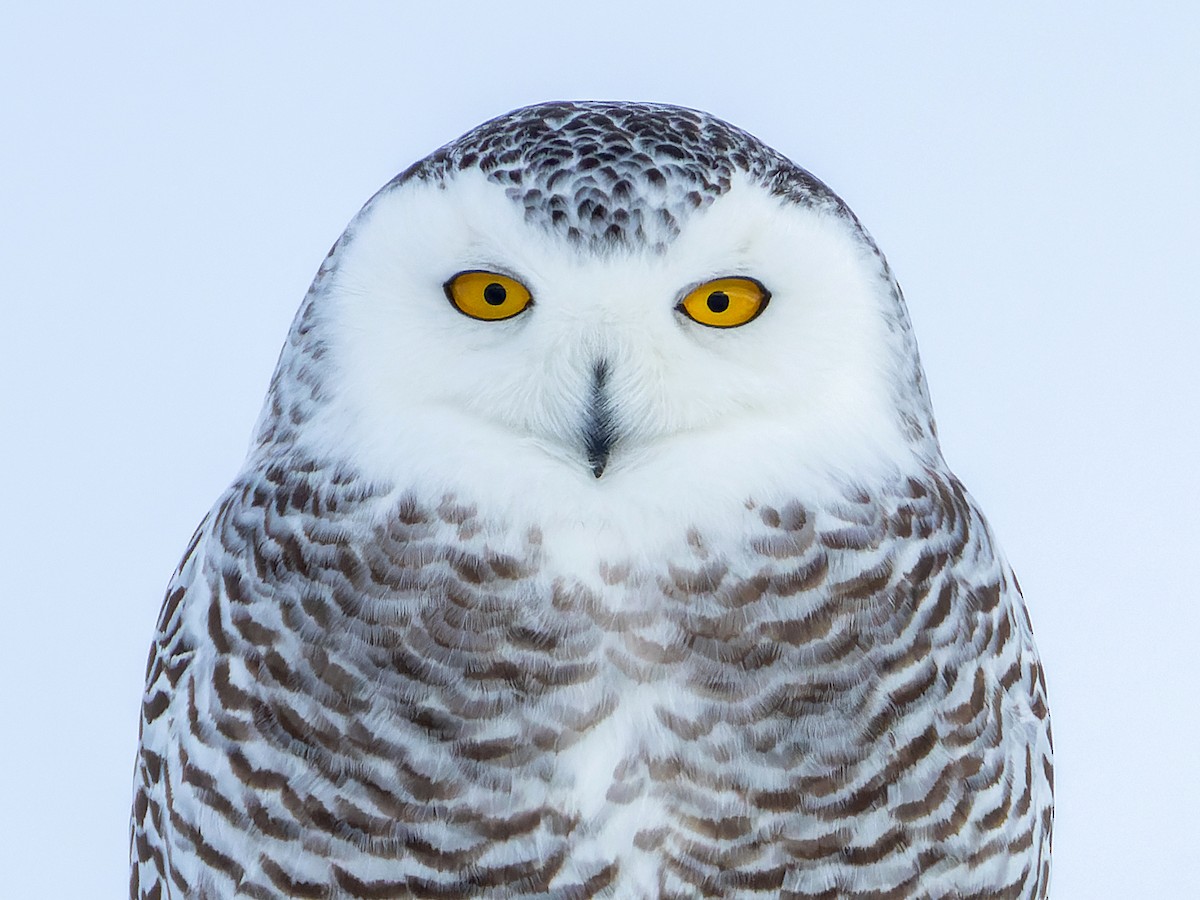
The Snowy Owl is a large, distinctive owl species native to the Arctic regions. Renowned for its striking white plumage, it is a powerful predator adapted to cold, open environments. It is one of the largest owl species in North America and Europe.
Dimensioni e longevità
- Lunghezza
- 53-70 cm (21-28 in)
- Apertura alare
- 120-150 cm (47-59 in)
- Peso
- 1.3-2.5 kg (2.9-5.5 lbs), females generally larger than males
- Longevità
- Up to 10 years in the wild, over 20 years in captivity
- Dieta
- Carnivore, primarily preying on lemmings, but also other small mammals and birds
Caratteristiche fisiche
- Piumaggio
- Adult males are almost pure white, sometimes with a few faint dark spots or bars. Females and younger birds have more extensive dark barring, which can range from sparse to quite heavy, giving them a mottled appearance. The white plumage provides excellent camouflage in snowy environments.
- Forma del becco
- Short, strongly hooked, and black.
- Colore degli occhi
- Bright yellow, large, and forward-facing.
- Colore delle zampe
- Legs and feet are heavily feathered, appearing white, with black talons.
- Caratteristiche distintive
- Large size, predominantly white plumage, round head without ear tufts, bright yellow eyes, and heavily feathered feet. The dark barring on females and juveniles is a key identifier.
- Aspetto giovanile
- Juveniles are heavily barred with dark brown or black markings, appearing much darker than adult females. They gradually lighten with successive molts.
- Cambiamenti stagionali
- No significant seasonal plumage changes, as their white coloration is adapted for year-round snowy environments. Plumage may become slightly soiled or worn over time.
- Dimorfismo sessuale
- Males are typically whiter with fewer dark markings, often appearing almost pure white as they age. Females are larger and retain more extensive dark barring throughout their lives. This difference is most pronounced in adults.
Come identificare
- 1
Plumage Coloration
Look for predominantly white plumage. Adult males are almost pure white; females and juveniles have varying degrees of dark barring. No other large owl in its range is primarily white.
- 2
Size and Shape
A very large, bulky owl with a round head (no ear tufts) and bright yellow eyes. Its size alone distinguishes it from most other white birds.
- 3
Habitat
Typically found in open, treeless environments like tundra, fields, or coastal areas, especially during winter irruptions. Rarely seen in dense forests.
- 4
Behavior
Often perches conspicuously on low vantage points (rocks, fence posts, hay bales) and hunts during the day. Its powerful, silent flight is distinctive.
- 5
Absence of Ear Tufts
Unlike many other large owls (e.g., Great Horned Owl), the Snowy Owl lacks prominent ear tufts, giving its head a smooth, rounded appearance.
Habitat e areale
- Biomi
- Arctic tundra, open grasslands, coastal dunes, agricultural fields during irruptions.
- Areale geografico
- Circumpolar Arctic regions of North America, Europe, and Asia. Breeding occurs north of the treeline. During winter, especially in irruption years, they can move south into southern Canada, the northern United States, and parts of Eurasia.
- Fascia altitudinale
- Typically found at low elevations, primarily in flat or gently rolling tundra landscapes.
- Ambienti preferiti
- Open, treeless areas with good visibility for hunting, often perching on small hummocks, rocks, or fence posts. They avoid dense forests.
Comportamento
- Periodo di attività
- Primarily diurnal, especially during the Arctic summer's 24-hour daylight. They can also hunt at dawn and dusk, and occasionally at night.
- Abitudini alimentari
- Primarily a diurnal hunter, unlike most owls, especially during the continuous daylight of the Arctic summer. They hunt from a perch or in low flight, swooping down to catch prey. Lemmings are their primary food source, and their breeding success and winter movements are strongly tied to lemming population cycles. They also prey on voles, hares, ptarmigan, ducks, and other small to medium-sized birds and mammals.
- Comportamento sociale
- Generally solitary outside of the breeding season. During breeding, they form monogamous pairs. They can be quite tolerant of other Snowy Owls in areas with abundant prey.
- Tipo di volo
- Powerful, silent, and direct flight with deep, strong wing beats. They often fly low to the ground when hunting.
- Migrazione
- Partially migratory. Many individuals remain in the Arctic year-round, but some undertake irregular, irruptive migrations south during winters when lemming populations crash in their breeding grounds. These irruptions can bring them far south of their typical winter range.
- Territorialità
- Territorial during the breeding season, defending their nesting area from other owls and predators. Males perform aerial displays to establish territory and attract mates.
Canto e richiami
- Canto
- Males produce a deep, resonant, hooting call, 'hoo, hoo, hoo,' often in series of two to six hoots, used for territorial defense and attracting mates. This call can carry for long distances across the open tundra.
- Richiamo
- Various calls include harsh 'kree-kree-kree' alarm calls, hisses, clacks, and shrieks, especially when agitated or defending the nest. Females have a softer, higher-pitched hoot than males.
- Quando vocalizza
- Most vocal during the breeding season, particularly at dawn and dusk, but also throughout the day in the continuous daylight of the Arctic summer. Less vocal during winter.
Riproduzione
- Stagione riproduttiva
- May to September, highly dependent on lemming availability. Breeding may not occur in years of low prey abundance.
- Abitudini di nidificazione
- Nests are shallow scrapes on the ground, typically on a raised hummock, ridge, or rock outcrop that offers good visibility and drainage. The female creates the scrape, sometimes lining it with moss or feathers. No elaborate nest construction.
- Dimensione della covata
- 3-11 eggs, but can be as many as 14 in years of exceptional lemming abundance. Clutch size is directly correlated with prey availability.
- Descrizione dell'uovo
- White, oval, and unspotted. Eggs are laid asynchronously, meaning they are laid over several days, resulting in chicks of varying sizes.
- Periodo di incubazione
- 32-34 days, primarily by the female. The male provides food during this time.
- Periodo di involo
- Chicks leave the nest at 14-26 days, before they can fly, and disperse around the nesting area. They begin to fly at 35-50 days old and become independent shortly after.
- Cure parentali
- Both parents care for the young. The female incubates and broods, while the male hunts and brings food to the nest. Both parents aggressively defend the nest and young from predators.
Dove trovarlo
Arctic Tundra
During the breeding season, the best place to find them is in the vast, open tundra regions of the Arctic circumpolar north.
Open Fields and Coastal Areas
During winter irruptions, they can be found in open agricultural fields, coastal dunes, prairies, and even airports in more southerly regions.
Elevated Perches
Look for them perched on fence posts, hay bales, telephone poles, small hummocks, or rocks in open landscapes.
Consigli sul campo
- Scan Open Landscapes. Use binoculars or a spotting scope to scan vast, open areas, especially during winter. Their white plumage can make them surprisingly difficult to spot against snow, but they often choose prominent perches.
- Look for Irruptions. Pay attention to birding reports and news during winter, as irruption years offer the best chance to see them outside their typical range. These events are often tied to lemming population crashes.
- Respect Their Space. Snowy Owls are often stressed by human disturbance, especially during winter when food can be scarce. Maintain a respectful distance and avoid flushing them, as this expends valuable energy.
- Observe Behavior. Watch for their characteristic hunting behavior: sitting patiently on a low perch, then swooping down silently to catch prey. They are often quite tolerant of observers if approached slowly and respectfully.
Fatti rapidi
- Primary Prey:
- Lemmings
- Hunting Time:
- Diurnal (daytime) in the Arctic summer
- Ear Tufts:
- Absent
- Migration:
- Irruptive, tied to prey availability
- Nest Type:
- Ground scrape
Curiosità
- The Snowy Owl is the official bird of Quebec, Canada.
- Their heavily feathered feet act like snowshoes, distributing their weight and providing insulation against the cold.
- They can turn their heads almost 270 degrees in either direction, allowing them to scan their surroundings without moving their bodies.
- A single Snowy Owl can eat 3-5 lemmings per day, or more during the breeding season when feeding young.
- Their scientific name, 'Bubo scandiacus', refers to their hooting call ('Bubo') and their association with Scandinavia ('scandiacus').
Classificazione scientifica
- Regno
- Animalia
- Phylum
- Chordata
- Classe
- Aves
- Ordine
- Strigiformes
- Famiglia
- Strigidae
- Genere
- Bubo
- Specie
- Bubo scandiacus
Esplora Snowy Owl
Identifica uccelli ovunque
Gratis su iOS, Android e Web. Identificazione per foto e suono, database completo e la tua lista personale.