
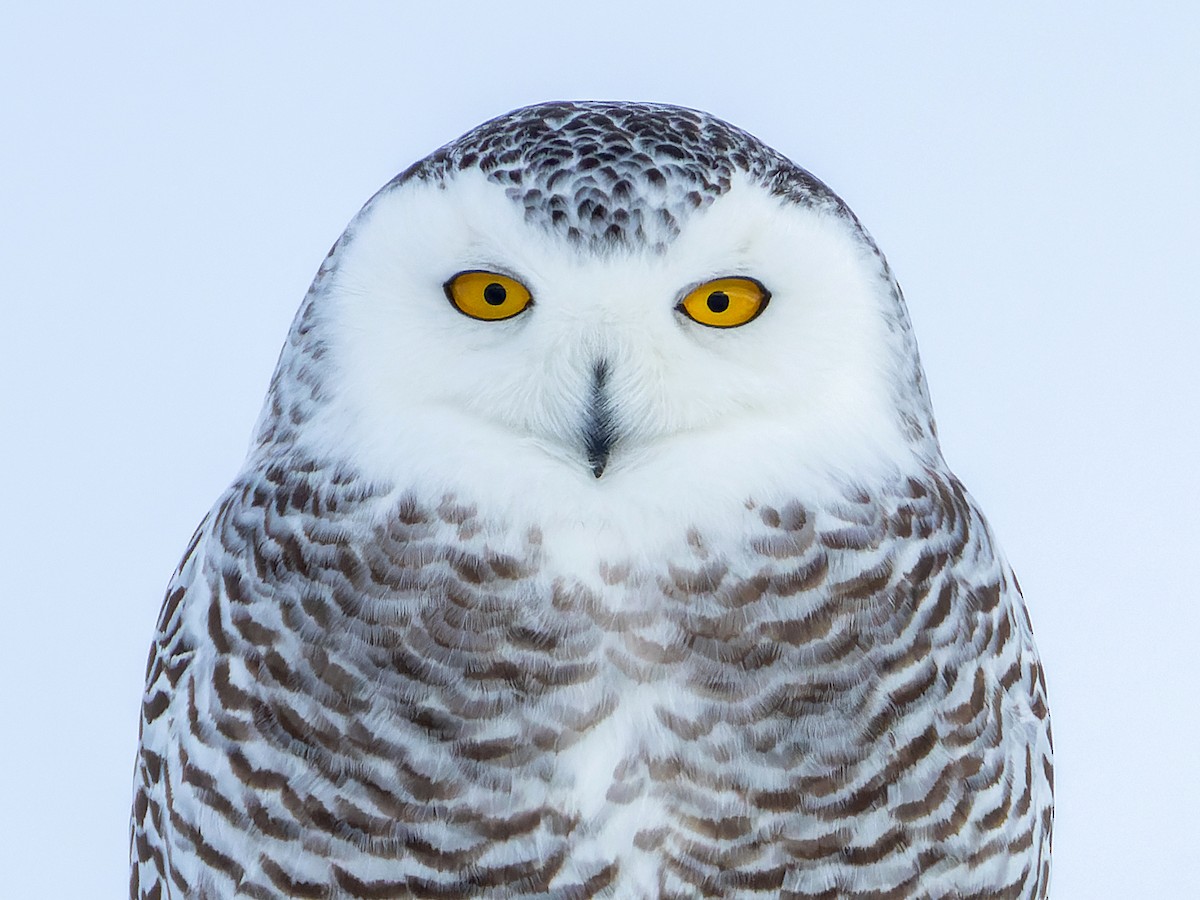
Come identificare Snowy Owl
Bubo scandiacus
Visto un uccello? Identificalo all'istante con l'app Birdby
Apri l'appPer identificare correttamente Snowy Owl (Bubo scandiacus), controlla ciascuna di queste caratteristiche. Gli uccelli possono essere complicati da riconoscere, perché comportamento, habitat e canto spesso confermano ciò che una sola foto non può.
Dimensioni a colpo d'occhio
- Lunghezza
- 53-70 cm (21-28 in)
- Apertura alare
- 120-150 cm (47-59 in)
- Peso
- 1.3-2.5 kg (2.9-5.5 lbs), females generally larger than males
Caratteristiche fisiche da controllare
- 1
Piumaggio
Colorazione e disegno generale del piumaggio.
Adult males are almost pure white, sometimes with a few faint dark spots or bars. Females and younger birds have more extensive dark barring, which can range from sparse to quite heavy, giving them a mottled appearance. The white plumage provides excellent camouflage in snowy environments.
- 2
Forma del becco
Forma e colore del becco, un segno di campo chiave.
Short, strongly hooked, and black.
- 3
Colore degli occhi
Colore dell'iride e segni distintivi sugli occhi.
Bright yellow, large, and forward-facing.
- 4
Colore delle zampe
Colore di zampe e piedi.
Legs and feet are heavily feathered, appearing white, with black talons.
- 5
Caratteristiche distintive
Tratti distintivi che separano questa specie.
Large size, predominantly white plumage, round head without ear tufts, bright yellow eyes, and heavily feathered feet. The dark barring on females and juveniles is a key identifier.
- 6
Aspetto giovanile
Come i giovani si differenziano dagli adulti.
Juveniles are heavily barred with dark brown or black markings, appearing much darker than adult females. They gradually lighten with successive molts.
- 7
Cambiamenti stagionali
Variazione del piumaggio tra stagione riproduttiva e non.
No significant seasonal plumage changes, as their white coloration is adapted for year-round snowy environments. Plumage may become slightly soiled or worn over time.
- 8
Dimorfismo sessuale
Differenze tra maschi e femmine.
Males are typically whiter with fewer dark markings, often appearing almost pure white as they age. Females are larger and retain more extensive dark barring throughout their lives. This difference is most pronounced in adults.
Segni di campo chiave
- Plumage Coloration. Look for predominantly white plumage. Adult males are almost pure white; females and juveniles have varying degrees of dark barring. No other large owl in its range is primarily white.
- Size and Shape. A very large, bulky owl with a round head (no ear tufts) and bright yellow eyes. Its size alone distinguishes it from most other white birds.
- Habitat. Typically found in open, treeless environments like tundra, fields, or coastal areas, especially during winter irruptions. Rarely seen in dense forests.
- Behavior. Often perches conspicuously on low vantage points (rocks, fence posts, hay bales) and hunts during the day. Its powerful, silent flight is distinctive.
- Absence of Ear Tufts. Unlike many other large owls (e.g., Great Horned Owl), the Snowy Owl lacks prominent ear tufts, giving its head a smooth, rounded appearance.
Esplora Snowy Owl
Identifica uccelli ovunque
Gratis su iOS, Android e Web. Identificazione per foto e suono, database completo e la tua lista personale.