
Visto un uccello? Identificalo all'istante con l'app Birdby
Apri l'appInformazioni
The Cattle Egret (Bubulcus ibis) is a cosmopolitan species of heron (family Ardeidae) found in the tropics, subtropics, and warm temperate zones. It is the only member of the genus Bubulcus. It is a small, white heron, often seen foraging in fields alongside livestock, from which it derives its common name. Its diet primarily consists of insects, particularly those disturbed by grazing animals. The species has undergone one of the most rapid and wide-ranging natural expansions of any bird species, colonizing new continents within the last century.
Dimensioni e longevità
- Lunghezza
- 46-56 cm
- Apertura alare
- 88-96 cm
- Peso
- 270-510 g
- Longevità
- Up to 15 years in the wild, typically 5-7 years.
- Dieta
- Insectivore, primarily feeding on insects (especially grasshoppers, crickets, flies, moths, beetles) and other invertebrates (spiders, earthworms). Also consumes small vertebrates such as frogs, lizards, and fish, particularly when associated with agricultural machinery.
Caratteristiche fisiche
- Piumaggio
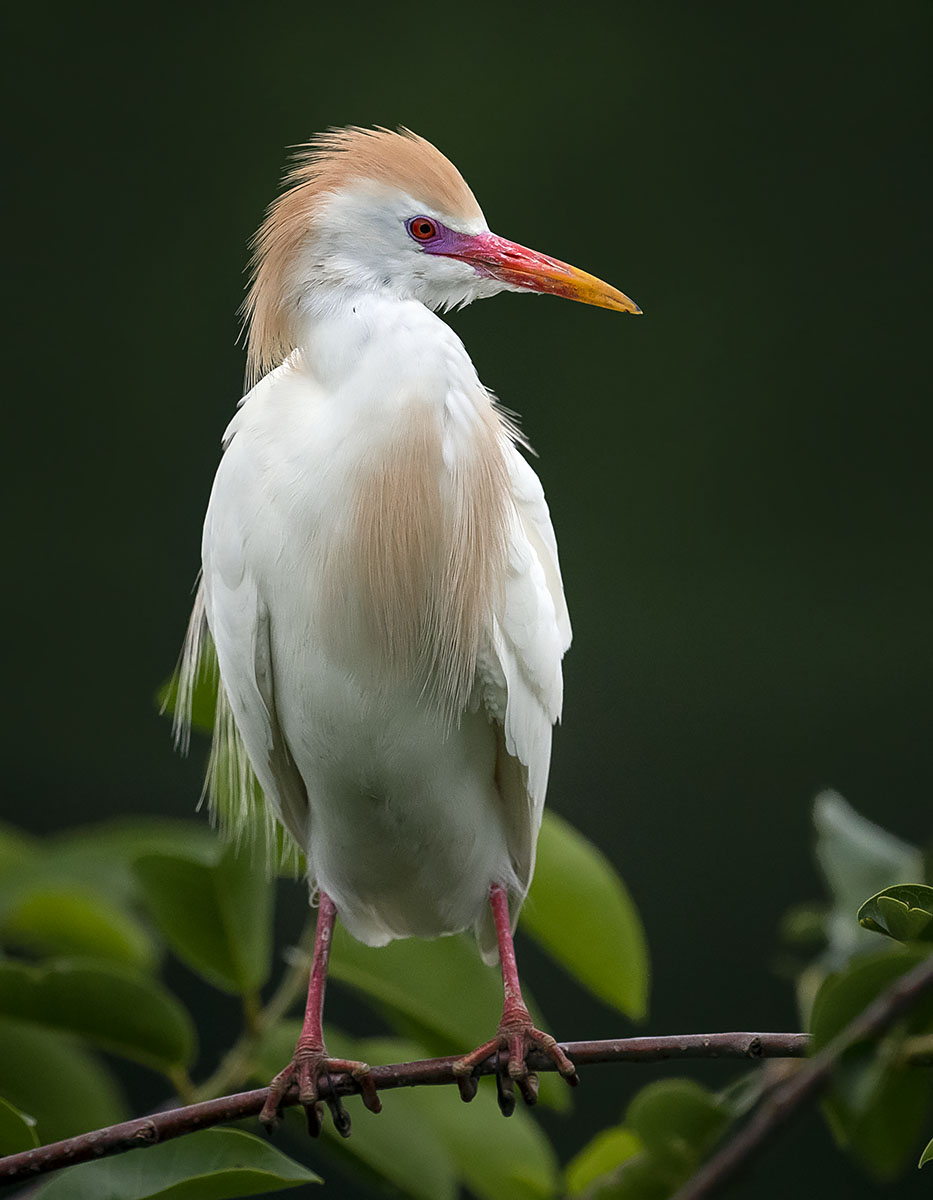
- Non-breeding adults are entirely white with a yellow bill and greenish-yellow legs. Breeding adults develop buff-orange plumes on the crown, nape, back, and breast. The bill becomes brighter orange-yellow, and the legs turn reddish-orange.
- Forma del becco
- Relatively short, stout, and pointed bill, yellow in non-breeding plumage, brighter orange-yellow in breeding plumage.
- Colore degli occhi
- Yellow iris, often with a reddish tinge during breeding season.
- Colore delle zampe
- Greenish-yellow in non-breeding adults, reddish-orange in breeding adults.
- Caratteristiche distintive
- Its small size, stocky build, and habit of associating with livestock or agricultural machinery are key identifiers. The buff-orange breeding plumes are distinctive. Unlike other white egrets, it has a relatively short, thick neck and a more hunched posture when foraging.
- Aspetto giovanile
- Juveniles resemble non-breeding adults, being entirely white with a duller yellow-grey bill and dark greyish-black legs. They lack any buff coloration.
- Cambiamenti stagionali
- Pronounced seasonal changes in plumage and soft part coloration. Non-breeding plumage is pure white with a yellow bill and greenish-yellow legs. Breeding plumage involves the development of buff-orange plumes on the crown, nape, back, and breast, with the bill becoming brighter orange-yellow and the legs turning reddish-orange. The eyes may also become redder.
- Dimorfismo sessuale
- Males and females are generally similar in appearance, though males may be slightly larger and have more extensive or brighter breeding plumes.
Come identificare
- 1
Size and Shape
Relatively small and stocky for an egret, with a short, thick neck and a somewhat hunched posture when foraging on land.
- 2
Plumage (Non-breeding)
Pure white body plumage. Look for the yellow bill and greenish-yellow legs.
- 3
Plumage (Breeding)
Distinctive buff-orange plumes on the crown, nape, back, and breast. The bill becomes brighter orange-yellow, and legs turn reddish-orange.
- 4
Behavior
Its strong association with grazing livestock or agricultural machinery is a key identification clue. It often walks alongside these animals, snatching disturbed insects.
- 5
Habitat
Prefers open, grassy fields, pastures, and agricultural areas, rather than deep water, distinguishing it from most other egrets.
Habitat e areale
- Biomi
- Grasslands, savannas, agricultural fields, pastures, wetlands, rice paddies, and open woodlands.
- Areale geografico
- Cosmopolitan, found in Africa, Europe, Asia, Australia, and the Americas. Originally native to Africa and parts of Asia, it has naturally expanded its range across the globe, colonizing the Americas in the late 19th and early 20th centuries.
- Fascia altitudinale
- Primarily lowlands, up to 2,000 meters, but generally avoids high altitudes.
- Ambienti preferiti
- Open, grassy habitats, especially those with grazing mammals (cattle, horses, sheep) or agricultural machinery that disturb insects. Also found near water bodies, but less dependent on aquatic environments than other egrets.
Comportamento
- Periodo di attività
- Diurnal, actively foraging during daylight hours.
- Abitudini alimentari
- Opportunistic feeder, primarily insectivorous. It often forages in close proximity to large grazing animals, catching insects (especially grasshoppers and crickets) flushed out by their movements. It also follows agricultural machinery (tractors, plows) for the same reason. It may also feed on small vertebrates and aquatic invertebrates, particularly in wetlands.
- Comportamento sociale
- Highly social, often seen in flocks, especially when foraging or roosting. Breeds in large, mixed-species colonies, often with other herons, ibises, and spoonbills. Forms communal roosts outside the breeding season.
- Tipo di volo
- Direct and steady flight with slow, deliberate wingbeats. Neck is retracted in an 'S' shape, and legs trail behind the body, typical of herons.
- Migrazione
- Partially migratory. Northern populations in Europe and Asia migrate south for winter. African and some southern populations are largely resident or undertake local movements. The species is known for its strong dispersal capabilities, which have facilitated its global expansion.
- Territorialità
- Generally not territorial in foraging areas, often feeding in close proximity to conspecifics and other species. However, pairs defend a small territory around their nest within the breeding colony.
Canto e richiami
- Canto
- Not known for a complex song. Vocalizations are generally limited to harsh, croaking, or guttural calls.
- Richiamo
- A variety of harsh, raspy calls, often described as 'rick-rack', 'karr', or 'graak'. These calls are typically given during courtship, in colonies, or when disturbed. They are generally less vocal than other egrets.
- Quando vocalizza
- Most vocal during the breeding season within colonies, during courtship displays, and when interacting with other birds. Less vocal when foraging or outside the breeding season.
Riproduzione
- Stagione riproduttiva
- Highly variable depending on geographic location and rainfall. In temperate regions, typically spring and summer (e.g., April-July in Europe). In tropical regions, often coincides with the rainy season.
- Abitudini di nidificazione
- Nests colonially, often in large mixed-species heronries, typically in trees or shrubs, sometimes in reedbeds. Nests are flimsy platforms of sticks, reeds, or other vegetation, built by both parents.
- Dimensione della covata
- 2-6 eggs, most commonly 3-4.
- Descrizione dell'uovo
- Pale blue or greenish-blue, unmarked, oval-shaped. Approximately 45 x 34 mm.
- Periodo di incubazione
- 22-26 days, incubated by both parents.
- Periodo di involo
- Chicks fledge (leave the nest) at about 30-35 days, but remain dependent on parents for several more weeks.
- Cure parentali
- Both parents share incubation duties and care for the young. Chicks are altricial (helpless at birth) and require extensive parental feeding and protection.
Dove trovarlo
Agricultural Fields
Look in pastures with cattle, sheep, or horses, or fields being plowed or harvested by tractors.
Wetlands and Rice Paddies
While preferring drier habitats, they will also forage in shallow wetlands, especially if livestock are present.
Communal Roosts/Colonies
During breeding season, locate large heronries, often in trees or dense vegetation near water, where they will gather in large numbers.
Consigli sul campo
- Look for Livestock. The most reliable way to find Cattle Egrets is to locate grazing animals. They will almost invariably be present if the habitat is suitable.
- Observe Foraging Behavior. Watch for their characteristic foraging style: walking close to animals or machinery, making short dashes to catch insects.
- Check for Breeding Plumage. During spring and summer, the buff-orange plumes are unmistakable and make identification easier.
- Listen for Calls. While not highly vocal, their harsh 'rick-rack' calls can be heard, especially in breeding colonies.
Specie simili
Little Egret
Egretta garzetta
The Little Egret is slenderer, has a black bill (yellow lores in breeding), black legs with yellow feet, and two long nuchal plumes in breeding plumage. It is more aquatic, typically foraging in shallow water, whereas the Cattle Egret prefers drier, grassy habitats.
Great Egret
Ardea alba
The Great Egret is significantly larger, has a longer neck, a longer, dagger-like yellow bill (black in breeding), and black legs. It lacks the buff breeding plumes of the Cattle Egret and is typically found in deeper water or larger wetlands.
Snowy Egret
Egretta thula
Found in the Americas, the Snowy Egret is similar in size to the Cattle Egret but has a slender black bill, black legs with bright yellow feet, and lacy plumes on its head, neck, and back during breeding. It is primarily an aquatic feeder.
Fatti rapidi
- Common Name:
- Cattle Egret
- Scientific Name:
- Bubulcus ibis
- Family:
- Ardeidae
- Diet:
- Insectivore
- Conservation Status:
- Least Concern
- Key Behavior:
- Associates with grazing animals
- Breeding Plumage:
- Buff-orange plumes on head, neck, back
Curiosità
- The Cattle Egret has one of the most dramatic natural range expansions of any bird species, colonizing new continents (Americas, Australia) within the last century without human introduction.
- They have a symbiotic relationship with grazing animals; the egrets benefit from the food, and the animals may benefit from the egrets removing parasites or warning of predators.
- Despite being a heron, the Cattle Egret is less dependent on water than most other heron species, often foraging in dry fields far from water bodies.
- They are known to follow agricultural machinery, such as tractors and plows, to catch insects disturbed by the equipment.
Classificazione scientifica
- Regno
- Animalia
- Phylum
- Chordata
- Classe
- Aves
- Ordine
- Pelecaniformes
- Famiglia
- Ardeidae
- Genere
- Bubulcus
- Specie
- Bubulcus ibis
Esplora Cattle Egret
Identifica uccelli ovunque
Gratis su iOS, Android e Web. Identificazione per foto e suono, database completo e la tua lista personale.