
Visto un uccello? Identificalo all'istante con l'app Birdby
Apri l'appInformazioni
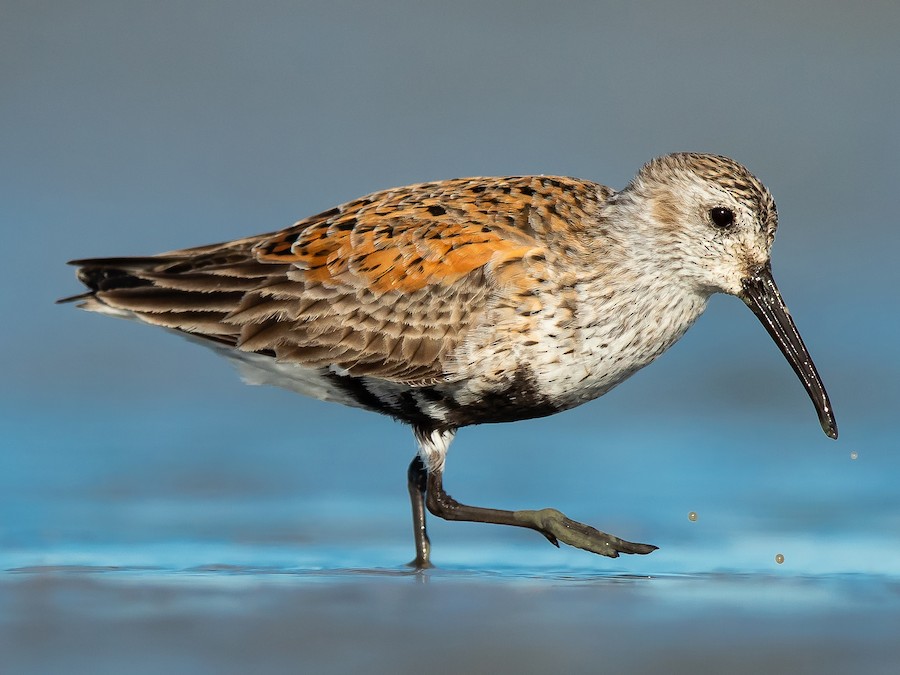
The Dunlin (Piovanello comune) is a small, migratory shorebird, a member of the sandpiper family. It is characterized by its medium-length, slightly decurved bill and distinctive breeding plumage featuring a black belly patch. It is one of the most widespread and numerous waders, found across Arctic and subarctic regions, migrating to temperate and tropical coasts during the non-breeding season.
Dimensioni e longevità
- Lunghezza
- 16-22 cm
- Apertura alare
- 32-39 cm
- Peso
- 40-75 g (breeding), 50-85 g (non-breeding)
- Longevità
- Up to 24 years in the wild, typically 5-10 years.
- Dieta
- Carnivore (primarily invertebrates)
Caratteristiche fisiche
- Piumaggio
- Variable depending on season and age. Breeding adults have a striking black belly patch, rufous back, and streaked breast. Non-breeding adults are duller, grey-brown above and white below. Juveniles resemble non-breeding adults but with more streaking on the flanks and a faint black belly patch.
- Forma del becco
- Medium-length, slender, and slightly decurved (downward-curved) at the tip; black.
- Colore degli occhi
- Dark brown
- Colore delle zampe
- Black
- Caratteristiche distintive
- The slightly decurved bill is a key feature. In breeding plumage, the prominent black belly patch is diagnostic. In non-breeding plumage, the grey-brown upperparts and white underparts, combined with the bill shape, help distinguish it. A white wing-bar is visible in flight.
- Aspetto giovanile
- Juveniles have a scaly-patterned rufous-brown back with dark centers to feathers, a streaked breast, and often a faint, mottled black belly patch. They have a cleaner white belly than adults in non-breeding plumage and a more distinct supercilium.
- Cambiamenti stagionali
- Breeding plumage (April-August): Rufous-brown upperparts with black streaking, a prominent black belly patch, and a streaked breast. Non-breeding plumage (September-March): Uniform grey-brown upperparts, white underparts, and a faint supercilium. The black belly patch is absent.
- Dimorfismo sessuale
- Males and females are generally similar in plumage, though females tend to be slightly larger and have a slightly longer bill on average. The black belly patch in breeding plumage can be more extensive in females.
Come identificare
- 1
Bill Shape
Look for the medium-length, slender bill that is distinctly decurved (downward-curved) at the tip. This is a primary identification feature in all plumages.
- 2
Breeding Plumage (Black Belly)
In summer, the prominent black patch on the lower belly is diagnostic. The back is rufous-brown with dark streaking.
- 3
Non-breeding Plumage (Grey-brown)
In winter, the bird is uniformly grey-brown above and white below, with a faint supercilium. The decurved bill remains key.
- 4
Flight Call
Listen for the distinctive, slightly trilled 'krrreet' or 'chrrrip' call, often given when flocks take flight or are disturbed.
- 5
Behavior
Observe its feeding behavior: a characteristic 'sewing machine' probing action in mud or sand. Often seen in large, dense flocks.
- 6
White Wing-bar
In flight, a narrow but distinct white wing-bar is visible, which can help distinguish it from some other small sandpipers.
Habitat e areale
- Biomi
- Tundra, coastal wetlands, estuaries, mudflats, sandy beaches, salt marshes, lagoons.
- Areale geografico
- Breeds in Arctic and subarctic regions of Eurasia and North America. Winters along temperate and tropical coasts of Europe, Africa, Asia, and North America.
- Fascia altitudinale
- Primarily found at sea level, occasionally inland during migration or in specific breeding areas.
- Ambienti preferiti
- During breeding, prefers wet tundra with mosses, sedges, and dwarf shrubs. During migration and winter, favors intertidal mudflats, sandy shores, and estuaries where it can forage for invertebrates.
Comportamento
- Periodo di attività
- Diurnal, but also feeds at night during low tide, especially in wintering grounds.
- Abitudini alimentari
- Probes soft mud or sand with its bill, often in a characteristic 'sewing machine' action, searching for small invertebrates such as marine worms, crustaceans, mollusks, and insect larvae. Also picks items from the surface. Feeds in large, dense flocks during migration and winter.
- Comportamento sociale
- Highly gregarious outside the breeding season, forming large to enormous flocks, sometimes numbering tens of thousands, often associating with other wader species. During breeding, they are territorial and monogamous.
- Tipo di volo
- Fast and direct flight, often in tightly packed, synchronized flocks that perform intricate aerial maneuvers, especially when disturbed. Shows a distinct white wing-bar in flight.
- Migrazione
- Long-distance migratory. Northern populations undertake extensive migrations to southern wintering grounds. European breeders winter along the coasts of Western Europe and Africa. North American breeders winter along the coasts of the southern US and Mexico. Migration occurs in broad fronts, often with stopovers at key coastal wetlands.
- Territorialità
- Highly territorial during the breeding season, with males defending nesting territories through aerial displays and vocalizations. Non-territorial during migration and winter.
Canto e richiami
- Canto
- The breeding song, given during display flights, is a trilling, reedy 'prrree-prrree-prrree' or 'kree-kree-kree' often interspersed with buzzing notes.
- Richiamo
- Common call is a distinctive, slightly trilled 'krrreet' or 'chrrrip', often given in flight or when disturbed. Also a softer 'whit' or 'chip' call.
- Quando vocalizza
- Most vocal during the breeding season, especially during courtship and territorial defense. Calls are also frequently heard during migration and on wintering grounds, particularly when flocks are disturbed or taking flight.
Riproduzione
- Stagione riproduttiva
- May to August, with peak egg-laying in June.
- Abitudini di nidificazione
- Nests on the ground in a shallow scrape, typically in wet tundra or marshy areas, often concealed by vegetation. The nest is lined with leaves, moss, and grass.
- Dimensione della covata
- Usually 4 eggs.
- Descrizione dell'uovo
- Typically 4 eggs, pear-shaped, olive-buff to pale green or brownish, heavily spotted and blotched with dark brown or black, especially at the broader end.
- Periodo di incubazione
- 20-22 days, shared by both parents, though the female often takes the majority of the incubation duties.
- Periodo di involo
- Chicks are precocial and leave the nest shortly after hatching. They are able to feed themselves but are guarded by both parents. Fledge in approximately 19-21 days.
- Cure parentali
- Both parents care for the young initially. Often, the female departs before the young fledge, leaving the male to complete parental duties until the chicks are independent.
Dove trovarlo
Coastal Mudflats and Estuaries
These are prime wintering and migratory stopover sites, especially during low tide when vast areas of mud are exposed for foraging.
Sandy Beaches and Lagoons
Can be found foraging along the water's edge on sandy beaches and in sheltered coastal lagoons.
Salt Marshes
Utilizes salt marshes for feeding and roosting, particularly during high tide when other foraging areas are submerged.
Arctic Tundra (Breeding)
During the breeding season, they are found in wet, mossy tundra habitats in the Arctic and subarctic regions.
Consigli sul campo
- Check Tides. For coastal observations, plan your visit around low tide when mudflats are exposed, and Dunlins are actively feeding. They often roost in large groups at high tide.
- Scan Flocks. Dunlins often occur in large, mixed flocks with other waders. Carefully scan these flocks for the characteristic bill shape and, in summer, the black belly patch.
- Listen for Calls. Their distinctive 'krrreet' call is a good indicator of their presence, especially when they are flying or disturbed.
- Observe Feeding Behavior. Watch for their rapid, probing 'sewing machine' feeding action, which is typical for the species.
- Use a Scope. Due to their small size and often distant feeding locations, a spotting scope is highly recommended for detailed observation and identification.
Specie simili
Sanderling
Calidris alba
Sanderlings are paler overall, lack a hind toe, and have a shorter, straighter, stouter bill. In breeding plumage, they lack the black belly patch of the Dunlin. In non-breeding plumage, Sanderlings are very pale, almost white, with a prominent black carpal patch on the wing.
Curlew Sandpiper
Calidris ferruginea
Curlew Sandpipers have a longer, more strongly decurved bill than the Dunlin. In breeding plumage, they are brick-red below, lacking the distinct black belly patch. In non-breeding plumage, they are paler grey above and whiter below, with a more prominent supercilium and a more elegant appearance.
Baird's Sandpiper
Calidris bairdii
Baird's Sandpiper is typically smaller, has a shorter, straighter bill, and a scaly-backed appearance in all plumages. It lacks the black belly patch in breeding plumage and has a buffy wash across the breast.
Fatti rapidi
- Common Name:
- Dunlin (Piovanello comune)
- Scientific Name:
- Calidris alpina
- Family:
- Scolopacidae
- Conservation Status:
- Least Concern
- Key ID Feature (Breeding):
- Black belly patch
- Key ID Feature (All plumages):
- Decurved bill
- Diet:
- Invertebrates (worms, crustaceans, insects)
- Habitat:
- Coastal mudflats, estuaries, tundra
- Migration:
- Long-distance migrant
Curiosità
- The Dunlin is one of the most numerous and widespread wader species globally, with an estimated population in the millions.
- Its scientific name 'alpina' refers to its breeding habitat in mountainous or high-latitude regions, such as the Alps (though it breeds much further north).
- Dunlins are known for their spectacular synchronized flocking behavior, often forming 'murmurations' over coastal areas, especially at dusk or when disturbed by predators.
- They have a highly sensitive bill tip, packed with nerve endings, which allows them to detect prey buried in the mud by touch, even when their bill is fully submerged.
- There are several recognized subspecies of Dunlin, varying slightly in size, bill length, and plumage tones, reflecting their vast breeding range.
Classificazione scientifica
- Regno
- Animalia
- Phylum
- Chordata
- Classe
- Aves
- Ordine
- Charadriiformes
- Famiglia
- Scolopacidae
- Genere
- Calidris
- Specie
- Calidris alpina
Esplora Piovanello comune
Identifica uccelli ovunque
Gratis su iOS, Android e Web. Identificazione per foto e suono, database completo e la tua lista personale.