
Visto un uccello? Identificalo all'istante con l'app Birdby
Apri l'appInformazioni
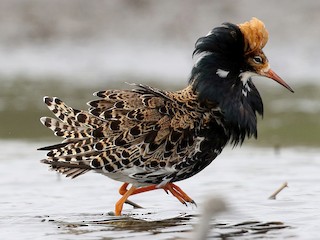
The Ruff is a medium-sized wading bird, renowned for the spectacular breeding plumage of the male, which features an elaborate ruff and ear tufts. This species exhibits extreme sexual dimorphism, with males being significantly larger and more colorful than females (known as 'Reeves'). They are highly migratory, breeding in northern Eurasia and wintering in southern Europe, Africa, and parts of Asia.
Dimensioni e longevità
- Lunghezza
- 20-32 cm (male), 18-26 cm (female)
- Apertura alare
- 46-58 cm (male), 42-50 cm (female)
- Peso
- 110-250 g (male), 70-150 g (female)
- Longevità
- Up to 10 years in the wild
- Dieta
- Omnivore (primarily invertebrates, some plant material)
Caratteristiche fisiche
- Piumaggio
- Highly variable. Breeding males display an elaborate ruff and ear tufts, which can be black, white, chestnut, rufous, or barred, often with iridescent sheens. The body plumage of breeding males is also variable, ranging from black to rufous to buff, often with intricate patterns. Breeding females (Reeves) are duller, typically mottled brown and black above, with paler underparts. Non-breeding adults of both sexes are duller, with grey-brown upperparts and white underparts, often with a faint breast band. Juveniles resemble non-breeding adults but have a more scaly appearance on the back and buff wash on the breast.
- Forma del becco
- Medium-length, straight, and slender bill, typically dark brown to black, sometimes with a paler base.
- Colore degli occhi
- Dark brown
- Colore delle zampe
- Variable, ranging from yellowish-orange to greenish-yellow, sometimes dull greyish-green.
- Caratteristiche distintive
- The male's elaborate breeding ruff and ear tufts are unmistakable. In non-breeding plumage, the combination of a relatively small head, long neck, slightly hunched posture, and variable leg color helps distinguish it. The white oval patches on either side of the rump, visible in flight, are also a key feature.
- Aspetto giovanile
- Juveniles have a scaly appearance on their upperparts due to pale feather fringes, and a buff wash on the breast and flanks. They lack the strong markings of breeding adults and are generally paler than non-breeding adults.
- Cambiamenti stagionali
- Males undergo a dramatic change from their elaborate breeding plumage to a duller, grey-brown non-breeding plumage. Females also become duller outside the breeding season, losing any subtle breeding coloration. The ruff and ear tufts are shed after breeding.
- Dimorfismo sessuale
- Extreme. Males are significantly larger than females and develop elaborate ruffs and ear tufts during the breeding season, which are absent in females. Males also exhibit a wide range of plumage colors and patterns during breeding.
Come identificare
- 1
Size and Shape
Medium-sized wader with a relatively small head, long neck, and often a slightly hunched posture. Males are noticeably larger than females.
- 2
Breeding Male Plumage
Unmistakable with its elaborate ruff and ear tufts, which vary widely in color (black, white, rufous, barred). Body plumage also highly variable.
- 3
Non-breeding Plumage
Both sexes are duller, grey-brown above, white below. Look for the relatively long neck, small head, and variable leg color (yellowish to greenish).
- 4
Flight Identification
In flight, look for the distinctive white oval patches on either side of the dark rump, contrasting with the dark central tail. Wings are pointed.
- 5
Behavior
Often seen probing in mud or shallow water. Males' lekking behavior is unique and a key identifier during breeding season.
Habitat e areale
- Biomi
- Wetlands, grasslands, tundra, marshes, wet meadows, floodplains, coastal mudflats.
- Areale geografico
- Breeds across northern Eurasia, from Scandinavia and northern Europe eastward through Siberia. Winters in southern Europe, Africa (especially sub-Saharan Africa), and parts of southern Asia (India, Southeast Asia). Migrates through much of Europe and Asia.
- Fascia altitudinale
- Primarily lowlands, typically found at or near sea level, especially during migration and wintering.
- Ambienti preferiti
- Shallow freshwater or brackish wetlands with short vegetation, muddy edges, and open areas for feeding. During migration, they utilize a variety of wetland habitats, including estuaries, sewage farms, and flooded fields.
Comportamento
- Periodo di attività
- Diurnal, though may feed at night during migration or in areas with tidal influence.
- Abitudini alimentari
- Forages by probing in soft mud or shallow water, picking insects and other invertebrates from the surface. Diet includes insects (especially larvae), worms, crustaceans, mollusks, and sometimes seeds or other plant material. They often feed in groups, sometimes with other waders.
- Comportamento sociale
- Highly social, especially outside the breeding season, forming large flocks. During breeding, males gather at leks (communal display grounds) where they perform elaborate courtship displays to attract females. Females are more solitary during nesting.
- Tipo di volo
- Strong, direct flight with rapid wingbeats. Often flies in dense, coordinated flocks during migration. When displaying, males perform elaborate aerial maneuvers.
- Migrazione
- Long-distance migratory. Breeds in the Arctic and sub-Arctic regions of Eurasia and migrates south to wintering grounds in Africa, southern Europe, and Asia. Migration occurs in broad fronts, often with stopovers at suitable wetland sites.
- Territorialità
- Males are highly territorial on the lek, defending small display territories. Females are not territorial but defend their nest site during incubation.
Canto e richiami
- Canto
- Males are largely silent on the lek, with displays being primarily visual. They may produce soft, guttural grunts or purring sounds during interactions.
- Richiamo
- Generally a quiet species. Calls include a soft 'tew-it' or 'tew-tew' in flight, and a low 'kek' or 'krek' when alarmed or disturbed.
- Quando vocalizza
- Most vocal during migration and on the breeding grounds, though calls are generally subdued.
Riproduzione
- Stagione riproduttiva
- May to July
- Abitudini di nidificazione
- Nests are shallow scrapes on the ground, typically in dense vegetation in wet meadows or tundra, often lined with grass and leaves. Females build the nest and incubate alone.
- Dimensione della covata
- 3-4 eggs
- Descrizione dell'uovo
- Typically 4 eggs, pear-shaped, olive-buff to greenish-brown with dark brown spots and blotches, concentrated at the broad end.
- Periodo di incubazione
- 20-23 days
- Periodo di involo
- 25-28 days
- Cure parentali
- Only the female incubates the eggs and cares for the young. Males play no role in parental care after mating.
Dove trovarlo
Wetlands and Marshes
During migration and winter, look in shallow freshwater or brackish wetlands, sewage farms, and flooded fields.
Tundra and Wet Meadows
Breeding grounds are typically in the Arctic and sub-Arctic tundra and wet meadows of northern Eurasia.
Coastal Mudflats
Can be found on coastal mudflats during migration, though less common than in freshwater habitats.
Consigli sul campo
- Observe Lekking Behavior. If in breeding areas, seek out leks where males gather to display. This is a spectacular and unique behavioral event.
- Look for Flocks. Outside the breeding season, Ruffs often form large, sometimes mixed-species, flocks in suitable wetland habitats.
- Study Leg Color. While variable, leg color can be a useful field mark, ranging from yellowish-orange to greenish-grey.
- Check Rump in Flight. The white oval patches on the rump, visible in flight, are a reliable identification feature for all plumages.
Specie simili
Common Snipe
Gallinago gallinago
Ruffs are generally larger and more upright, with a shorter bill relative to body size. Snipe have a much longer bill, cryptic streaky plumage, and a distinctive 'drumming' display flight.
Wood Sandpiper
Tringa glareola
Wood Sandpipers are smaller, more slender, with longer legs and a more delicate bill. They have a prominent supercilium and a different flight pattern with less pointed wings. Ruffs lack the strong supercilium.
Curlew Sandpiper
Calidris ferruginea
Curlew Sandpipers are smaller, with a distinctly downcurved bill. In breeding plumage, they are brick-red, while non-breeding birds are greyer. Ruffs have a straight bill and different overall shape.
Fatti rapidi
- Common Name:
- Ruff (Combattente in Italian)
- Scientific Name:
- Calidris pugnax
- Family:
- Scolopacidae (Sandpipers and allies)
- Conservation Status:
- Least Concern (IUCN Red List)
- Diet:
- Invertebrates, some plant material
- Migration:
- Long-distance migrant
- Sexual Dimorphism:
- Extreme, especially in breeding plumage
Curiosità
- The male Ruff's elaborate breeding display, known as 'lekking,' is one of the most complex and visually stunning among birds. Males gather at communal display grounds and perform ritualized fights and dances to attract females.
- Male Ruffs exhibit three distinct behavioral morphs: 'independents' (territorial, with large ruffs), 'satellites' (non-territorial, with white ruffs, associating with independents), and 'faeders' (females mimics, very rare, with small ruffs and female-like plumage).
- The scientific name 'pugnax' means 'fond of fighting,' referring to the aggressive displays of males during the breeding season.
- Ruffs are one of the few bird species where the female (Reeve) is responsible for all parental care, from incubation to raising the chicks, while the male's role ends after mating.
- The plumage variability of male Ruffs is so extensive that it was once thought that each male had a unique combination of ruff and body colors.
Classificazione scientifica
- Regno
- Animalia
- Phylum
- Chordata
- Classe
- Aves
- Ordine
- Charadriiformes
- Famiglia
- Scolopacidae
- Genere
- Calidris
- Specie
- Calidris pugnax
Esplora Ruff
Identifica uccelli ovunque
Gratis su iOS, Android e Web. Identificazione per foto e suono, database completo e la tua lista personale.