
Visto un uccello? Identificalo all'istante con l'app Birdby
Apri l'appInformazioni
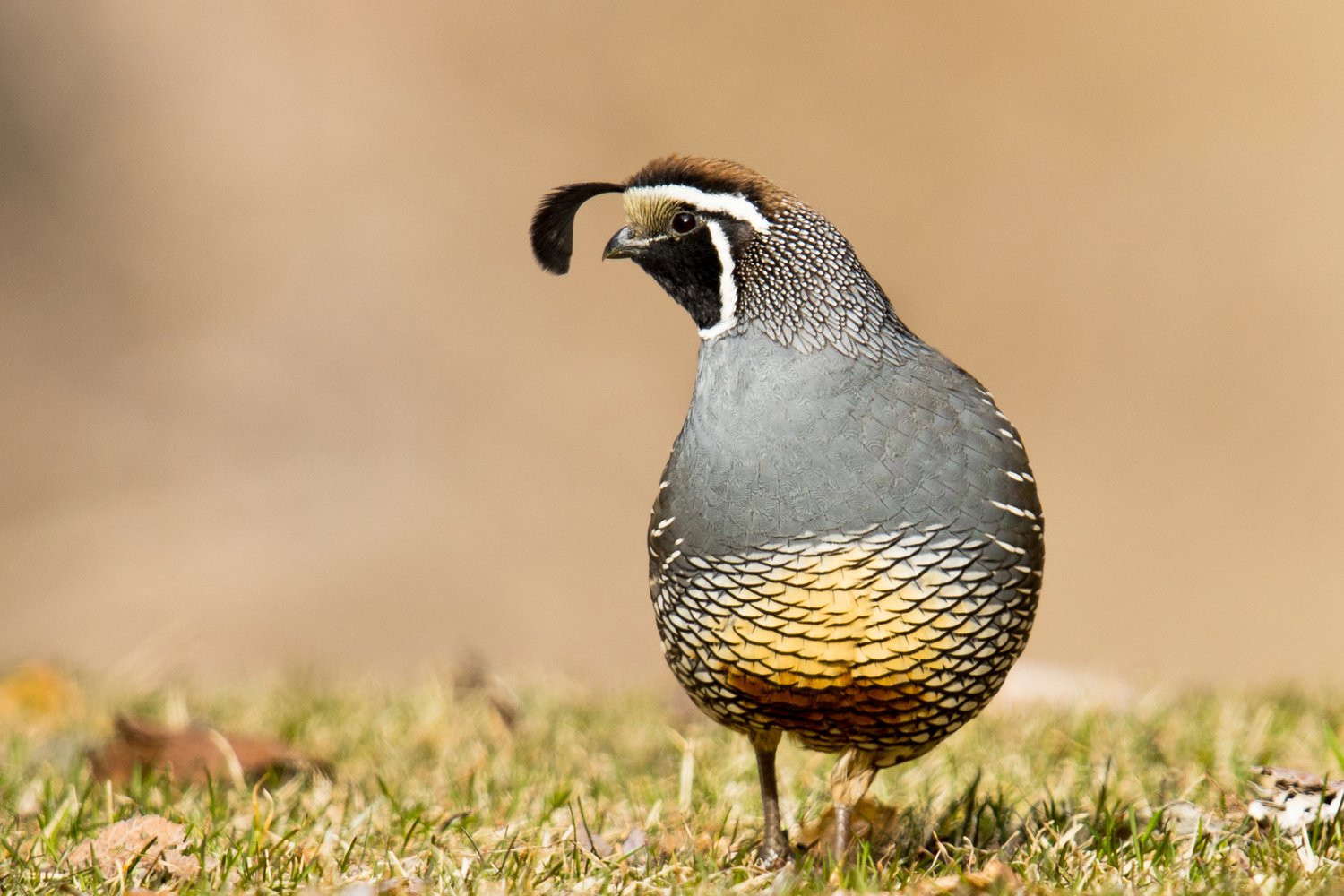
The California Quail is a small, plump ground-dwelling bird native to the western United States and Mexico. It is easily recognized by its distinctive curving plume (topknot) on its head, its social nature, and its characteristic 'chi-ca-go' call. It is the state bird of California.
Dimensioni e longevità
- Lunghezza
- 23-28 cm (9-11 in)
- Apertura alare
- 32-36 cm (12.5-14 in)
- Peso
- 150-250 g (5.3-8.8 oz)
- Longevità
- 2-7 years in the wild, up to 10 years in captivity
- Dieta
- Omnivore, primarily herbivorous
Caratteristiche fisiche
- Piumaggio
- Males have a dark brown cap bordered by a white stripe, a black face with a white border, and a black, curving topknot. The back is olive-brown, and the flanks are streaked with chestnut. The belly is scaled with white and chestnut, with a central chestnut patch. Females are duller overall, lacking the strong facial markings and chestnut belly patch, with a smaller, straighter topknot. Both sexes have a short, rounded tail.
- Forma del becco
- Short, stout, and slightly curved, dark gray to black.
- Colore degli occhi
- Dark brown.
- Colore delle zampe
- Dark gray to black.
- Caratteristiche distintive
- The most distinctive feature is the comma-shaped, forward-curving black topknot on the head, prominent in males and smaller in females. Males also have a striking black face outlined in white.
- Aspetto giovanile
- Juveniles resemble adult females but are duller and more mottled, with a very small or absent topknot. Their plumage is generally streaky brown.
- Cambiamenti stagionali
- No significant seasonal plumage changes. Plumage remains consistent year-round, though wear and tear can make colors appear slightly duller before molting.
- Dimorfismo sessuale
- Pronounced. Males are more brightly colored with distinct facial patterns (black face, white border) and a larger, more curved topknot. Females are duller, with a brownish-gray face and a smaller, straighter topknot.
Come identificare
- 1
Topknot
Look for the distinctive, forward-curving black plume on the head. It's larger and more curved in males.
- 2
Male Facial Pattern
Males have a striking black face outlined by a crisp white stripe, and a dark brown cap.
- 3
Belly Pattern
Males have a chestnut patch on the lower belly, surrounded by white and chestnut scaling. Females are duller with less distinct scaling and no central chestnut patch.
- 4
Overall Coloration
Olive-brown back, streaked chestnut flanks, and a generally plump, rounded body shape.
- 5
Behavior
Often seen in coveys, running along the ground, or bursting into short, whirring flights when startled. Listen for their characteristic 'chi-ca-go' call.
Habitat e areale
- Biomi
- Chaparral, oak woodlands, grasslands, agricultural areas, suburban gardens, riparian zones.
- Areale geografico
- Native to the western United States (primarily California, Oregon, Washington, Nevada, Utah, Arizona) and Baja California, Mexico. Introduced to British Columbia, Hawaii, Chile, Argentina, New Zealand, and Australia.
- Fascia altitudinale
- Sea level up to 2,400 meters (8,000 feet), though most common below 1,200 meters (4,000 feet).
- Ambienti preferiti
- Prefers areas with dense shrub cover for protection, open ground for foraging, and access to water. Often found near human habitation, especially in suburban areas with suitable landscaping.
Comportamento
- Periodo di attività
- Diurnal, most active during early morning and late afternoon, often resting in shade during the hottest parts of the day.
- Abitudini alimentari
- Forages on the ground, scratching and pecking for seeds, leaves, flowers, berries, and insects. Diet varies seasonally, with seeds being dominant in winter and spring, and green vegetation and insects increasing in summer. They often feed in coveys.
- Comportamento sociale
- Highly social, forming coveys (flocks) of 10-100+ individuals outside the breeding season. During breeding, pairs become more territorial but may still forage in loose groups. Coveys provide safety in numbers.
- Tipo di volo
- Short, explosive bursts of flight, often accompanied by rapid wing beats and a whirring sound, typically to escape predators or move between cover. They prefer to run rather than fly.
- Migrazione
- Non-migratory; resident throughout its range. May make short, local movements to find food or water, especially during harsh weather.
- Territorialità
- During the breeding season, males establish and defend small territories around nesting sites. Outside of breeding, coveys are not territorial in the same way, but maintain a home range.
Canto e richiami
- Canto
- The primary song, often given by males, is a distinctive three-note call described as 'chi-ca-go' or 'chi-ca-go-go', with the middle note accented. It's a loud, clear, and often repeated call used for communication within the covey and territorial advertisement.
- Richiamo
- Various calls include a soft 'whit' or 'pip' contact call, a sharp 'kuk-kuk-kuk' alarm call given when startled, and a 'squawk' or 'squeal' when flushed. Chicks have soft peeping calls.
- Quando vocalizza
- Most vocal during the breeding season (spring and early summer) and when coveys are active, especially at dawn and dusk. Alarm calls can be heard anytime a threat is perceived.
Riproduzione
- Stagione riproduttiva
- Typically from April to July, but can vary with rainfall and food availability.
- Abitudini di nidificazione
- Nests are shallow depressions on the ground, often concealed under dense vegetation, a log, or a rock. Lined with grass, leaves, and feathers. Both parents participate in nest selection and construction.
- Dimensione della covata
- Usually 10-16 eggs, but can range from 6 to 28 (the latter often due to 'dump nesting' by multiple females).
- Descrizione dell'uovo
- 8-16 eggs, typically 10-12. Eggs are creamy white to pale buff, heavily spotted and blotched with reddish-brown or olive-brown, often concentrated at the larger end. Approximately 3.2 x 2.5 cm (1.25 x 1 in).
- Periodo di incubazione
- 21-23 days, primarily by the female, though the male may sit on the eggs occasionally.
- Periodo di involo
- Precocial chicks leave the nest within hours of hatching and are able to feed themselves. They can make short flights within 10-14 days and are independent by 4-6 weeks.
- Cure parentali
- Both parents care for the chicks, leading them to food and water, and protecting them from predators. Males often take over care of the first brood if the female attempts a second clutch.
Dove trovarlo
Chaparral and Shrublands
Dense, thorny scrub provides excellent cover and foraging opportunities.
Oak Woodlands
Open woodlands with an understory of shrubs and grasses are ideal.
Suburban Gardens and Parks
Often found in well-landscaped areas with a mix of open ground, shrubs, and access to water, especially in California.
Agricultural Edges
Fields bordered by hedgerows or brushy areas can attract them.
Consigli sul campo
- Listen for their call. Their distinctive 'chi-ca-go' call is often the first indication of their presence. Listen for it at dawn and dusk.
- Look for coveys. Outside of breeding season, they are almost always in groups. Scan open areas near dense cover for moving groups of birds.
- Check near water sources. They need regular access to water, so look near streams, ponds, or even bird baths in suitable habitats.
- Be patient and quiet. They are wary birds. Move slowly and quietly, and use binoculars to scan for movement in dense vegetation.
- Observe their behavior. Watch for their characteristic running and scratching behavior while foraging. If startled, they will often run for cover before flying.
Specie simili
Gambel's Quail
Callipepla gambelii
Gambel's Quail has a black patch on the belly (California Quail has a chestnut patch) and a chestnut crown (California Quail has a dark brown cap bordered by white). The male Gambel's Quail has a more extensive black face and throat. Their ranges overlap in some areas of the southwestern US.
Scaled Quail
Callipepla squamata
Scaled Quail lacks the prominent black topknot, instead having a white, fluffy crest. Its plumage has a distinctive 'scaled' appearance on the breast and back, which is absent in the California Quail. Their ranges generally do not overlap significantly.
Mountain Quail
Oreortyx pictus
Mountain Quail is larger, has a long, straight head plume (not curved), and a distinctive chestnut throat and flanks with bold white barring. It prefers higher elevations and denser forest habitats than the California Quail.
Fatti rapidi
- State Bird:
- California
- Social Structure:
- Coveys (flocks) outside breeding season
- Primary Defense:
- Running and hiding in dense cover
- Diet Focus:
- Seeds and green vegetation
- Nesting:
- Ground nest, well-concealed
Curiosità
- California Quail chicks are precocial, meaning they are born with open eyes, covered in down, and can walk and feed themselves within hours of hatching.
- The distinctive topknot is made of six feathers that are fused at the base.
- They are known to engage in 'dust bathing,' where they roll in dry soil to clean their feathers and remove parasites.
- Coveys often have sentinels that stand guard on elevated perches, alerting the group to danger with alarm calls.
- In some areas, California Quail have adapted well to suburban environments, becoming a common sight in gardens and parks.
Classificazione scientifica
- Regno
- Animalia
- Phylum
- Chordata
- Classe
- Aves
- Ordine
- Galliformes
- Famiglia
- Odontophoridae
- Genere
- Callipepla
- Specie
- Callipepla californica
Esplora California Quail
Identifica uccelli ovunque
Gratis su iOS, Android e Web. Identificazione per foto e suono, database completo e la tua lista personale.