
Come identificare California Quail
Callipepla californica
Visto un uccello? Identificalo all'istante con l'app Birdby
Apri l'appPer identificare correttamente California Quail (Callipepla californica), controlla ciascuna di queste caratteristiche. Gli uccelli possono essere complicati da riconoscere, perché comportamento, habitat e canto spesso confermano ciò che una sola foto non può.
Dimensioni a colpo d'occhio
- Lunghezza
- 23-28 cm (9-11 in)
- Apertura alare
- 32-36 cm (12.5-14 in)
- Peso
- 150-250 g (5.3-8.8 oz)
Caratteristiche fisiche da controllare
- 1
Piumaggio
Colorazione e disegno generale del piumaggio.
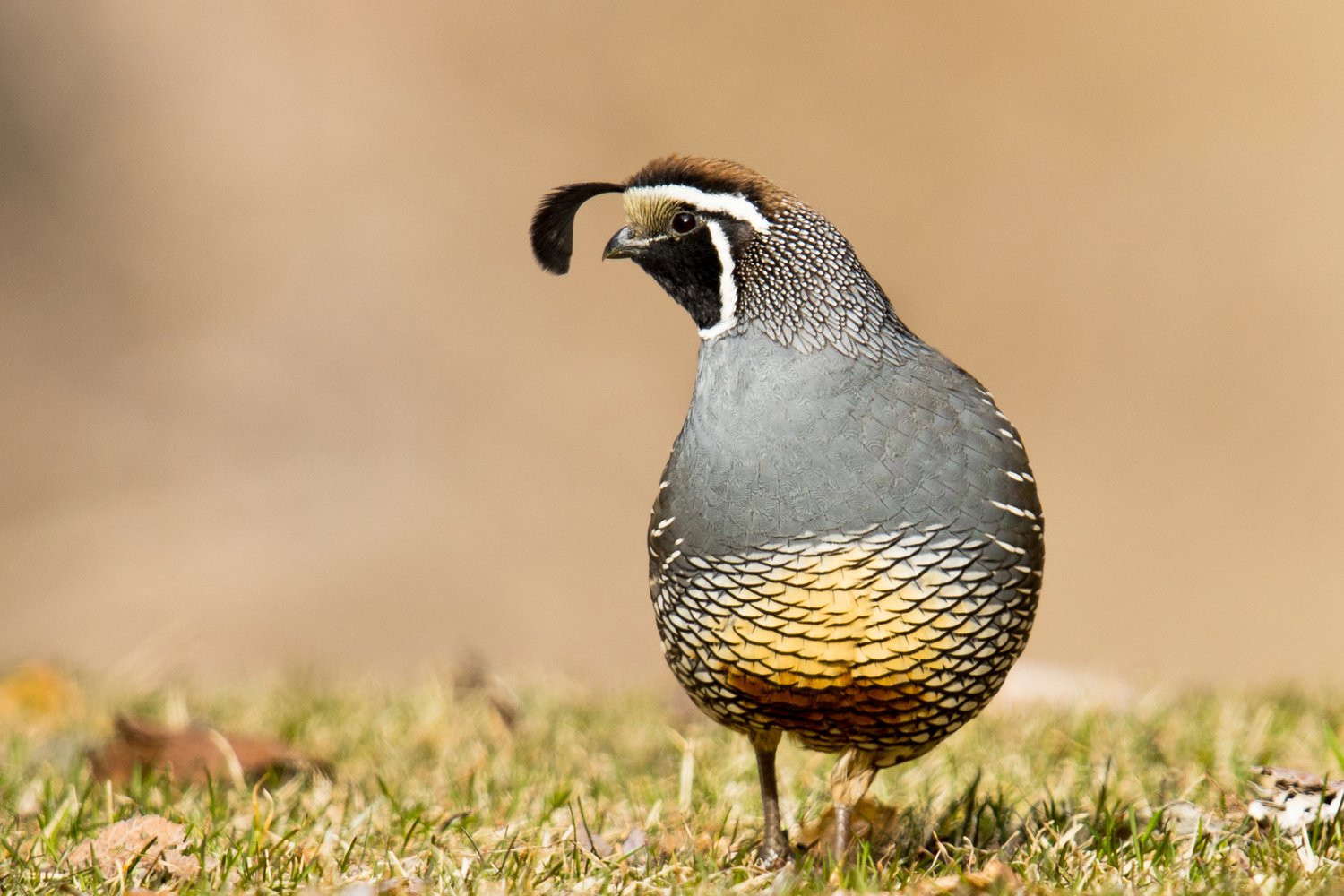
Males have a dark brown cap bordered by a white stripe, a black face with a white border, and a black, curving topknot. The back is olive-brown, and the flanks are streaked with chestnut. The belly is scaled with white and chestnut, with a central chestnut patch. Females are duller overall, lacking the strong facial markings and chestnut belly patch, with a smaller, straighter topknot. Both sexes have a short, rounded tail.
- 2
Forma del becco
Forma e colore del becco, un segno di campo chiave.
Short, stout, and slightly curved, dark gray to black.
- 3
Colore degli occhi
Colore dell'iride e segni distintivi sugli occhi.
Dark brown.
- 4
Colore delle zampe
Colore di zampe e piedi.
Dark gray to black.
- 5
Caratteristiche distintive
Tratti distintivi che separano questa specie.
The most distinctive feature is the comma-shaped, forward-curving black topknot on the head, prominent in males and smaller in females. Males also have a striking black face outlined in white.
- 6
Aspetto giovanile
Come i giovani si differenziano dagli adulti.
Juveniles resemble adult females but are duller and more mottled, with a very small or absent topknot. Their plumage is generally streaky brown.
- 7
Cambiamenti stagionali
Variazione del piumaggio tra stagione riproduttiva e non.
No significant seasonal plumage changes. Plumage remains consistent year-round, though wear and tear can make colors appear slightly duller before molting.
- 8
Dimorfismo sessuale
Differenze tra maschi e femmine.
Pronounced. Males are more brightly colored with distinct facial patterns (black face, white border) and a larger, more curved topknot. Females are duller, with a brownish-gray face and a smaller, straighter topknot.
Segni di campo chiave
- Topknot. Look for the distinctive, forward-curving black plume on the head. It's larger and more curved in males.
- Male Facial Pattern. Males have a striking black face outlined by a crisp white stripe, and a dark brown cap.
- Belly Pattern. Males have a chestnut patch on the lower belly, surrounded by white and chestnut scaling. Females are duller with less distinct scaling and no central chestnut patch.
- Overall Coloration. Olive-brown back, streaked chestnut flanks, and a generally plump, rounded body shape.
- Behavior. Often seen in coveys, running along the ground, or bursting into short, whirring flights when startled. Listen for their characteristic 'chi-ca-go' call.
Esplora California Quail
Identifica uccelli ovunque
Gratis su iOS, Android e Web. Identificazione per foto e suono, database completo e la tua lista personale.