
Visto un uccello? Identificalo all'istante con l'app Birdby
Apri l'appInformazioni
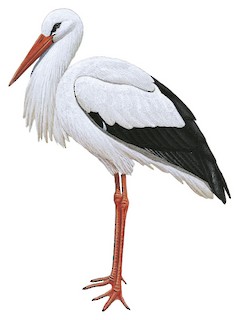
The White Stork is a large, long-legged, long-necked wading bird with a long, stout bill. It is widely recognized for its striking white plumage contrasted with black flight feathers, and its association with human settlements and folklore.
Dimensioni e longevità
- Lunghezza
- 100-115 cm (39-45 in)
- Apertura alare
- 155-215 cm (61-85 in)
- Peso
- 2.3-4.5 kg (5.1-9.9 lb)
- Longevità
- Up to 35 years in the wild, typically 10-15 years
- Dieta
- Carnivore, primarily consuming insects, amphibians, reptiles, small mammals, and fish.
Caratteristiche fisiche
- Piumaggio
- Adults have entirely white plumage on the body, head, and neck, with contrasting glossy black primary and secondary flight feathers (remiges) and greater coverts, which are visible when the wings are folded or in flight. The black coloration is due to melanin.
- Forma del becco
- Long, straight, and pointed. Bright red in adults during the breeding season, duller red or reddish-brown outside of breeding season.
- Colore degli occhi
- Dark brown with a red orbital ring.
- Colore delle zampe
- Long and slender, bright red in adults, duller red or reddish-brown outside of breeding season.
- Caratteristiche distintive
- Large size, predominantly white body with black flight feathers, long red legs, and a long red bill. Distinctive slow, powerful wing beats in flight, often soaring on thermals.
- Aspetto giovanile
- Juveniles resemble adults but have duller, brownish-red bills and legs, and their black flight feathers may appear duller and less glossy. Their white plumage may also have a slightly dingier appearance.
- Cambiamenti stagionali
- The intensity of the red coloration of the bill and legs is brightest during the breeding season, becoming somewhat duller outside of this period. No significant plumage changes between breeding and non-breeding seasons.
- Dimorfismo sessuale
- Males and females are outwardly similar in plumage and size, though males tend to be slightly larger and heavier than females. This difference is often not discernible in the field.
Come identificare
- 1
Plumage
Look for the striking contrast of pure white body plumage with glossy black flight feathers. This is the most definitive visual cue.
- 2
Bill and Legs
Observe the long, straight, bright red bill and long, red legs in adults. Juveniles have duller, brownish-red bills and legs.
- 3
Size and Shape
Note its large size, long neck, and long legs. In flight, the neck is outstretched, and legs trail behind the tail.
- 4
Flight Pattern
Watch for its characteristic slow, powerful wing beats interspersed with long periods of soaring on thermals, often at great heights.
- 5
Behavior
Look for them foraging in open fields, often near water, or nesting on prominent elevated structures in human settlements. Listen for bill-clattering.
Habitat e areale
- Biomi
- Open grasslands, agricultural fields, wet meadows, marshes, steppes, and savannas. They prefer areas with short vegetation for foraging and access to water.
- Areale geografico
- Breeds across Europe (from Portugal east to Russia), North Africa, and parts of Asia (Turkey, Central Asia). Winters primarily in sub-Saharan Africa and the Indian subcontinent. Some populations are resident in parts of Spain and North Africa.
- Fascia altitudinale
- Typically found in lowlands, from sea level up to approximately 1,500 meters (4,900 ft), though they can be observed at higher altitudes during migration.
- Ambienti preferiti
- Open country with scattered trees or human structures for nesting, close to wetlands, rivers, or agricultural land that provides abundant food sources. They are highly synanthropic, often nesting on buildings, utility poles, and purpose-built platforms in villages and towns.
Comportamento
- Periodo di attività
- Diurnal. They are active during daylight hours, foraging and engaging in social behaviors.
- Abitudini alimentari
- Opportunistic carnivores. They walk slowly through short vegetation, scanning for prey, which they seize with their long bills. Their diet is highly varied and includes large insects (e.g., grasshoppers, beetles), earthworms, amphibians (frogs, toads), reptiles (lizards, snakes), small mammals (voles, shrews, young rabbits), and fish. They often follow agricultural machinery to catch disturbed prey.
- Comportamento sociale
- Highly social, especially during migration and in wintering grounds, forming large flocks. During the breeding season, they are colonial nesters, often forming loose colonies on suitable structures. They are monogamous for a breeding season, often returning to the same nest and mate year after year.
- Tipo di volo
- Powerful and graceful. They often soar on thermals, especially during migration, to conserve energy. Their flight is characterized by slow, deep wing beats interspersed with long glides. They hold their neck outstretched and legs trailing behind in flight.
- Migrazione
- Long-distance migrant. European populations migrate south to Africa, crossing the Mediterranean via two main routes: the Strait of Gibraltar (western route) and the Bosphorus/Middle East (eastern route), avoiding long sea crossings. Asian populations migrate to India. They migrate in large flocks, often numbering thousands of individuals, utilizing thermals to soar. Migration occurs in autumn (August-October) and spring (February-April).
- Territorialità
- While colonial nesters, pairs defend the immediate vicinity of their nest site from other storks and potential predators. Foraging grounds are generally not defended territorially.
Canto e richiami
- Canto
- White Storks are largely silent birds, lacking a developed syrinx. They do not have a true song.
- Richiamo
- Their primary form of communication is bill-clattering (clapping their mandibles together rapidly), which produces a loud, resonant sound. This is used in greeting, courtship displays, territorial defense, and as an alarm signal. They may also emit hissing sounds, especially when disturbed at the nest.
- Quando vocalizza
- Bill-clattering is most frequent during the breeding season, particularly during pair bonding, nest building, and when adults greet each other at the nest. It can also be heard during social interactions in wintering grounds.
Riproduzione
- Stagione riproduttiva
- Typically from March to August, varying geographically. Arrival at breeding grounds usually occurs in March-April.
- Abitudini di nidificazione
- Build large, bulky nests made of sticks, branches, and various debris (rags, plastic, paper). Nests are often reused and enlarged annually, sometimes reaching several meters in height and weighing hundreds of kilograms. They prefer elevated sites such as rooftops, chimneys, church steeples, utility poles, and purpose-built nesting platforms. Occasionally, they nest in large trees.
- Dimensione della covata
- 3-5 eggs, most commonly 4.
- Descrizione dell'uovo
- Typically 3-5 (range 1-7) dull white, oval eggs, sometimes with a faint bluish or yellowish tinge, measuring approximately 73 x 52 mm.
- Periodo di incubazione
- 33-34 days, shared by both parents.
- Periodo di involo
- 58-64 days after hatching. Young are fed by both parents and remain dependent for some time after fledging.
- Cure parentali
- Both male and female participate in nest building, incubation, and feeding of the chicks. They bring food to the nest in their gullets and regurgitate it for the young.
Dove trovarlo
Agricultural Areas
Look in cultivated fields, pastures, and meadows, especially those recently mown or plowed, where prey is easily accessible.
Wetlands and Marshes
Areas with shallow water, ponds, and ditches are good foraging grounds for amphibians and fish.
Villages and Towns
During the breeding season, check rooftops, chimneys, church steeples, and utility poles for their large nests, particularly in rural European and North African settlements.
Migration Bottlenecks
During spring and autumn migration, large concentrations can be observed at key migratory choke points like the Strait of Gibraltar, Bosphorus, and along the Rift Valley in the Middle East.
Consigli sul campo
- Scan open landscapes. White Storks prefer open habitats for foraging. Use binoculars to scan fields and wetlands for their distinctive white and black forms.
- Look up in villages. In their breeding range, always look up at elevated structures in human settlements for their prominent nests. They are often quite tolerant of human presence.
- Observe flight patterns. During migration, look for large flocks soaring high on thermals. Their distinctive flight silhouette is easily recognizable.
- Listen for bill-clattering. While not vocal in the traditional sense, their bill-clattering is a unique sound that indicates their presence, especially near nests.
Specie simili
Black Stork
Ciconia nigra
The Black Stork is entirely black with a white belly, and has a red bill and legs. It is generally shyer and prefers forested wetlands, unlike the White Stork's preference for open country and human proximity.
Saddle-billed Stork
Ephippiorhynchus senegalensis
Found only in Africa. It is much larger, has a distinctive black and red bill with a yellow 'saddle', and black and white plumage pattern (black head, neck, back, white body).
Yellow-billed Stork
Mycteria ibis
Found only in Africa. It has a yellow bill, pinkish-white plumage, and black flight feathers. Its feeding method involves tactile probing in water, unlike the White Stork's visual hunting on land.
Fatti rapidi
- Primary Communication:
- Bill-clattering
- Nesting Sites:
- Rooftops, chimneys, utility poles, trees
- Migration Distance:
- Long-distance, intercontinental
- Diet Versatility:
- Opportunistic carnivore, wide range of small animals
- Cultural Significance:
- Symbol of good luck, fertility, and childbirth in many cultures
Curiosità
- White Storks are one of the few large bird species that have adapted well to human-modified landscapes, often nesting directly on human structures.
- The longest recorded lifespan for a White Stork in the wild is over 35 years, though average lifespan is much shorter.
- Their migration routes are so well-defined that they have been used for centuries by humans to predict weather patterns and seasonal changes.
- The White Stork's lack of a syrinx means it cannot produce complex vocalizations, relying instead on mechanical sounds like bill-clattering.
- Some White Storks have been observed to 'commute' between Europe and Africa, making the round trip of over 10,000 km annually.
Classificazione scientifica
- Regno
- Animalia
- Phylum
- Chordata
- Classe
- Aves
- Ordine
- Ciconiiformes
- Famiglia
- Ciconiidae
- Genere
- Ciconia
- Specie
- Ciconia ciconia
Esplora White Stork
Identifica uccelli ovunque
Gratis su iOS, Android e Web. Identificazione per foto e suono, database completo e la tua lista personale.