
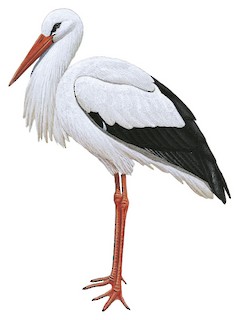
Dove vive White Stork?
Ciconia ciconia
Visto un uccello? Identificalo all'istante con l'app Birdby
Apri l'appWhite Stork vive in habitat e regioni specifiche. Sapere dove e quando guardare migliora le possibilità di un avvistamento riuscito.
Biomi
Open grasslands, agricultural fields, wet meadows, marshes, steppes, and savannas. They prefer areas with short vegetation for foraging and access to water.
Areale geografico
Breeds across Europe (from Portugal east to Russia), North Africa, and parts of Asia (Turkey, Central Asia). Winters primarily in sub-Saharan Africa and the Indian subcontinent. Some populations are resident in parts of Spain and North Africa.
Ambienti preferiti
Open country with scattered trees or human structures for nesting, close to wetlands, rivers, or agricultural land that provides abundant food sources. They are highly synanthropic, often nesting on buildings, utility poles, and purpose-built platforms in villages and towns.
Fascia altitudinale
Typically found in lowlands, from sea level up to approximately 1,500 meters (4,900 ft), though they can be observed at higher altitudes during migration.
Dove guardare
Agricultural Areas
Look in cultivated fields, pastures, and meadows, especially those recently mown or plowed, where prey is easily accessible.
Wetlands and Marshes
Areas with shallow water, ponds, and ditches are good foraging grounds for amphibians and fish.
Villages and Towns
During the breeding season, check rooftops, chimneys, church steeples, and utility poles for their large nests, particularly in rural European and North African settlements.
Migration Bottlenecks
During spring and autumn migration, large concentrations can be observed at key migratory choke points like the Strait of Gibraltar, Bosphorus, and along the Rift Valley in the Middle East.
Consigli sul campo
- Scan open landscapes. White Storks prefer open habitats for foraging. Use binoculars to scan fields and wetlands for their distinctive white and black forms.
- Look up in villages. In their breeding range, always look up at elevated structures in human settlements for their prominent nests. They are often quite tolerant of human presence.
- Observe flight patterns. During migration, look for large flocks soaring high on thermals. Their distinctive flight silhouette is easily recognizable.
- Listen for bill-clattering. While not vocal in the traditional sense, their bill-clattering is a unique sound that indicates their presence, especially near nests.
Migrazione
Long-distance migrant. European populations migrate south to Africa, crossing the Mediterranean via two main routes: the Strait of Gibraltar (western route) and the Bosphorus/Middle East (eastern route), avoiding long sea crossings. Asian populations migrate to India. They migrate in large flocks, often numbering thousands of individuals, utilizing thermals to soar. Migration occurs in autumn (August-October) and spring (February-April).
Esplora White Stork
Identifica uccelli ovunque
Gratis su iOS, Android e Web. Identificazione per foto e suono, database completo e la tua lista personale.