
Visto un uccello? Identificalo all'istante con l'app Birdby
Apri l'appInformazioni
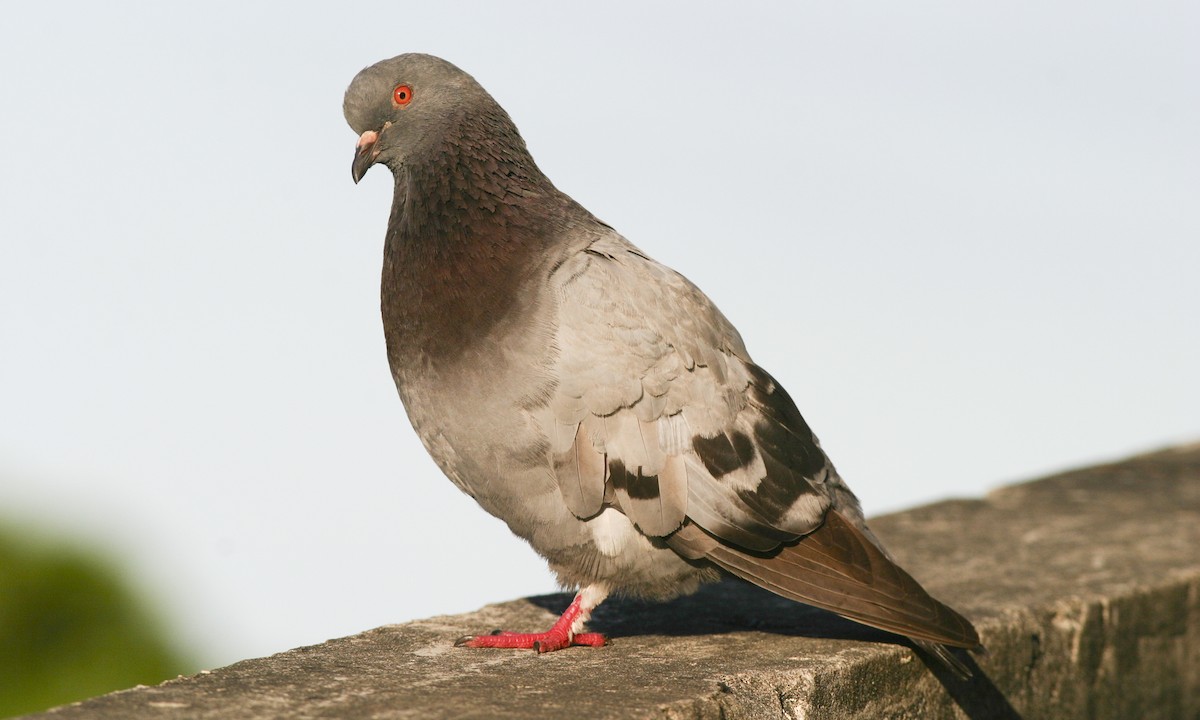
The Domestic Pigeon, also known as the Feral Pigeon, is a subspecies of the Rock Dove (Columba livia) that has been domesticated for thousands of years and subsequently returned to the wild in many urban and suburban environments worldwide. It exhibits a wide range of plumage variations due to selective breeding and subsequent interbreeding in feral populations. Highly adaptable, it thrives in close association with humans.
Dimensioni e longevità
- Lunghezza
- 30-35 cm
- Apertura alare
- 60-70 cm
- Peso
- 230-500 g
- Longevità
- 3-5 years (feral), up to 15 years (domesticated)
- Dieta
- Omnivore (primarily granivorous)
Caratteristiche fisiche
- Piumaggio
- Highly variable. The ancestral wild type (blue-bar) plumage is slate-grey with iridescent green and purple sheens on the neck and breast, two prominent black wing bars, and a white rump. Feral populations display a vast array of colors and patterns including solid black, white, brown, pied (patches of white and other colors), mottled, and various shades of grey, often lacking distinct wing bars or having multiple bars. The primary feathers are typically darker, and the undertail coverts are often white.
- Forma del becco
- Relatively short, slender, and dark grey to black, with a prominent cere (fleshy patch) at the base, which is typically white or pale grey.
- Colore degli occhi
- Typically orange to reddish-orange, with a narrow, pale orbital ring.
- Colore delle zampe
- Reddish-pink to dark red, scaly, with four toes (three forward, one backward).
- Caratteristiche distintive
- The most distinguishing feature is the immense variability in plumage. However, the general pigeon shape, head bobbing walk, and characteristic cooing vocalizations are consistent. The presence of a white cere at the base of the beak is also a good field mark.
- Aspetto giovanile
- Juveniles resemble adults but have duller plumage, less iridescence on the neck, and a less prominent or absent cere, which is often greyish. Their eyes may also appear duller.
- Cambiamenti stagionali
- No significant seasonal plumage changes. Plumage variations are primarily genetic rather than seasonal.
- Dimorfismo sessuale
- Minimal. Males tend to be slightly larger and heavier than females, with a more pronounced iridescent sheen on the neck and a more robust head. During courtship, males display more vigorous bowing and cooing. These differences are often subtle and not reliable for field identification.
Come identificare
- 1
Plumage Variability
Look for the wide range of colors and patterns. While some may resemble the ancestral blue-bar Rock Dove, many will be pied, solid black, white, or mottled. This variability is a key indicator of a feral domestic pigeon.
- 2
General Shape and Size
Observe the typical pigeon body shape: plump body, small head, short legs, and a relatively short tail. They are medium-sized pigeons, larger than doves but smaller than Wood Pigeons.
- 3
Head and Beak
Note the small head relative to the body, the slender dark beak, and especially the prominent white or pale grey cere at the base of the upper mandible.
- 4
Behavior
Watch for their characteristic head-bobbing walk while foraging on the ground. Their strong, direct flight with rapid wing beats is also distinctive. They are often seen in flocks in urban settings.
- 5
Vocalization
Listen for the soft, guttural cooing sounds, particularly the 'coo-roo-coo-coo' of males during courtship.
Habitat e areale
- Biomi
- Urban, suburban, agricultural, coastal cliffs (ancestral habitat).
- Areale geografico
- Cosmopolitan, found on every continent except Antarctica. Particularly abundant in human-modified landscapes globally.
- Fascia altitudinale
- Sea level up to several thousand meters in mountainous urban areas.
- Ambienti preferiti
- Cities, towns, villages, farms, industrial areas, bridges, buildings, cliffs, and any structure offering ledges for roosting and nesting, and open ground for foraging.
Comportamento
- Periodo di attività
- Diurnal. Most active during daylight hours, foraging and interacting. They roost communally at night.
- Abitudini alimentari
- Primarily ground feeders, pecking at seeds, grains, discarded human food, and occasionally small invertebrates. They are opportunistic and highly adapted to scavenging in urban environments. They can drink by sucking water, unlike most birds that scoop and tilt their heads.
- Comportamento sociale
- Highly gregarious, forming large flocks, especially around food sources and roosting sites. They are monogamous during breeding season but often form loose colonies. They communicate through various cooing sounds and body language.
- Tipo di volo
- Strong, direct, and swift flight with rapid wing beats. They can achieve considerable speeds. Often seen gliding on stiff wings after a series of flaps. They are highly maneuverable, especially when navigating urban obstacles.
- Migrazione
- Non-migratory; resident throughout their range. They may make local movements in search of food or suitable roosting sites.
- Territorialità
- Generally not territorial over large areas, but males will defend a small nesting territory around the nest site during breeding season, often with aggressive displays and pecking.
Canto e richiami
- Canto
- The 'song' is a characteristic soft, guttural cooing sound, often described as 'coo-roo-coo-coo' or 'doo-doo-doo'. This is primarily used by males during courtship displays.
- Richiamo
- Various cooing calls are used for communication within the flock, alarm calls (a sharp 'hoo-hoo-hoo' or 'ooh-ooh-ooh' when startled), and contact calls. The wing clatter during takeoff can also be a distinctive sound.
- Quando vocalizza
- Vocalize throughout the day, particularly during courtship displays in the breeding season and when interacting within flocks.
Riproduzione
- Stagione riproduttiva
- Year-round in many urban areas with sufficient food, but peaks in spring and summer (March to October in temperate regions).
- Abitudini di nidificazione
- Nests are typically flimsy platforms of twigs, grass, and debris, often placed on ledges of buildings, bridges, cliffs, or in sheltered cavities. Both parents participate in nest building.
- Dimensione della covata
- 1-3 eggs, typically 2.
- Descrizione dell'uovo
- Usually two pure white, elliptical eggs, smooth and non-glossy.
- Periodo di incubazione
- 17-19 days, shared by both parents.
- Periodo di involo
- 25-32 days. Young are fed 'crop milk' by both parents initially, then regurgitated seeds.
- Cure parentali
- Both parents share incubation duties and care for the altricial young, feeding them crop milk and later regurgitated food until they fledge.
Dove trovarlo
Urban Centers
Virtually any city, town, or village globally, especially around public squares, parks, train stations, and commercial areas.
Buildings and Structures
On ledges, roofs, window sills, bridges, and underpasses, which provide roosting and nesting sites.
Agricultural Areas
Around farms, barns, and grain storage facilities where food sources are abundant.
Coastal Areas
In some regions, they may inhabit coastal cliffs, mirroring the ancestral habitat of the wild Rock Dove.
Consigli sul campo
- Look Up. Pigeons frequently perch on high ledges, statues, and rooftops, offering good viewing opportunities.
- Observe Feeding Behavior. They are often found foraging on the ground in parks, plazas, and near outdoor eating areas, where they are accustomed to human presence.
- Listen for Cooing. Their characteristic cooing is a good indicator of their presence, especially during breeding season.
- Note Plumage Variation. Pay attention to the diverse plumage patterns; this is a key identifier for feral pigeons compared to other dove and pigeon species.
Specie simili
Rock Dove
Columba livia
The Domestic Pigeon (Columba livia domestica) is the domesticated form of the Rock Dove (Columba livia). Wild Rock Doves typically have a more uniform slate-grey plumage, two distinct black wing bars, a white rump, and a clean, unpatterned tail. Feral Domestic Pigeons often show a much wider range of colors and patterns, including pied, black, white, and various shades of grey, often lacking the distinct white rump or having irregular wing bars. True wild Rock Doves are now rare and restricted to coastal cliffs and caves, while feral pigeons are ubiquitous in urban settings.
Stock Dove
Columba oenas
Stock Doves are generally smaller and more uniformly blue-grey than most feral pigeons, lacking the white rump and having only faint, incomplete black wing bars. They have dark eyes and a yellowish-orange bill with a small, white cere. They prefer woodland and parkland habitats, rarely venturing into dense urban centers like feral pigeons.
Wood Pigeon
Columba palumbus
Wood Pigeons are significantly larger and bulkier than Domestic Pigeons. Adults have a distinctive white patch on the side of the neck (absent in juveniles) and a prominent white wing bar visible in flight. Their plumage is generally grey with a pinkish breast. They have a more robust bill and a longer tail. While they can be found in urban parks, they are more associated with woodlands and agricultural areas.
Fatti rapidi
- Global Distribution:
- Cosmopolitan
- Primary Habitat:
- Urban and suburban environments
- Diet:
- Seeds, grains, human scraps
- Sociality:
- Highly gregarious, forms flocks
- Breeding:
- Year-round in favorable conditions
Curiosità
- Domestic Pigeons were originally bred from the wild Rock Dove (Columba livia) and have been domesticated for over 5,000 years, primarily for food, messengers, and sport (racing).
- They possess an extraordinary homing ability, capable of finding their way back to their loft from hundreds of miles away, a trait utilized for 'homing pigeons' and messenger services throughout history.
- Pigeons can see in color and are believed to be able to detect polarized light, aiding in navigation.
- They are one of the few bird species that produce 'crop milk' (also known as pigeon milk), a nutrient-rich secretion from the lining of their crop, to feed their young.
- Despite their commonality, pigeons are highly intelligent birds, capable of recognizing human faces, learning complex tasks, and even distinguishing between different paintings by artists.
Classificazione scientifica
- Regno
- Animalia
- Phylum
- Chordata
- Classe
- Aves
- Ordine
- Columbiformes
- Famiglia
- Columbidae
- Genere
- Columba
- Specie
- Columba livia
Esplora Domestic Pigeon
Identifica uccelli ovunque
Gratis su iOS, Android e Web. Identificazione per foto e suono, database completo e la tua lista personale.