
Visto un uccello? Identificalo all'istante con l'app Birdby
Apri l'appInformazioni
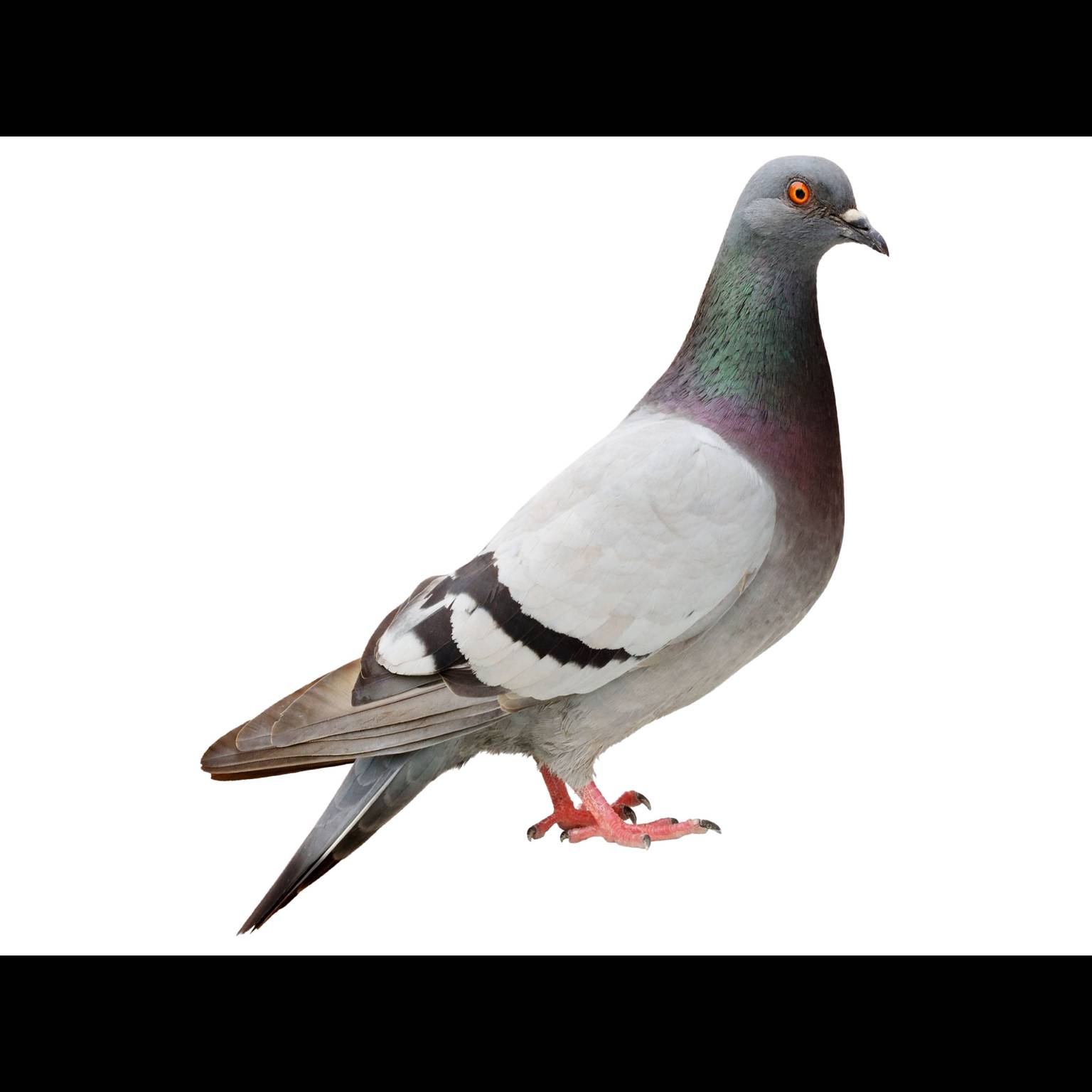
The Rock Dove, or Rock Pigeon, is a widespread species of pigeon that is the ancestor of all domestic pigeons. Its natural habitat is cliffs and rocky coasts, but it has adapted exceptionally well to urban environments, where it is commonly known as the Feral Pigeon. The wild form is characterized by its grey plumage with two distinct black wing bars.
Dimensioni e longevità
- Lunghezza
- 31-35 cm
- Apertura alare
- 62-68 cm
- Peso
- 238-380 g
- Longevità
- 3-5 years (wild), up to 15 years (domestic/feral)
- Dieta
- Granivore (seeds, grains, legumes), supplemented with invertebrates, fruits, and human food scraps in urban areas.
Caratteristiche fisiche
- Piumaggio
- The wild type (Rock Dove) has a dark bluish-grey head, neck, and chest with iridescent green and purplish gloss on the neck and upper breast. The back is pale grey, and the wings are pale grey with two prominent black bars. The rump is white, and the tail is grey with a broad black terminal band. Feral pigeons exhibit a wide range of plumage variations due to hybridization with domestic strains, including solid black, white, brown, pied, and various shades of grey with differing bar patterns.
- Forma del becco
- Slender, dark grey to blackish beak with a prominent white cere at the base.
- Colore degli occhi
- Orange-red, with a pale inner ring.
- Colore delle zampe
- Reddish-pink to purplish-red.
- Caratteristiche distintive
- The pure wild form is distinguished by its white rump, two distinct black wing bars, and iridescent neck plumage. Feral pigeons often retain the two black wing bars but can vary greatly in color. The characteristic bobbing head walk is also a key feature.
- Aspetto giovanile
- Juveniles resemble adults but have duller plumage, less iridescence on the neck, and a less prominent cere. Their eyes are typically duller brown.
- Cambiamenti stagionali
- No significant seasonal plumage changes. The iridescence on the neck may appear more vibrant during courtship displays.
- Dimorfismo sessuale
- Males and females are generally monomorphic in plumage, though males may appear slightly larger and have more pronounced iridescence on the neck during breeding displays.
Come identificare
- 1
Plumage (Wild Type)
Look for a blue-grey body, iridescent green and purple sheen on the neck, two distinct black wing bars, and a prominent white rump (especially visible in flight). The tail has a broad black terminal band.
- 2
Plumage (Feral Type)
Be aware of extreme variability. Many feral pigeons will still show the two black wing bars, but colors can range from pure white, black, brown, to various mottled or checkered patterns. The white rump is a key feature of the ancestral wild type, but may be obscured or absent in some feral variants.
- 3
Flight
Strong, direct flight with rapid wingbeats. Often flies in tight flocks. A characteristic 'whistle' can be heard from the wings during takeoff or rapid flight.
- 4
Behavior
Observe their characteristic head-bobbing walk while foraging on the ground. They are often seen perching on ledges, buildings, or cliffs.
- 5
Vocalization
Listen for the soft, guttural 'coo-COO-coo' song, especially from males during courtship.
Habitat e areale
- Biomi
- Coastal cliffs, rocky outcrops, urban and suburban areas, agricultural lands.
- Areale geografico
- Native to Europe, North Africa, and Western Asia. Introduced and naturalized worldwide, particularly in urban environments across all continents except Antarctica.
- Fascia altitudinale
- Sea level up to 4,000 meters in some mountainous regions.
- Ambienti preferiti
- Natural rock faces, sea cliffs, caves, and man-made structures such as buildings, bridges, and ruins that mimic their natural cliff habitats. They require access to open ground for foraging and fresh water.
Comportamento
- Periodo di attività
- Diurnal, most active during daylight hours, foraging in the morning and late afternoon.
- Abitudini alimentari
- Primarily ground feeders, pecking at seeds, grains, and legumes. In urban settings, they are opportunistic scavengers, consuming human food waste, bread, and other discarded items. They can also consume small invertebrates and fruits.
- Comportamento sociale
- Highly social, typically found in flocks of varying sizes, from a few individuals to hundreds or thousands in urban areas. They roost communally and often feed together. Monogamous during breeding season, but pair bonds can be fluid.
- Tipo di volo
- Strong, direct, and rapid flight with regular, powerful wingbeats. They can glide for short distances. Often fly in flocks, especially when commuting to feeding or roosting sites.
- Migrazione
- Generally resident throughout their range. Some localized movements may occur in response to food availability or harsh weather, but they are not considered migratory.
- Territorialità
- Males defend a small nesting territory around the nest site, primarily through cooing displays and occasional physical altercations. Feeding areas are generally not defended.
Canto e richiami
- Canto
- The primary vocalization is a soft, guttural 'coo-COO-coo' or 'doo-COO-doo' used by males during courtship and territorial displays. This is often accompanied by bowing and strutting.
- Richiamo
- A variety of soft cooing sounds, a low 'hoo-hoo-hoo' when alarmed or disturbed, and a sharp 'whistle' produced by the wings during rapid flight, especially when taking off.
- Quando vocalizza
- Vocalize throughout the day, particularly during breeding season and when interacting with other pigeons.
Riproduzione
- Stagione riproduttiva
- Year-round in many urban areas, with peaks in spring (March-July) and autumn (September-November). In natural habitats, typically March to October.
- Abitudini di nidificazione
- Nests are typically flimsy platforms of twigs, grass, and debris, often lined with finer materials. They are built on ledges, in crevices, or on sheltered platforms on cliffs, buildings, bridges, or in abandoned structures. Both parents participate in nest building.
- Dimensione della covata
- 1-2 eggs, most commonly 2. Can have multiple clutches per year (up to 5-6 in urban environments).
- Descrizione dell'uovo
- Typically two elliptical, glossy white eggs.
- Periodo di incubazione
- 17-19 days, shared by both parents.
- Periodo di involo
- 30-37 days. Young are fed 'crop milk' by both parents initially, then regurgitated seeds.
- Cure parentali
- Both parents incubate the eggs and feed the nestlings. They continue to care for the fledglings for a short period after they leave the nest.
Dove trovarlo
Coastal Cliffs and Rocky Outcrops
The natural habitat of the pure Rock Dove. Look along the coastlines of Europe, North Africa, and Western Asia where there are suitable rock formations and sea caves.
Urban and Suburban Areas
Feral Pigeons (descendants of Rock Doves) are ubiquitous in cities, towns, and villages worldwide. Look for them in parks, plazas, building ledges, bridges, and around human activity.
Agricultural Lands
Often found foraging in fields, especially after harvest, for spilled grains and seeds.
Consigli sul campo
- Look for the white rump. This is the most reliable field mark for distinguishing the wild Rock Dove from other similar pigeons, especially when seen in flight.
- Observe behavior. Their confident, ground-feeding behavior and characteristic head-bobbing walk are good indicators. They are generally quite tame, especially in urban settings.
- Listen for calls. The distinctive cooing is a common sound in areas where they are present.
- Check roosting sites. Look for them congregating on ledges of tall buildings, bridges, or natural cliffs, especially in the early morning or late afternoon.
Specie simili
Stock Dove
Columba oenas
Lacks the white rump of the Rock Dove, has a shorter tail, and typically only one indistinct black wing bar (sometimes none). Its plumage is a more uniform blue-grey, and it lacks the strong iridescence on the neck. Found in woodlands and agricultural areas, rarely in dense urban centers.
Common Wood Pigeon
Columba palumbus
Significantly larger than the Rock Dove, with a prominent white patch on the side of the neck (adults) and a white wing bar visible in flight. Its call is a distinctive five-note 'coo-COO-coo-coo-coo'. Found in woodlands, parks, and gardens.
Feral Pigeon (domestic variants)
Columba livia domestica
While taxonomically the same species, feral pigeons exhibit a vast array of colors and patterns (e.g., all black, all white, pied, rufous, checkered) due to centuries of selective breeding and subsequent interbreeding. The pure Rock Dove (Columba livia livia) is much rarer and confined to natural cliff habitats, always showing the classic blue-grey plumage with two black wing bars and a white rump.
Fatti rapidi
- Ancestor of:
- All domestic pigeons
- Habitat:
- Cliffs, urban areas
- Diet:
- Seeds, grains, human scraps
- Key ID Feature (Wild):
- White rump, two black wing bars
- Sociality:
- Highly social, flocks
Curiosità
- Rock Doves were domesticated over 5,000 years ago, primarily for food, messages, and sport.
- Homing pigeons, a breed of Rock Dove, are renowned for their exceptional navigational abilities, often returning to their loft from hundreds of miles away.
- Pigeons can see ultraviolet light, which helps them navigate and find food.
- They are one of the few bird species that can drink by sucking water, rather than tilting their heads back.
- The 'crop milk' fed to their young is a highly nutritious, cheese-like substance produced in the crop of both male and female parents.
Classificazione scientifica
- Regno
- Animalia
- Phylum
- Chordata
- Classe
- Aves
- Ordine
- Columbiformes
- Famiglia
- Columbidae
- Genere
- Columba
- Specie
- Columba livia
Esplora Rock Dove
Identifica uccelli ovunque
Gratis su iOS, Android e Web. Identificazione per foto e suono, database completo e la tua lista personale.