
Visto un uccello? Identificalo all'istante con l'app Birdby
Apri l'appInformazioni
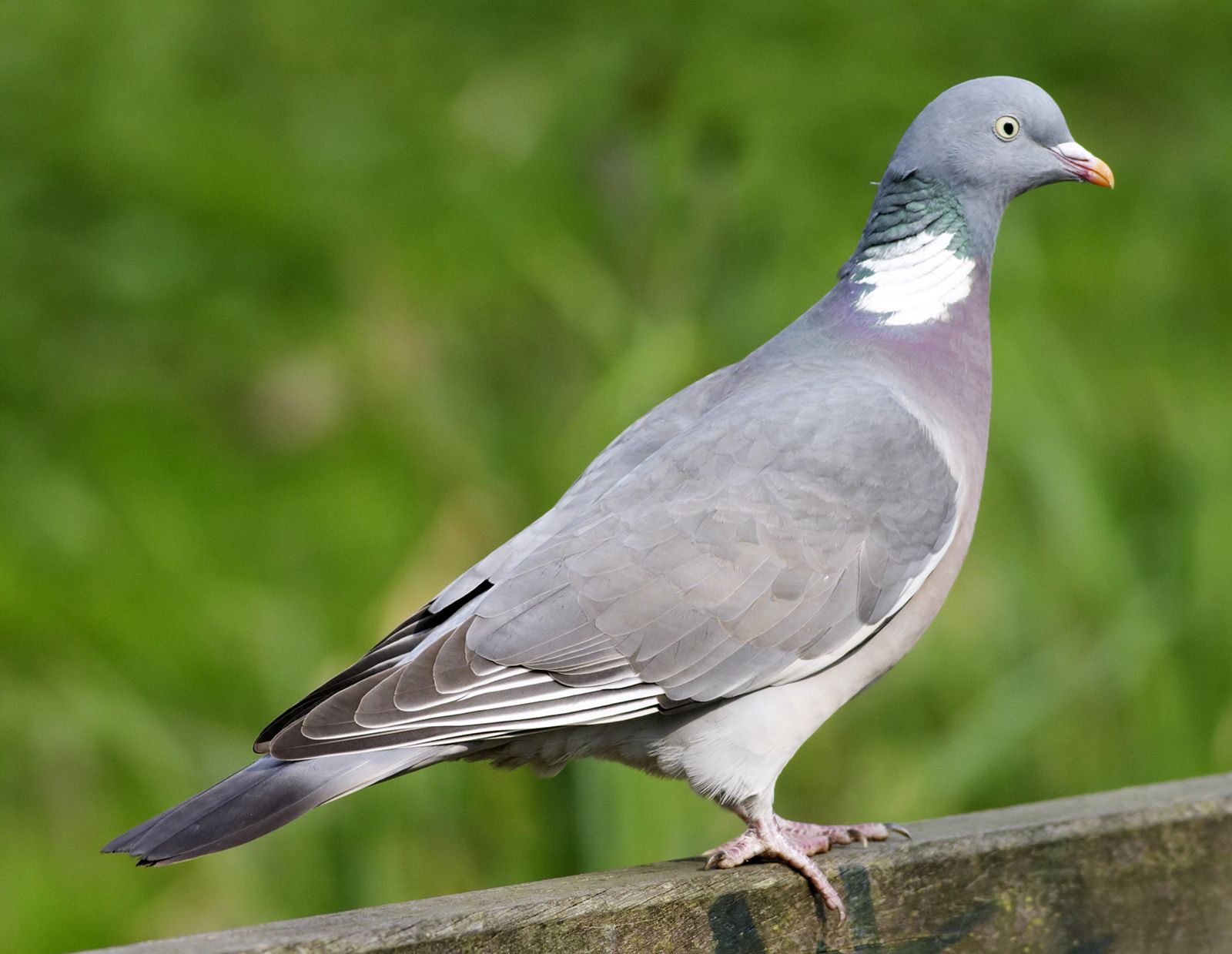
The Common Wood Pigeon, often referred to as Colombaccio in Italian, is the largest and most common pigeon species in Europe. It is a robust, largely grey pigeon with distinctive white patches on its neck and wings, particularly noticeable in flight. Highly adaptable, it thrives in a variety of habitats from woodlands to urban parks and gardens, and its population has significantly increased in recent decades.
Dimensioni e longevità
- Lunghezza
- 38-43 cm
- Apertura alare
- 68-80 cm
- Peso
- 300-615 g
- Longevità
- 3-5 years (up to 17 years recorded in the wild)
- Dieta
- Herbivore (primarily granivorous and frugivorous)
Caratteristiche fisiche
- Piumaggio
- Adults have a largely grey body, with a pinkish-purple wash on the breast. The head is grey, and the neck features iridescent green and purple patches, bordered by a prominent white patch on each side. The wings are grey with a distinctive white patch on the carpal joint, visible both at rest and in flight. The tail is grey with a broad black terminal band. The undertail coverts are white.
- Forma del becco
- Relatively small, slender, and pinkish-red at the base, fading to yellow at the tip. The cere (fleshy part at the base of the upper mandible) is white.
- Colore degli occhi
- Pale yellow to whitish-yellow
- Colore delle zampe
- Reddish-pink
- Caratteristiche distintive
- The most distinctive features are the prominent white neck patches (absent in juveniles) and the white wing patches, which are highly visible during flight. Its large size also distinguishes it from other common pigeons.
- Aspetto giovanile
- Juveniles lack the white neck patches and the iridescent green and purple on the neck. Their plumage is duller grey, and the breast lacks the pinkish wash. The bill is greyish, and the legs are duller pink. The white wing patches are also absent or much less defined.
- Cambiamenti stagionali
- No significant seasonal changes in plumage. The vibrancy of the neck iridescence might be slightly more pronounced during the breeding season in males, but this is subtle.
- Dimorfismo sessuale
- Males and females are generally monomorphic in plumage, making them difficult to distinguish visually in the field. Males may be slightly larger and have more vibrant neck iridescence, but this is not a reliable field mark.
Come identificare
- 1
Size and Shape
Look for a large, plump pigeon with a relatively small head and a long tail. It's noticeably larger than other common pigeons.
- 2
White Neck Patches
Adults have prominent white patches on the sides of the neck, bordered by iridescent green and purple. This is the most reliable field mark for adults.
- 3
White Wing Patches
In flight, look for a distinct white patch on the outer part of the wing (carpal joint). This is visible on both resting birds and in flight, but particularly striking when the wings are spread.
- 4
Flight Pattern
Observe its strong, direct flight with powerful wing beats. Listen for the characteristic wing clap on takeoff or during display flights.
- 5
Vocalization
Listen for its deep, five-note cooing call: 'hoo-hrooo-hoo-hoo-hoo'. This is a very distinctive sound of woodlands and gardens.
- 6
Juvenile Identification
Remember that juveniles lack the white neck and wing patches, appearing duller and more uniformly grey. Their identification relies more on size, shape, and association with adults.
Habitat e areale
- Biomi
- Temperate forests, woodlands, parks, gardens, agricultural land, urban areas.
- Areale geografico
- Widespread across Europe, western Asia, and North Africa. Its range extends from the Atlantic coast of Europe eastward to western Siberia and south to the Middle East and North Africa.
- Fascia altitudinale
- Sea level up to approximately 2,000 meters, though most common in lowlands and foothills.
- Ambienti preferiti
- Deciduous and mixed woodlands, coniferous plantations, suburban gardens, urban parks, farmland with hedgerows and scattered trees. It shows a strong preference for areas with mature trees for nesting and roosting, alongside open areas for foraging.
Comportamento
- Periodo di attività
- Diurnal. Active from dawn to dusk, foraging during the day and roosting in trees at night.
- Abitudini alimentari
- Primarily ground feeders, foraging for seeds, grains, buds, shoots, leaves, berries, and fruits. They are particularly fond of acorns, beech mast, and agricultural crops like oilseed rape, cereals, and peas. They can also consume invertebrates, especially during the breeding season. They often feed in large flocks in open fields.
- Comportamento sociale
- Highly social, especially outside the breeding season, forming large flocks that can number in the thousands, particularly when foraging or roosting. During the breeding season, they become more territorial and are typically seen in pairs, though loose colonies can form.
- Tipo di volo
- Strong, direct, and purposeful flight with powerful wing beats. Often performs a characteristic 'clapping' of wings on takeoff and during display flights. Glides on stiff wings.
- Migrazione
- Partially migratory. Northern and eastern populations are migratory, moving south and west for the winter. Southern and western populations are largely resident. Large migratory movements can be observed in autumn and spring, with birds from Scandinavia and Eastern Europe moving into Western and Southern Europe.
- Territorialità
- During the breeding season, males establish and defend a nesting territory, primarily through vocalizations and display flights. Outside of breeding, they are less territorial and often feed in communal flocks.
Canto e richiami
- Canto
- The song is a characteristic five-note cooing phrase, often transcribed as 'hoo-hrooo-hoo-hoo-hoo'. The first note is often emphasized, and the phrase is repeated several times. It's a deep, resonant sound.
- Richiamo
- A sharp, explosive 'whu-whoosh' sound made by the wings during display flights or when taking off rapidly. Alarm call is a short, sharp 'hoo'.
- Quando vocalizza
- Most vocal during the breeding season (spring and summer), with males cooing frequently from prominent perches to attract mates and defend territory. Calls can be heard year-round, especially the wing clap.
Riproduzione
- Stagione riproduttiva
- Typically March to September, but can extend into October or even November in mild climates, allowing for multiple broods (2-4 per year).
- Abitudini di nidificazione
- Nests are typically flimsy platforms of twigs, often so thin that the eggs can be seen from below. They are usually built in trees or large shrubs, often at a fork or against the trunk, but can also be found in ivy on buildings or in dense hedges. Both sexes participate in nest building.
- Dimensione della covata
- 2 eggs
- Descrizione dell'uovo
- Usually 2 eggs, rarely 1 or 3. Eggs are pure white, smooth, and elliptical. Approximately 40 x 29 mm.
- Periodo di incubazione
- 16-17 days, incubated by both parents.
- Periodo di involo
- 20-35 days. Young are altricial (helpless at birth) and fed 'pigeon milk' (crop milk) by both parents initially, then regurgitated seeds and fruits.
- Cure parentali
- Both parents share incubation duties and care for the young. They feed the squabs 'pigeon milk' for the first few days, gradually transitioning to solid food. Young are dependent on parents for several weeks after fledging.
Dove trovarlo
Woodlands and Forests
Primary habitat, especially mature deciduous and mixed woodlands, where they find ample food and nesting sites.
Parks and Gardens
Common in urban and suburban green spaces, often becoming quite tame and accustomed to human presence.
Agricultural Land
Frequently seen foraging in open fields, particularly those planted with cereals, oilseed rape, or peas. Look for large flocks.
Hedgerows and Scattered Trees
These provide important cover and nesting opportunities in agricultural landscapes.
Consigli sul campo
- Listen for the Call. The distinctive five-note cooing call is often heard before the bird is seen, especially in wooded areas. It's a good way to locate them.
- Look for Flocks. Outside the breeding season, Wood Pigeons often gather in large flocks, making them easier to spot, especially when feeding in open fields or roosting in trees.
- Observe Flight. Their strong, direct flight and the white wing patches are excellent identification features, particularly when they fly overhead.
- Check for Foraging Behavior. They spend a lot of time foraging on the ground, so scan open areas, lawns, and under trees for feeding birds.
- Be Patient in Urban Areas. In parks and gardens, they can be quite approachable. Sit quietly and observe their behavior.
Specie simili
Feral Pigeon (Rock Dove)
Columba livia domestica
Smaller than the Wood Pigeon, lacks the white neck patches and white wing patches. Feral Pigeons are highly variable in plumage but typically have two dark wing bars and a white rump (though this can vary). Their flight is less powerful and more erratic.
Stock Dove
Columba oenas
Smaller and darker grey than the Wood Pigeon. Lacks the white neck patches and white wing patches. Has iridescent green on the neck but no white. Its eyes are dark, not pale yellow. Has two short, incomplete black wing bars. Its call is a softer, more monotonous 'hoo-hoo-hoo'.
Turtle Dove
Streptopelia turtur
Significantly smaller and more slender than the Wood Pigeon. Has a distinctive black and white striped patch on the side of the neck (not a solid white patch). Plumage is browner with a scaly appearance on the back. Its call is a purring 'turrr-turrr-turrr'. It is also a summer visitor to Europe, unlike the largely resident or partially migratory Wood Pigeon.
Fatti rapidi
- Largest European Pigeon:
- Yes
- Distinctive Markings:
- White neck patches and white wing patches
- Diet:
- Mainly seeds, grains, leaves, berries
- Sociality:
- Highly social, forms large flocks outside breeding season
- Conservation Status:
- Least Concern (population increasing)
- Vocalization:
- Five-note cooing call ('hoo-hrooo-hoo-hoo-hoo')
Curiosità
- The Wood Pigeon's population has significantly increased in urban areas over the last few decades, adapting well to human environments.
- They are known to consume a wide variety of plant material, including crops, which can sometimes lead to them being considered agricultural pests.
- The 'pigeon milk' fed to their young is a highly nutritious, protein-rich secretion produced in the crop of both male and female parents.
- Their flimsy nests are often so poorly constructed that eggs or young can sometimes fall through, though they are surprisingly effective.
- The characteristic wing clap during display flights is thought to be a territorial signal and part of courtship.
Classificazione scientifica
- Regno
- Animalia
- Phylum
- Chordata
- Classe
- Aves
- Ordine
- Columbiformes
- Famiglia
- Columbidae
- Genere
- Columba
- Specie
- Columba palumbus
Esplora Common Wood Pigeon
Identifica uccelli ovunque
Gratis su iOS, Android e Web. Identificazione per foto e suono, database completo e la tua lista personale.