
Visto un uccello? Identificalo all'istante con l'app Birdby
Apri l'appInformazioni
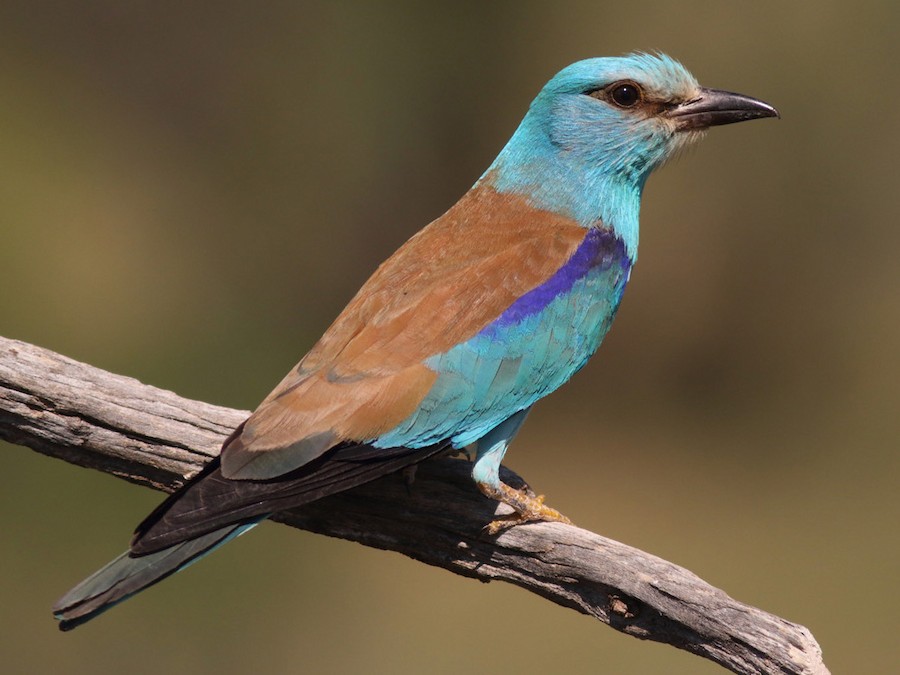
The European Roller is a medium-sized migratory bird renowned for its striking blue plumage and acrobatic flight displays. It is the only roller species found in Europe, breeding across a wide range from North Africa and Europe to Central Asia, and wintering in sub-Saharan Africa.
Dimensioni e longevità
- Lunghezza
- 29-32 cm
- Apertura alare
- 52-58 cm
- Peso
- 100-170 g
- Longevità
- Up to 9 years in the wild
- Dieta
- Insectivore, primarily feeding on large insects, but also small vertebrates.
Caratteristiche fisiche
- Piumaggio
- Adults are unmistakable with a brilliant turquoise-blue head, neck, and underparts. The back is chestnut-brown, and the primary flight feathers are dark blue to black, contrasting sharply with the iridescent blue coverts. The rump is also bright blue. The tail is blue with dark outer feathers.
- Forma del becco
- Strong, black, slightly hooked beak.
- Colore degli occhi
- Dark brown.
- Colore delle zampe
- Dull yellowish-brown to olive-brown.
- Caratteristiche distintive
- The combination of iridescent blue and chestnut-brown plumage, especially the bright blue underparts and contrasting dark primaries, is unique among European birds. Its 'rolling' display flight is also highly distinctive.
- Aspetto giovanile
- Juveniles are duller than adults, with a more muted, greenish-blue plumage and a less vibrant chestnut back. The head and underparts are often tinged with grey-brown, and the bill is paler.
- Cambiamenti stagionali
- No significant seasonal plumage changes; breeding and non-breeding plumages are similar, though plumage may appear slightly worn by the end of the breeding season.
- Dimorfismo sessuale
- Males and females are virtually identical in plumage, though males may be slightly larger on average.
Come identificare
- 1
Plumage Coloration
Look for the striking combination of iridescent turquoise-blue on the head, neck, and underparts, contrasting with a chestnut-brown back. The dark blue primaries against the bright blue wing coverts are also key.
- 2
Flight Pattern
Observe its characteristic 'rolling' display flight during the breeding season, involving acrobatic twists and dives. Otherwise, a strong, direct flight.
- 3
Perching Behavior
Often perches conspicuously on elevated wires, dead branches, or posts in open areas, scanning for prey.
- 4
Vocalizations
Listen for its harsh, chattering 'rak-rak-rak' calls, especially when disturbed or during display.
- 5
Habitat
Search in open, warm, dry landscapes with scattered trees, often near agricultural land.
Habitat e areale
- Biomi
- Open woodlands, agricultural areas, steppes, savannas, and semi-deserts.
- Areale geografico
- Breeds from North Africa, across Europe (primarily southern and eastern) and the Middle East, to Central Asia. Winters in sub-Saharan Africa, from Senegal east to Kenya and south to South Africa.
- Fascia altitudinale
- Typically found from sea level up to 1,000 meters, occasionally higher in some parts of its range.
- Ambienti preferiti
- Prefers warm, dry, open landscapes with scattered trees, copses, or groves, often near agricultural fields, pastures, or river valleys. Requires old trees (oaks, poplars, pines) or cliffs for nesting cavities, and open ground for foraging.
Comportamento
- Periodo di attività
- Diurnal.
- Abitudini alimentari
- Primarily an aerial hunter, often perching on elevated vantage points (wires, branches, posts) to scan for prey. It swoops down to catch large insects (grasshoppers, crickets, beetles, cicadas) on the ground or in flight. Also takes small lizards, frogs, and rodents. It may beat larger prey against a perch before swallowing.
- Comportamento sociale
- Generally solitary or found in pairs during the breeding season. Migrates in loose flocks.
- Tipo di volo
- Strong, direct flight with powerful wingbeats. During courtship, males perform spectacular 'rolling' display flights, involving steep dives, twists, and turns, often accompanied by harsh calls.
- Migrazione
- Long-distance migratory species. European populations migrate south through the Mediterranean and North Africa to winter in sub-Saharan Africa. Asian populations migrate to eastern and southern Africa. Autumn migration occurs from August to October, and spring migration from April to May.
- Territorialità
- Territorial during the breeding season, defending nesting and foraging areas around the nest site.
Canto e richiami
- Canto
- Not a true songbird. Its vocalizations are generally harsh and unmusical.
- Richiamo
- The most common call is a harsh, chattering 'rak-rak-rak' or 'krrrak-krrrak', often given in flight or from a perch. Also produces a 'shree-shree-shree' call during display flights.
- Quando vocalizza
- Most vocal during the breeding season, especially during courtship displays and when defending territory.
Riproduzione
- Stagione riproduttiva
- May to July in most of its range.
- Abitudini di nidificazione
- Nests in natural tree cavities (often old woodpecker holes), crevices in cliffs, or sometimes in artificial nest boxes. Does not excavate its own nest hole. The nest itself is a simple, unlined scrape or a sparse collection of grass and feathers.
- Dimensione della covata
- 3-6 eggs.
- Descrizione dell'uovo
- 3-6 (typically 4-5) glossy white, unspotted eggs.
- Periodo di incubazione
- 18-19 days, primarily by the female.
- Periodo di involo
- 25-30 days after hatching.
- Cure parentali
- Both parents participate in feeding the young, bringing a variety of insects and small vertebrates to the nest.
Dove trovarlo
Open Woodlands
Look in areas with scattered mature trees, especially those with old woodpecker holes suitable for nesting.
Agricultural Landscapes
Often found near fields, pastures, and orchards where insect prey is abundant and perching sites are available.
River Valleys and Steppes
These habitats provide a mix of open foraging areas and suitable nesting trees or cliffs.
Power Lines/Fences
Rollers frequently use elevated man-made structures as hunting perches.
Consigli sul campo
- Timing. Best seen during the breeding season (May-July) in its European range, when birds are most active and vocal. During migration, they can be seen at stopover sites.
- Observation Strategy. Scan open areas with binoculars, focusing on prominent perches. Their bright plumage makes them relatively easy to spot once located.
- Listen for Calls. Their harsh calls can often draw attention to their presence before they are seen.
- Patience. While conspicuous, they can be shy. Observe from a distance to avoid disturbing them, especially near nest sites.
Specie simili
Abyssinian Roller
Coracias abyssinicus
Found in Africa, not typically overlapping with European Roller's breeding range. Has longer outer tail streamers and a slightly different shade of blue, often with a more purplish hue on the head and breast. The European Roller lacks tail streamers.
Indian Roller
Coracias benghalensis
Found in Asia. Has a browner breast and a more purplish-blue crown and nape, with a distinct pale blue patch on the primaries that is less extensive than the European Roller's overall blue wing coverts. The European Roller has a uniformly blue head and underparts.
Fatti rapidi
- Color:
- Brilliant turquoise-blue and chestnut-brown
- Diet:
- Large insects, small vertebrates
- Migration:
- Long-distance migrant to sub-Saharan Africa
- Nesting:
- Tree cavities or cliff crevices
- Conservation:
- Near Threatened (declining populations)
Curiosità
- The name 'roller' comes from its spectacular, acrobatic courtship flight, which involves rapid dives and twists.
- Despite its vibrant colors, the European Roller is surprisingly camouflaged when perched among foliage, especially in dappled sunlight.
- It is the national bird of Botswana.
- Rollers are part of the order Coraciiformes, which also includes kingfishers and bee-eaters, sharing some morphological similarities like syndactyl feet (two outer toes fused at the base).
Classificazione scientifica
- Regno
- Animalia
- Phylum
- Chordata
- Classe
- Aves
- Ordine
- Coraciiformes
- Famiglia
- Coraciidae
- Genere
- Coracias
- Specie
- Coracias garrulus
Esplora European Roller
Identifica uccelli ovunque
Gratis su iOS, Android e Web. Identificazione per foto e suono, database completo e la tua lista personale.