
Come identificare European Roller
Coracias garrulus
Visto un uccello? Identificalo all'istante con l'app Birdby
Apri l'appPer identificare correttamente European Roller (Coracias garrulus), controlla ciascuna di queste caratteristiche. Gli uccelli possono essere complicati da riconoscere, perché comportamento, habitat e canto spesso confermano ciò che una sola foto non può.
Dimensioni a colpo d'occhio
- Lunghezza
- 29-32 cm
- Apertura alare
- 52-58 cm
- Peso
- 100-170 g
Caratteristiche fisiche da controllare
- 1
Piumaggio
Colorazione e disegno generale del piumaggio.
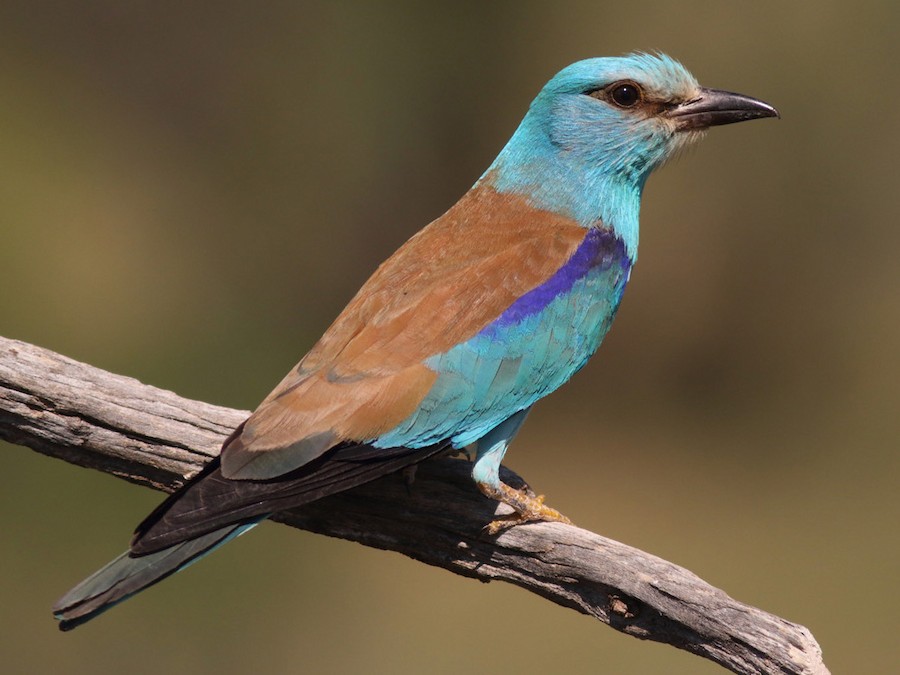
Adults are unmistakable with a brilliant turquoise-blue head, neck, and underparts. The back is chestnut-brown, and the primary flight feathers are dark blue to black, contrasting sharply with the iridescent blue coverts. The rump is also bright blue. The tail is blue with dark outer feathers.
- 2
Forma del becco
Forma e colore del becco, un segno di campo chiave.
Strong, black, slightly hooked beak.
- 3
Colore degli occhi
Colore dell'iride e segni distintivi sugli occhi.
Dark brown.
- 4
Colore delle zampe
Colore di zampe e piedi.
Dull yellowish-brown to olive-brown.
- 5
Caratteristiche distintive
Tratti distintivi che separano questa specie.
The combination of iridescent blue and chestnut-brown plumage, especially the bright blue underparts and contrasting dark primaries, is unique among European birds. Its 'rolling' display flight is also highly distinctive.
- 6
Aspetto giovanile
Come i giovani si differenziano dagli adulti.
Juveniles are duller than adults, with a more muted, greenish-blue plumage and a less vibrant chestnut back. The head and underparts are often tinged with grey-brown, and the bill is paler.
- 7
Cambiamenti stagionali
Variazione del piumaggio tra stagione riproduttiva e non.
No significant seasonal plumage changes; breeding and non-breeding plumages are similar, though plumage may appear slightly worn by the end of the breeding season.
- 8
Dimorfismo sessuale
Differenze tra maschi e femmine.
Males and females are virtually identical in plumage, though males may be slightly larger on average.
Segni di campo chiave
- Plumage Coloration. Look for the striking combination of iridescent turquoise-blue on the head, neck, and underparts, contrasting with a chestnut-brown back. The dark blue primaries against the bright blue wing coverts are also key.
- Flight Pattern. Observe its characteristic 'rolling' display flight during the breeding season, involving acrobatic twists and dives. Otherwise, a strong, direct flight.
- Perching Behavior. Often perches conspicuously on elevated wires, dead branches, or posts in open areas, scanning for prey.
- Vocalizations. Listen for its harsh, chattering 'rak-rak-rak' calls, especially when disturbed or during display.
- Habitat. Search in open, warm, dry landscapes with scattered trees, often near agricultural land.
Esplora European Roller
Identifica uccelli ovunque
Gratis su iOS, Android e Web. Identificazione per foto e suono, database completo e la tua lista personale.