
Visto un uccello? Identificalo all'istante con l'app Birdby
Apri l'appInformazioni
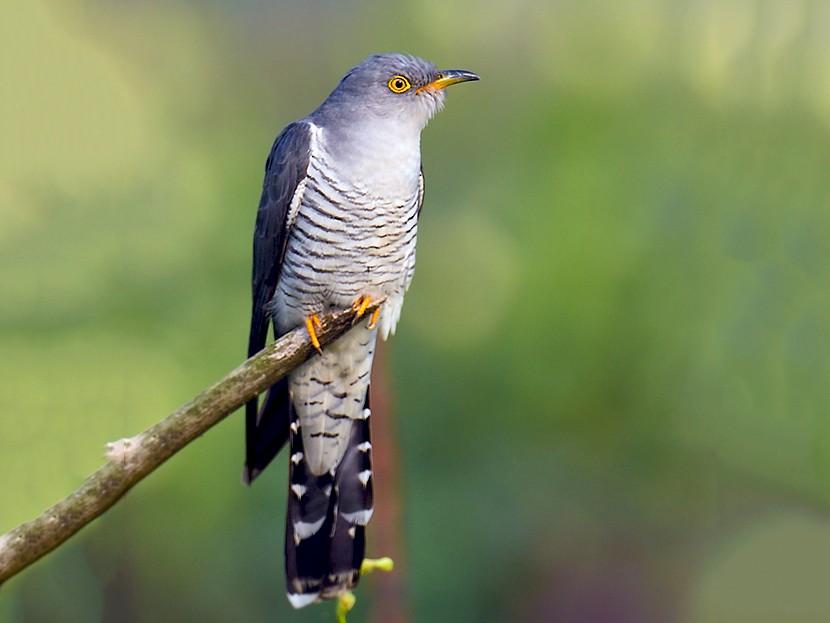
The Common Cuckoo is a medium-sized, brood-parasitic bird found across Eurasia and Africa. Renowned for its distinctive 'cuck-oo' call, it is a master of mimicry, laying its eggs in the nests of other bird species, leaving the host parents to raise its young. Its appearance often mimics that of a small raptor, particularly a Eurasian Sparrowhawk, which may aid in its parasitic strategy by deterring host parents.
Dimensioni e longevità
- Lunghezza
- 32-34 cm
- Apertura alare
- 55-60 cm
- Peso
- 105-130 g (male), 95-115 g (female)
- Longevità
- 6-8 years (up to 12 years recorded)
- Dieta
- Insectivore, primarily feeding on large, hairy caterpillars that many other birds avoid, as well as other insects like beetles, grasshoppers, and larvae.
Caratteristiche fisiche
- Piumaggio
- Adult males typically have a grey head, neck, and upperparts, with a dark grey tail tipped with white. The underparts are white with fine, dark grey barring. Adult females are similar to males but often have a rufous wash on the breast and sometimes a slightly browner tone to the grey. A less common 'hepatic' morph female exists, which is entirely rufous-brown with dark barring on the upperparts and underparts.
- Forma del becco
- Relatively short, slightly downcurved, and stout bill; dark grey to blackish, with a yellowish base to the lower mandible.
- Colore degli occhi
- Bright yellow eye-ring and iris in adults; juveniles have a dark iris.
- Colore delle zampe
- Short, strong, and yellowish-orange legs and feet.
- Caratteristiche distintive
- Long, wedge-shaped tail; pointed wings; often flies with rapid wing beats followed by glides, resembling a small raptor. The grey upperparts and barred underparts are key. The distinctive call is also a primary identification feature.
- Aspetto giovanile
- Juveniles are distinctly different, appearing dark grey-brown to rufous-brown on the upperparts, heavily barred with black. They have a prominent white nape patch, white feather edgings giving a scaly appearance, and a dark iris. The underparts are whitish with dense dark barring.
- Cambiamenti stagionali
- No significant seasonal plumage changes in adults, beyond typical feather wear and moult. Juveniles moult into adult-like plumage during their first winter.
- Dimorfismo sessuale
- Males and females are largely similar in plumage, though females can be slightly browner-grey and may exhibit the 'hepatic' morph. Females are generally slightly smaller and lighter than males.
Come identificare
- 1
Call
The male's distinctive 'cuck-oo' call is the most reliable and often the first sign of its presence. Listen for the two-note call, with the first note higher.
- 2
Flight
Observe its flight pattern: direct, strong, with rapid wing beats followed by glides, often resembling a small raptor. Look for pointed wings and a long, wedge-shaped tail.
- 3
Plumage (Adult Male/Female)
Look for grey upperparts (head, back, wings, tail) and white underparts with fine, dark barring. The tail is dark with white spots on the outer feathers. Yellow eye-ring and legs are also key.
- 4
Plumage (Hepatic Female)
If present, note the rufous-brown plumage with dark barring all over, including the upperparts. This morph is less common but distinctive.
- 5
Plumage (Juvenile)
Identify juveniles by their dark brown or rufous-brown upperparts with heavy black barring and a prominent white nape patch. They also have a dark iris.
- 6
Behavior
Watch for its habit of perching conspicuously on branches or wires, often in open areas, before flying off to forage or call.
Habitat e areale
- Biomi
- Forests, woodlands, scrublands, heathlands, grasslands, agricultural areas, and open country with scattered trees.
- Areale geografico
- Breeds across most of Europe and Asia, from the Atlantic to the Pacific. Winters in sub-Saharan Africa and parts of southern Asia.
- Fascia altitudinale
- Sea level up to 3,000 meters in some mountainous regions, though typically found at lower to mid-elevations.
- Ambienti preferiti
- Prefers diverse habitats with a mix of open areas for foraging and scattered trees or bushes for perching and calling. The presence of suitable host species is a critical factor.
Comportamento
- Periodo di attività
- Diurnal, most active during daylight hours.
- Abitudini alimentari
- Primarily insectivorous, specializing in large, hairy caterpillars (e.g., Lackey Moth, Oak Eggar, Fox Moth larvae) that are toxic or unpalatable to many other birds. It removes the irritating hairs by rubbing the caterpillar on a branch or by swallowing them, then regurgitating the indigestible hairs in pellets. Also consumes other insects like beetles, grasshoppers, and larvae. Forages by perching and scanning, then swooping down to catch prey.
- Comportamento sociale
- Solitary and highly territorial during the breeding season. Males defend large territories, and females also maintain individual territories within or overlapping male territories. Not social outside of breeding interactions.
- Tipo di volo
- Strong, direct, and often hawk-like flight, with rapid wing beats followed by long glides. Wings are held below the horizontal during glides. Can be mistaken for a small raptor, particularly a Eurasian Sparrowhawk, due to its flight profile and barring.
- Migrazione
- Long-distance migratory. European and Asian populations migrate south to sub-Saharan Africa and parts of southern Asia for the winter. They typically arrive in breeding grounds in April-May and depart in July-September. Juveniles migrate independently of adults.
- Territorialità
- Highly territorial during the breeding season. Males establish and defend territories with their distinctive calls. Females also defend territories, particularly around host nests.
Canto e richiami
- Canto
- The iconic 'cuck-oo' call, typically given by the male. The first syllable is higher pitched and louder than the second. It can be repeated many times. The call is primarily used to attract females and establish territory.
- Richiamo
- Females have a bubbling, trilling call, often described as 'kwik-kwik-kwik...' or 'whi-whi-whi...'. Males may also give a 'gowk-gowk-gowk' call, especially when agitated or pursuing a female. Alarm calls are harsh 'ha-ha-ha' notes.
- Quando vocalizza
- Males call frequently from April to July in breeding territories, primarily during the morning and evening, but also throughout the day. Female calls are less frequent and often heard during interactions with males or near host nests.
Riproduzione
- Stagione riproduttiva
- April to July in temperate regions.
- Abitudini di nidificazione
- Obligate brood parasite. Does not build its own nest. Females lay their eggs singly in the nests of over 100 different host species, though individual females often specialize in one or a few host species. Common hosts include Dunnock, Meadow Pipit, Reed Warbler, and Pied Wagtail.
- Dimensione della covata
- One egg per host nest. A female can lay 12-25 eggs in a breeding season.
- Descrizione dell'uovo
- Eggs are typically small, mimicking the size, color, and pattern of the host species' eggs. This mimicry is crucial for successful parasitism. A female cuckoo can lay up to 25 eggs in a season, each in a different host nest.
- Periodo di incubazione
- 11-13 days (incubated by the host parents).
- Periodo di involo
- 17-21 days (raised by the host parents). The cuckoo chick typically hatches before or at the same time as host chicks. Within hours or days of hatching, the cuckoo chick instinctively ejects host eggs or chicks from the nest.
- Cure parentali
- None by the biological parents. The cuckoo chick is entirely raised by the host parents, who feed it until it fledges and often for several weeks after fledging, despite its much larger size.
Dove trovarlo
Woodlands and Forests
Look in deciduous and mixed woodlands, especially those with open clearings or edges.
Heathlands and Moorlands
Often found in open, shrubby habitats where host species like Meadow Pipits are common.
Reedbeds and Wetlands
In areas with Reed Warblers, cuckoos can be found near reedbeds and marshy areas.
Agricultural Landscapes
Can be present in farmland with hedgerows, scattered trees, and suitable host species.
Consigli sul campo
- Listen for the call. The male's 'cuck-oo' call is the most reliable way to detect its presence, especially from April to July. Learn to distinguish it from other bird calls.
- Scan open areas. Cuckoos often perch prominently on exposed branches, fence posts, or power lines, making them easier to spot in open habitats.
- Observe host species. If you see small passerines (like Dunnocks or Reed Warblers) aggressively mobbing a larger bird, it might be a cuckoo, as host species recognize and harass the parasite.
- Look for hawk-like flight. Keep an eye out for a bird with a raptor-like flight profile but with more pointed wings and a longer tail, especially if it's not soaring like a true raptor.
- Be patient. Cuckoos can be elusive despite their loud calls. Patience and careful observation are key to spotting them.
Specie simili
Eurasian Sparrowhawk
Accipiter nisus
The Common Cuckoo's flight profile and barring can resemble a Sparrowhawk. However, cuckoos have more pointed wings, a longer, more wedge-shaped tail, and lack the hooked bill and strong talons of a raptor. Sparrowhawks have broader, more rounded wings and a shorter, squarer tail. Cuckoos also lack the distinct facial pattern of a Sparrowhawk.
Great Spotted Cuckoo
Clamator glandarius
The Great Spotted Cuckoo is larger, has a prominent crest, and is heavily spotted with white on its dark plumage. Its range is primarily southern Europe, Africa, and parts of Asia. The Common Cuckoo lacks a crest and has a grey and barred plumage.
Oriental Cuckoo
Cuculus optatus
Very similar in appearance to the Common Cuckoo, especially the grey morph. Distinguished primarily by subtle differences in call and sometimes by slightly darker upperparts and more extensive barring on the flanks. Its breeding range is further east in Asia.
Fatti rapidi
- Brood Parasite:
- Lays eggs in other birds' nests.
- Diet Specialization:
- Eats hairy caterpillars.
- Migration:
- Long-distance migrant to Africa and Asia.
- Mimicry:
- Eggs mimic host eggs; flight mimics raptors.
- Juvenile Behavior:
- Ejects host eggs/chicks from the nest.
Curiosità
- The word 'cuckoo' is onomatopoeic, derived directly from the male's distinctive call.
- Female cuckoos often specialize in parasitizing a particular host species, and their eggs evolve to mimic the eggs of that specific host.
- A cuckoo chick, often much larger than its foster parents, will instinctively push host eggs or chicks out of the nest, ensuring it receives all the food.
- The Common Cuckoo is one of the few birds that can digest the toxic, hairy caterpillars that many other birds avoid.
- There are different 'gentes' or 'races' of female cuckoos, each specializing in a different host species and laying eggs that match that host's eggs.
Classificazione scientifica
- Regno
- Animalia
- Phylum
- Chordata
- Classe
- Aves
- Ordine
- Cuculiformes
- Famiglia
- Cuculidae
- Genere
- Cuculus
- Specie
- Cuculus canorus
Esplora Common Cuckoo
Identifica uccelli ovunque
Gratis su iOS, Android e Web. Identificazione per foto e suono, database completo e la tua lista personale.