
Come identificare Common Cuckoo
Cuculus canorus
Visto un uccello? Identificalo all'istante con l'app Birdby
Apri l'appPer identificare correttamente Common Cuckoo (Cuculus canorus), controlla ciascuna di queste caratteristiche. Gli uccelli possono essere complicati da riconoscere, perché comportamento, habitat e canto spesso confermano ciò che una sola foto non può.
Dimensioni a colpo d'occhio
- Lunghezza
- 32-34 cm
- Apertura alare
- 55-60 cm
- Peso
- 105-130 g (male), 95-115 g (female)
Caratteristiche fisiche da controllare
- 1
Piumaggio
Colorazione e disegno generale del piumaggio.
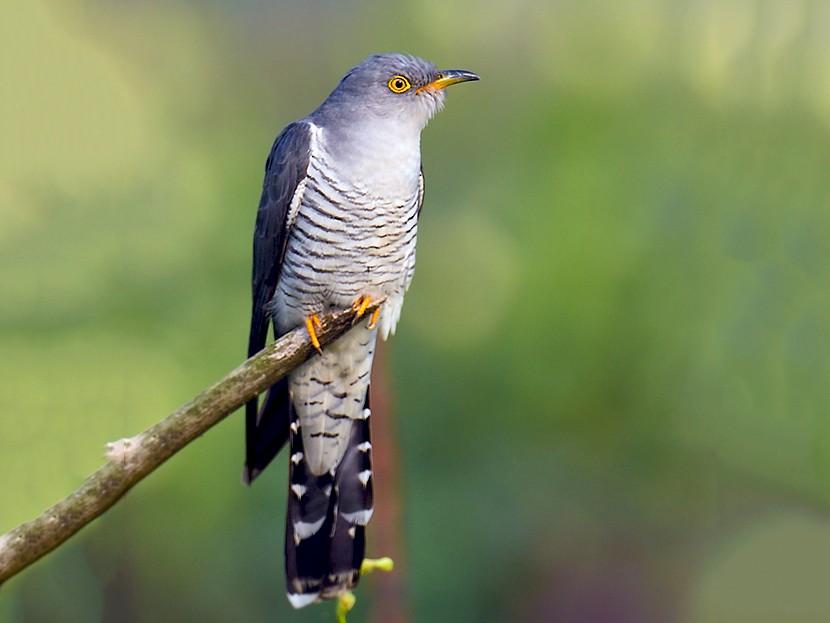
Adult males typically have a grey head, neck, and upperparts, with a dark grey tail tipped with white. The underparts are white with fine, dark grey barring. Adult females are similar to males but often have a rufous wash on the breast and sometimes a slightly browner tone to the grey. A less common 'hepatic' morph female exists, which is entirely rufous-brown with dark barring on the upperparts and underparts.
- 2
Forma del becco
Forma e colore del becco, un segno di campo chiave.
Relatively short, slightly downcurved, and stout bill; dark grey to blackish, with a yellowish base to the lower mandible.
- 3
Colore degli occhi
Colore dell'iride e segni distintivi sugli occhi.
Bright yellow eye-ring and iris in adults; juveniles have a dark iris.
- 4
Colore delle zampe
Colore di zampe e piedi.
Short, strong, and yellowish-orange legs and feet.
- 5
Caratteristiche distintive
Tratti distintivi che separano questa specie.
Long, wedge-shaped tail; pointed wings; often flies with rapid wing beats followed by glides, resembling a small raptor. The grey upperparts and barred underparts are key. The distinctive call is also a primary identification feature.
- 6
Aspetto giovanile
Come i giovani si differenziano dagli adulti.
Juveniles are distinctly different, appearing dark grey-brown to rufous-brown on the upperparts, heavily barred with black. They have a prominent white nape patch, white feather edgings giving a scaly appearance, and a dark iris. The underparts are whitish with dense dark barring.
- 7
Cambiamenti stagionali
Variazione del piumaggio tra stagione riproduttiva e non.
No significant seasonal plumage changes in adults, beyond typical feather wear and moult. Juveniles moult into adult-like plumage during their first winter.
- 8
Dimorfismo sessuale
Differenze tra maschi e femmine.
Males and females are largely similar in plumage, though females can be slightly browner-grey and may exhibit the 'hepatic' morph. Females are generally slightly smaller and lighter than males.
Segni di campo chiave
- Call. The male's distinctive 'cuck-oo' call is the most reliable and often the first sign of its presence. Listen for the two-note call, with the first note higher.
- Flight. Observe its flight pattern: direct, strong, with rapid wing beats followed by glides, often resembling a small raptor. Look for pointed wings and a long, wedge-shaped tail.
- Plumage (Adult Male/Female). Look for grey upperparts (head, back, wings, tail) and white underparts with fine, dark barring. The tail is dark with white spots on the outer feathers. Yellow eye-ring and legs are also key.
- Plumage (Hepatic Female). If present, note the rufous-brown plumage with dark barring all over, including the upperparts. This morph is less common but distinctive.
- Plumage (Juvenile). Identify juveniles by their dark brown or rufous-brown upperparts with heavy black barring and a prominent white nape patch. They also have a dark iris.
- Behavior. Watch for its habit of perching conspicuously on branches or wires, often in open areas, before flying off to forage or call.
Esplora Common Cuckoo
Identifica uccelli ovunque
Gratis su iOS, Android e Web. Identificazione per foto e suono, database completo e la tua lista personale.