
Visto un uccello? Identificalo all'istante con l'app Birdby
Apri l'appInformazioni
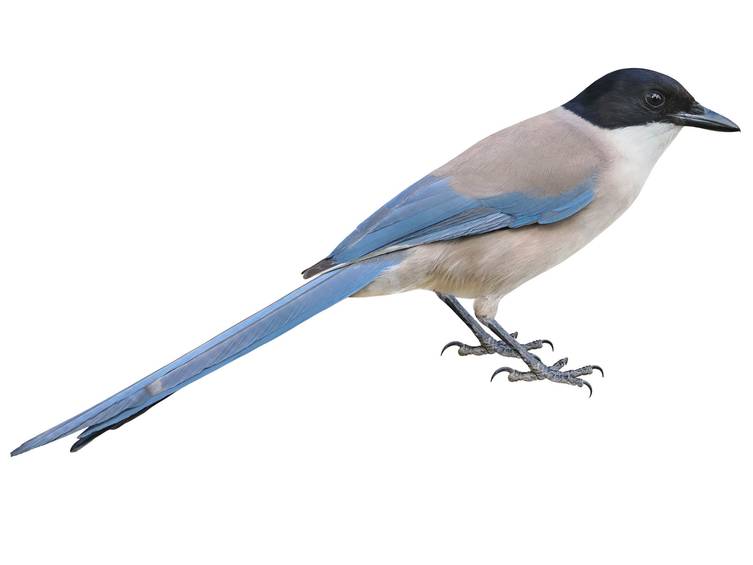
The Azure-winged Magpie is a medium-sized passerine bird in the crow family, Corvidae. It is notable for its striking azure blue wings and tail, contrasting with a black cap and greyish-brown body. It exhibits a disjunct distribution, with populations in East Asia and the Iberian Peninsula, a biogeographical puzzle that has fascinated ornithologists for centuries.
Dimensioni e longevità
- Lunghezza
- 31-35 cm
- Apertura alare
- 38-45 cm
- Peso
- 65-90 g
- Longevità
- Up to 10-15 years in the wild
- Dieta
- Omnivore
Caratteristiche fisiche
- Piumaggio
- Adults have a glossy black cap extending from the forehead to the nape, contrasting sharply with a white throat. The back and underparts are a pale greyish-brown, sometimes with a pinkish tinge. The most distinctive feature is the bright azure blue wings and long, graduated tail. The primary coverts are also blue, and the primaries are tipped with black. The undertail coverts are white.
- Forma del becco
- Relatively small, slender, and slightly decurved black beak.
- Colore degli occhi
- Dark brown
- Colore delle zampe
- Black
- Caratteristiche distintive
- The combination of a black cap, white throat, greyish-brown body, and brilliant azure blue wings and tail is unique. The long, graduated tail is particularly noticeable in flight.
- Aspetto giovanile
- Juveniles resemble adults but have a duller, browner black cap, often with some greyish mottling. The blue on the wings and tail is less vibrant and more muted, sometimes with a greenish-blue tint. The body plumage may also be duller and less distinctly greyish-brown.
- Cambiamenti stagionali
- No significant seasonal plumage changes. Plumage may appear slightly duller due to wear towards the end of the breeding season before the annual molt.
- Dimorfismo sessuale
- Males and females are monomorphic in plumage, appearing identical. There might be slight size differences, with males typically being marginally larger, but this is not reliably discernible in the field.
Come identificare
- 1
Plumage Coloration
Look for the unique combination of a glossy black cap, white throat, pale greyish-brown body, and striking azure blue wings and tail. This pattern is diagnostic.
- 2
Tail Shape and Color
The long, graduated, azure blue tail is a key identifier, especially in flight. It's longer than most other corvids in its range.
- 3
Social Behavior
Often seen in noisy, cohesive flocks, particularly outside the breeding season. Their communal foraging and vocalizations are characteristic.
- 4
Vocalizations
Listen for their distinctive harsh, chattering calls ('ksssh-ksssh') mixed with more metallic or flute-like notes. They are often quite vocal.
- 5
Habitat Preference
Search in open woodlands, olive groves, cork oak forests, and parks, especially in the Iberian Peninsula or East Asia.
Habitat e areale
- Biomi
- Temperate forests, woodlands, parks, gardens, olive groves, cork oak forests, pine forests, and cultivated areas with scattered trees.
- Areale geografico
- Disjunct distribution: one population in East Asia (China, Korea, Japan, Mongolia) and another in the Iberian Peninsula (Spain and Portugal).
- Fascia altitudinale
- Typically found from sea level up to 1,500 meters, occasionally higher in some parts of its Asian range.
- Ambienti preferiti
- Prefers open woodlands, especially those with a mix of deciduous and coniferous trees, and areas with scattered trees and shrubs, often near human habitation.
Comportamento
- Periodo di attività
- Diurnal.
- Abitudini alimentari
- Highly omnivorous. Diet includes a wide variety of insects (beetles, caterpillars, grasshoppers), spiders, snails, small vertebrates (lizards, nestlings), eggs, and carrion. A significant portion of their diet consists of fruits, berries, acorns, pine nuts, and seeds, especially in autumn and winter. They often cache food, particularly acorns, for later consumption.
- Comportamento sociale
- Highly social birds, typically found in noisy flocks outside the breeding season, sometimes numbering dozens of individuals. During the breeding season, they form smaller, more dispersed groups or pairs, but often nest colonially or semi-colonially. They are known for their cooperative breeding behavior in some populations.
- Tipo di volo
- Flight is undulating and rather weak, often in loose flocks. The long tail is prominent during flight, giving it a distinctive silhouette. They are agile in trees, hopping and climbing.
- Migrazione
- Essentially resident throughout its range, though some local movements may occur in response to food availability, particularly in winter. Not a migratory species.
- Territorialità
- During the breeding season, pairs or small groups defend a nesting territory. Outside of breeding, they are less territorial and forage in communal flocks.
Canto e richiami
- Canto
- Not known for a complex song. Their vocalizations are generally harsh and chattering. They can produce a variety of calls, some of which are melodious but not typically considered a 'song'.
- Richiamo
- Common calls include a harsh, grating 'ksssh-ksssh' or 'shree-shree', a metallic 'chink-chink', and a more melodious, flute-like 'pee-oo'. They also have alarm calls and contact calls used within the flock. Vocalizations are often given in chorus by a group.
- Quando vocalizza
- Vocalizes year-round, but particularly noisy during the breeding season and when foraging in flocks.
Riproduzione
- Stagione riproduttiva
- Typically from April to July, with peak activity in May and June.
- Abitudini di nidificazione
- Nests are usually built in trees or large shrubs, often at a considerable height (3-15 meters). They are bulky, cup-shaped structures made of twigs, roots, moss, and mud, lined with softer materials like hair, wool, and feathers. They often nest in loose colonies.
- Dimensione della covata
- Usually 6-8 eggs, but can range from 4 to 10.
- Descrizione dell'uovo
- Eggs are typically pale greenish-blue or buff, heavily spotted and blotched with dark brown, olive, or grey, particularly at the broader end. Average size is about 29 x 21 mm.
- Periodo di incubazione
- 15-17 days, primarily by the female.
- Periodo di involo
- 16-19 days after hatching. Young are fed by both parents and often by helpers (non-breeding adults from the previous year's brood) in cooperative breeding systems.
- Cure parentali
- Both parents participate in nest building, incubation (female primarily), and feeding of the young. In some populations, particularly the Iberian, cooperative breeding is common, with offspring from previous years assisting in raising new broods.
Dove trovarlo
Iberian Peninsula
Common in central and southern Spain and Portugal, particularly in cork oak (Quercus suber) and holm oak (Quercus ilex) woodlands, olive groves, and pine forests.
East Asia
Widespread in China, Korea, Japan, and parts of Mongolia, inhabiting a variety of woodlands, parks, and cultivated areas.
Parks and Gardens
Can be found in urban and suburban parks and large gardens with mature trees, especially where food sources are abundant.
Consigli sul campo
- Look for flocks. Outside the breeding season, they are almost always found in flocks. Listen for their characteristic calls to locate them.
- Check oak and pine trees. They frequently forage for acorns and pine nuts in these trees, especially in autumn and winter.
- Observe their flight. Their undulating flight with the long, blue tail is quite distinctive and can help confirm identification from a distance.
- Visit during early morning or late afternoon. Like many birds, they are often most active and vocal during these times.
Specie simili
Eurasian Magpie
Pica pica
The Eurasian Magpie is larger, has a much longer, iridescent green-black tail, and its plumage is predominantly black and white with iridescent green and purple sheens on the wings and tail. It lacks the distinct black cap and greyish-brown body of the Azure-winged Magpie, and its blue is restricted to iridescent patches on the wings, not the vibrant azure of the entire wing and tail.
Jay
Garrulus glandarius
The Jay is stockier, has a shorter tail, and its plumage is predominantly pinkish-brown with a distinctive black and white streaked crown, a black moustachial stripe, and a bright blue patch on the wing with fine black barring. It lacks the black cap, white throat, and extensive azure blue wings and tail of the Azure-winged Magpie.
Fatti rapidi
- Distinctive Feature:
- Azure blue wings and tail with a black cap
- Sociality:
- Highly social, often in flocks
- Diet:
- Omnivorous, includes acorns and insects
- Distribution Anomaly:
- Disjunct populations in East Asia and Iberian Peninsula
- Conservation Status:
- Least Concern
Curiosità
- The disjunct distribution of the Azure-winged Magpie (East Asia and Iberian Peninsula) is a long-standing ornithological mystery. Hypotheses include ancient land bridges, human introduction (though genetic evidence largely refutes this for the Iberian population), or a relict population from a once continuous range.
- Recent genetic studies have led to the splitting of Cyanopica cyanus into two distinct species: the Iberian Azure-winged Magpie (Cyanopica cooki) and the Asian Azure-winged Magpie (Cyanopica cyanus sensu stricto). The 'Averla Azzurra' typically refers to the Iberian population.
- They are known for their intelligence and problem-solving abilities, typical of the Corvidae family.
- In some parts of their range, they exhibit cooperative breeding, where non-breeding individuals (often offspring from previous years) help the breeding pair raise their young.
Classificazione scientifica
- Regno
- Animalia
- Phylum
- Chordata
- Classe
- Aves
- Ordine
- Passeriformes
- Famiglia
- Corvidae
- Genere
- Cyanopica
- Specie
- Cyanopica cyanus (or Cyanopica cooki for the Iberian population)
Esplora Azure-winged Magpie
Identifica uccelli ovunque
Gratis su iOS, Android e Web. Identificazione per foto e suono, database completo e la tua lista personale.